Summary:
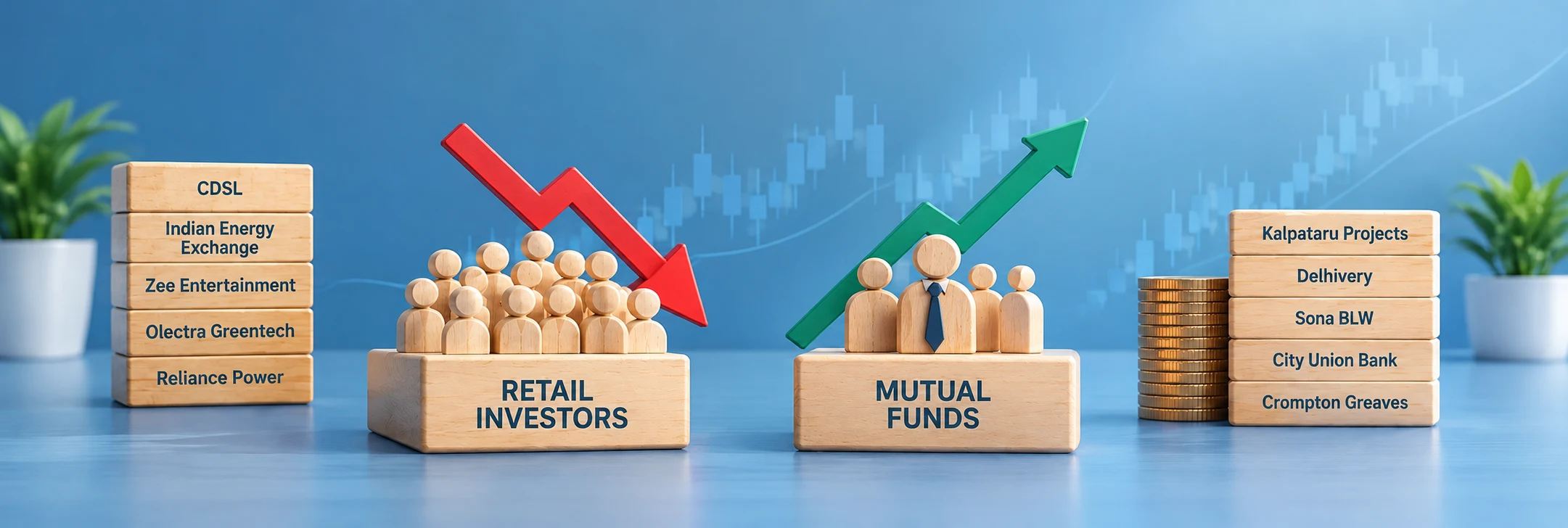
Nine of the 10 small-cap companies with the highest retail shareholding recorded negative one-year returns, with losses reaching 56.8%. In comparison, six of the 10 small-cap companies with the highest mutual fund ownership delivered positive returns over the same period.
Over the past year, small-cap stocks with a larger proportion of ownership by retail investors have lagged behind those with more ownership by mutual funds. According to a study of small-cap companies, 9 of the 10 stocks with the highest retail shareholding posted negative returns, with losses approaching 57%. The results indicate a large difference in performance between ownership classes.
Retail-Heavy Small-Cap Stocks See Steep Selloff
The study looked at companies where retail investors’ investments were up to Rs 1 lakh per company.
Nine of the 10 companies with the largest retail ownership posted negative returns in the past year, ranging from 8.8% to 57%. One stock gained 7.3%.
Several widely held companies suffered large corrections despite having previously enjoyed substantial retail participation.
One-year returns on some retail-heavy stocks:
| Company | Returns |
| Central Depository Services (India) Ltd. | -16.1% |
| Indian Energy Exchange | -27.5% |
| Zee Entertainment Enterprises | -35.5% |
| Olectra Greentech | -30.1% |
| Reliance Power | -56.8% |
Source: Bloomberg data, newspaper analysis, October 2026
Reliance Power witnessed the steepest fall among these five companies while the correction was relatively smaller for Central Depository Services (India).
Stocks Held by Mutual Funds Have Higher Returns
Companies with more mutual fund ownership, in contrast, did better over the same period.
Of the 10 small-cap companies with the largest mutual fund shareholding, 6 have posted positive returns ranging from 10.3% to about 89%. The other 4 dropped by 2-28%.
Selected companies in this category were:
| Company | 1-Year Performance |
| Crompton Greaves Consumer Electricals | -28.4% |
| Kalpataru Projects International | +10.3% |
| Delhivery | -8.6% |
| Sona BLW Precision Forgings | +89.2% |
| City Union Bank | +40.8% |
However, this greater involvement from institutions did not come with positive returns necessarily, as many in this category also posted losses.
Earlier Stock Rallies Saw Retail Ownership Climb
One notable trend is the increase in retail participation following substantial stock price appreciation.
Central Depository Services (India) Ltd. (CDSL) shares gained approximately 125% between October 5, 2023, and October 5, 2025, before declining around 16% over the following year.
During this period, retail shareholding increased from 39.16% in June 2023 to 52.19% in June 2026, indicating that retail investors increased their participation after the stock had already recorded substantial gains.
Similarly, Amara Raja Energy & Mobility gained approximately 56% between October 2023 and October 2025 before correcting nearly 26% over the subsequent year.
Its retail shareholding increased from 19.29% in June 2023 to 27.52% in June 2026.
These examples show that increasing retail ownership can coincide with an earlier rally, although the data does not establish that ownership changes caused subsequent declines.