Summary:
Adani Power has begun construction of a 3,200 MW thermal power plant in Assam’s Dhubri district with an investment of ₹48,000 crore. The Chapar project is expected to become Northeast India’s largest power-generation asset, with phased commissioning from December 2030.
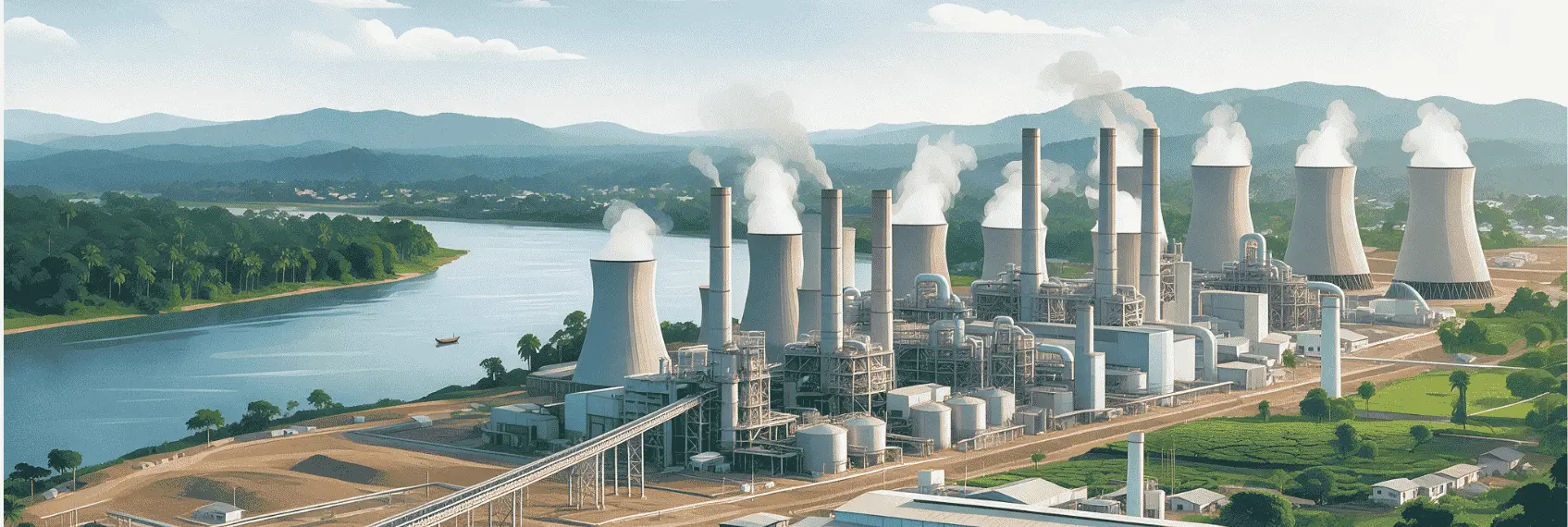
Adani Power has begun construction of a 3,200 MW ultra-supercritical thermal power plant at Chapar in Assam’s Dhubri district, following the foundation stone ceremony on September 20. The project involves an investment of around ₹48,000 crore and is expected to become the largest power generation asset in Northeast India once commissioned. The plant will be built in four 800 MW units, with commissioning planned in phases from December 2030.
The project is part of a broader ₹63,000 crore power-sector investment planned by the Adani Group in Assam. Of this, around ₹48,000 crore is earmarked for the Chapar thermal plant, while approximately ₹15,000 crore is planned for two pumped-storage projects with a combined capacity of 2,700 MW through Adani Green Energy. Across different sectors, the group’s investment commitment in Assam exceeds ₹80,000 crore.
What is Adani Power’s Assam project?
Adani Power is constructing a 3,200 MW ultra-supercritical thermal power plant at Chapar in Assam’s Dhubri district, involving an investment of around ₹48,000 crore. The four-unit project is scheduled for phased commissioning from December 2030.
| Key Metric | Details |
|---|---|
| Company | Adani Power |
| Project | Chapar Thermal Power Plant |
| Location | Dhubri district, Assam |
| Capacity | 3,200 MW |
| Investment | ₹48,000 crore |
| Technology | Ultra-supercritical |
| Configuration | 4 × 800 MW units |
| Commissioning | Phased from December 2030 |
| Construction jobs | Up to 20,000 |
| Operational jobs | Around 5,000 |
| Transmission infrastructure | 400 kV Chapar-Rangia line and substations |
Project To Add Jobs And Support Local Industry
The Chapar plant is expected to generate up to 20,000 jobs during construction and around 5,000 jobs once operational. The company has already conducted four to five recruitment drives in Assam and said around 4,500 local youth have been hired. Across its businesses in the state, the Adani Group expects to generate nearly 40,000 direct and indirect employment opportunities.
The project is also expected to create opportunities for local contractors, suppliers, transport operators and service providers. The plant will add to Assam’s power-generation capacity and is intended to provide electricity for households, businesses and industries. The project’s four-unit configuration will use ultra-supercritical technology, with modern efficiency and environmental systems.
The investment is part of a wider push to strengthen Assam’s energy infrastructure. The state is also developing transmission infrastructure to evacuate the additional 3,200 MW, including a planned 400 kV Chapar-Rangia transmission line and associated substations.
Adani Group’s Wider Assam Expansion
Adani Group’s plans in Assam extend beyond thermal power. The group’s ₹63,000 crore power investment includes renewable-linked pumped-storage capacity, while Adani Energy Solutions is working on smart-metering projects in the state. The group also has investments in aviation and cement, including Terminal 2 at Lokapriya Gopinath Bordoloi International Airport in Guwahati, which became operational on February 22, 2026.
The company has also indicated interest in exploring renewable-energy opportunities in Assam, citing the state’s water resources, geography and renewable-energy potential.
Why Adani Power Shares Rose After The Announcement
The foundation ceremony came after a strong move in Adani Power shares on September 19, when the stock gained around 0.33% to ₹206.60. On September 21, the shares traded higher, reaching ₹210.55 during the session before moderating.
The Assam project adds 3,200 MW to Adani Power’s planned generation capacity and fits into its broader expansion strategy. However, the foundation ceremony itself does not immediately add revenue or earnings, as commissioning is scheduled only from December 2030. The market response therefore needs to be viewed alongside the company’s broader capacity expansion and financial performance.
What Investors Will Track Next
The key milestones will be construction progress, funding requirements, commissioning timelines and eventual plant utilisation. With the first units scheduled from December 2030, the project represents a long-term capacity addition rather than an immediate earnings driver.
For Assam, the project is expected to strengthen electricity availability and create a larger industrial ecosystem. For Adani Power, it adds another large-scale thermal asset to its expanding generation portfolio.