Summary:
The US Federal Reserve raised interest rates by 25 basis points to 3.75%-4% under Chair Kevin Warsh, citing elevated inflation. Policymakers signalled further tightening, while higher Treasury yields and a stronger dollar could influence global markets, emerging currencies and India.
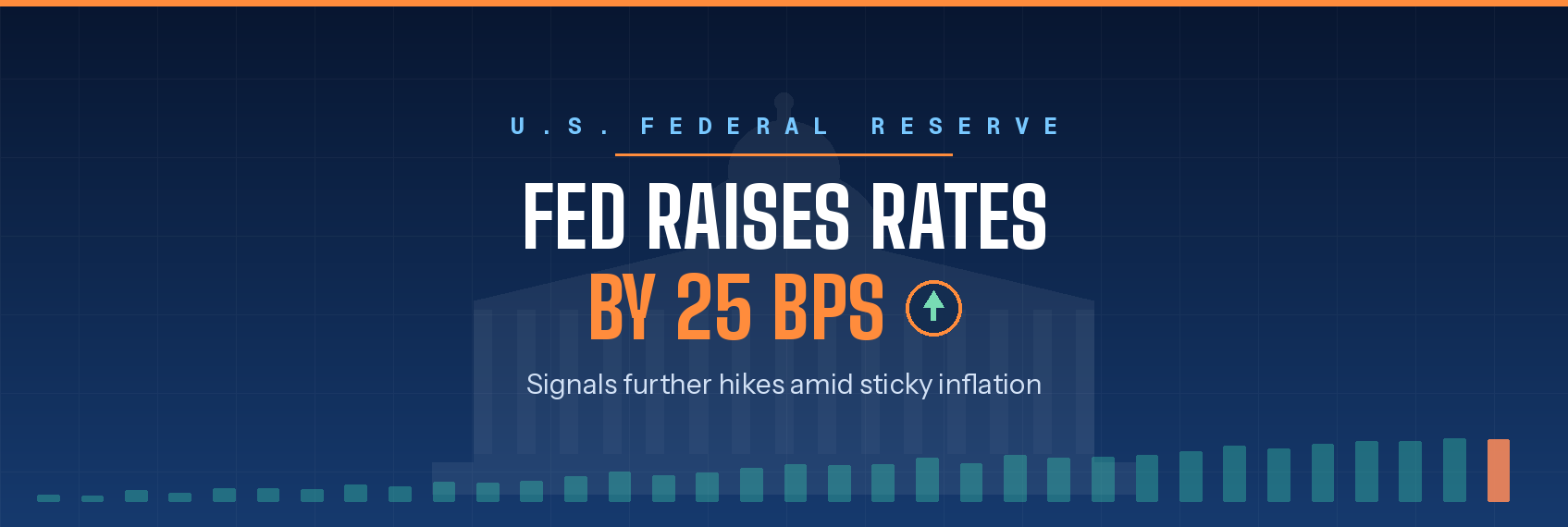
The US Federal Reserve raised its benchmark interest rate by 25 basis points to a target range of 3.75%-4% from 3.5%-3.75%, marking its first rate hike since July 2023 and the first major monetary policy move under Chair Kevin Warsh. The Federal Open Market Committee approved the decision unanimously in a 12-0 vote.
The Fed said economic activity was expanding at a solid pace, while domestic spending remained resilient. Productivity growth was strong, capital investment remained robust and job gains had kept pace with workforce growth. The unemployment rate had changed little. However, inflation remained elevated, prompting the central bank to focus on bringing inflation back towards its 2% target.
Warsh said price stability remained the Fed's predominant focus and noted that inflation was still too high and had persisted for too long. He also said recent summer inflation readings had not shown meaningful improvement in underlying price trends.
Fed Dot Plot Signals Another Hike
The latest projections indicate that Wednesday's rate increase may not be a one-off move. Of the 18 policymakers submitting rate projections, 16 see at least one more 25-basis-point increase by the end of 2026. Twelve policymakers project one additional 25-basis-point hike, while four see another 50 basis points of tightening.
The projections put the median federal funds rate at around 4%-4.25% by the end of 2026. The Fed also expects inflation to decline gradually, with the median PCE inflation projection at 3.7% for 2026, 2.3% for 2027, 2.1% for 2028 and 2% in 2029.
Warsh did not submit an individual interest-rate projection, consistent with his criticism of the Fed's dot plot and preference against guidance that could be interpreted as committing the central bank to a predetermined policy path.
Why Stock Markets Fell After the Fed Decision
US equities initially gained after the widely expected rate hike but reversed course as investors focused on the possibility of further tightening. The Dow Jones Industrial Average declined 1.21% to 51,461.78, while the S&P 500 fell 0.44% to 7,552.14. The Nasdaq Composite ended almost flat, down 0.01% at 25,978.43.
Energy stocks were among the major laggards, with the sector declining 3%. Chevron fell 2.9% and Exxon Mobil declined 3.5%, while Devon Energy and ConocoPhillips lost more than 5%. Falling crude prices after Saudi Arabia offered additional supplies through Oman also weighed on energy shares.
The 2-year Treasury yield rose 7.5 basis points to 4.738%, while the 10-year yield moved towards 5%, reflecting expectations of tighter monetary policy. The US dollar also strengthened following the Fed's hawkish stance.
Impact on Global Markets and India
The Fed's decision strengthened the US dollar and increased pressure on emerging-market currencies, including the Indian rupee. The rupee could face additional pressure as higher US interest rates and elevated crude prices affect capital flows and India's import bill.
Asian markets were mixed on September 17, with the MSCI Asia-Pacific index rising 0.4% and Japan's Nikkei gaining 0.5%, while China's CSI300 and Hong Kong's Hang Seng declined. Nasdaq and S&P 500 futures were higher in early Asian trading after the previous session's declines.