Summary:
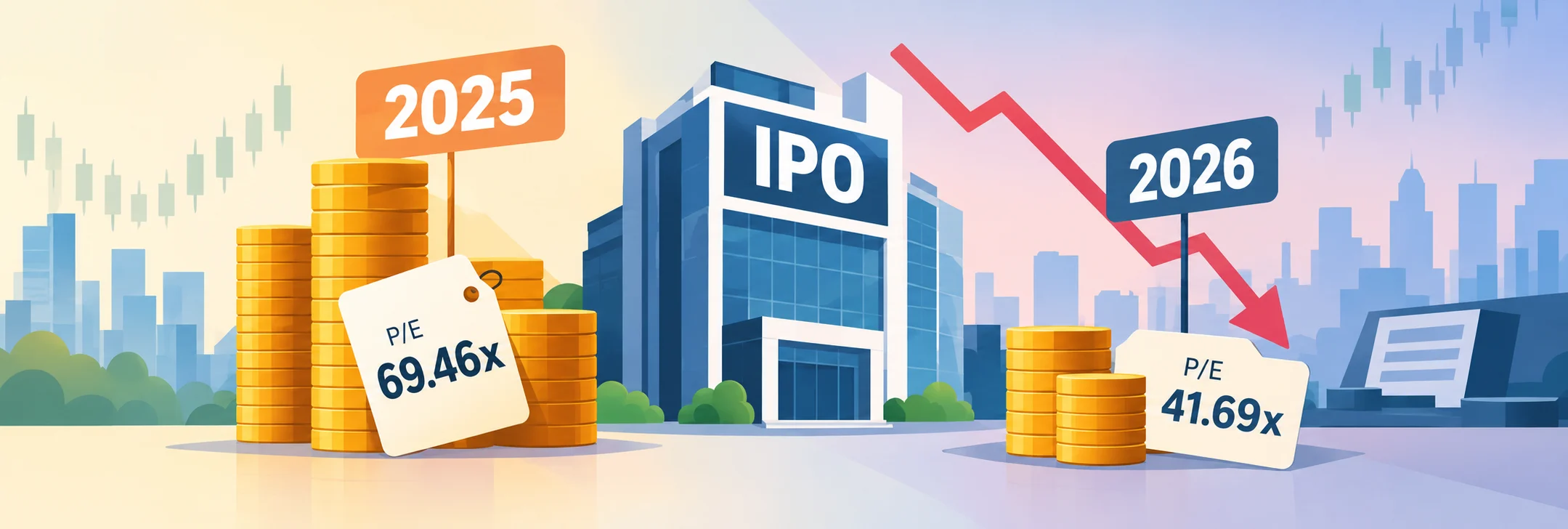
India's average IPO price-to-earnings multiple fell nearly 40% in 2026, declining from 69.46x in 2025 to 41.69x. Market volatility, higher crude oil prices, foreign investor selling and changing issuer profiles are reshaping IPO pricing despite strong fundraising.
Valuations in the Indian IPO market are witnessing a sharp correction, with the average price-to-earnings (P/E) multiple declining almost 40% in 2026 compared to 2025. Despite robust fundraising activity, companies coming to the stock market are being priced at lower earnings multiples in the face of volatile equities, rising crude oil prices and uncertainty over future returns.
2026: IPO Valuations Crash
The average P/E multiple of companies going into the primary market dropped from 69.46 times in 2025 to 41.69 times in 2026, according to data from the IPO market. The change follows a number of new-age businesses which experienced high valuations in 2025, buoyed by expectations of future earnings growth.
But recent public offerings tell a different story. Big businesses with long histories of operation have come into the market at rather low valuations.
The difference is shown in the following figures:
| Company | IPO P/E multiple |
| Lenskart Solutions (NSE: LENSKART) | 522.08x |
| Billionbrains Garage Ventures (NSE: GROWW) | 81.3x |
| National Stock Exchange of India | 43x |
| SBI Funds Management (NSE: SBIFUNDS) | 42x |
| Jio Platforms | 33x |
Reported IPO valuation multiples. Jio Platforms’ figure is for the company’s ongoing offering, not a completed listing.
There’s a large gap. High P/E multiples often imply expectations of higher future earnings growth, while lower multiples may reflect more moderate growth assumptions or different business characteristics.
What Is Behind The Price Adjustment?
There is a reason for the change.
Indian equities have been under pressure from geopolitical uncertainty, higher crude oil prices and foreign investor selling. That has taken a toll on the appetite for high premiums for companies whose earnings may take years to catch up to their valuations.
And the mix of IPO issuers has changed, too. While the majority of the focus in 2025 was on technology-led and consumer businesses, a number of established businesses in financial services and infrastructure entered the public market in 2026.
A tough pricing environment is also being faced by existing shareholders looking for exits through offer for sale (OFS).
Meanwhile, IPO fundraising in India continues to be strong. H1FY27 witnessed 78 companies raising ~₹94,276 crore, highlighting sustained access to primary-market capital despite tough conditions.
Why Some Newly-Listed Stocks Have Dropped?
The correction in IPO valuations doesn’t mean the end of all new stocks. But the high cost of issue pricing has made some companies more susceptible to selling pressure.
In March 2026, about 68% of mainboard companies listed in FY26 were trading below their IPO issue prices. This proved that high subscription demand and listing-day excitement did not always mean long-term gains.
Companies have felt the effects differently. For instance, Billionbrains Garage Ventures was listed at ₹112 against the issue price of ₹100 in November 2025, providing a listing gain of 12%.
A high valuation at the start leaves less room for bad earnings, slower growth or a switch in market sentiment. Conversely, companies that have stable earnings may be able to hold onto investor interest through market corrections.
What’s Next for India’s IPO Market?
Regulatory flexibility may allow companies to adjust their fundraising plans. SEBI has extended the relaxation for eligible issuers to revise fresh issue sizes by up to 50% without filing fresh draft documents subject to conditions till March 31, 2027.
For upcoming IPOs, profitability, earnings visibility, level of debt and the valuation sought compared to similar listed companies will continue to be important considerations going forward.
Primary market in India continues to see capital inflows but a steep fall in average IPO P/E multiples reflects a change in pricing. Premium valuations cannot be explained on strong demand alone, particularly in an environment of continued uncertainty in secondary-market conditions.