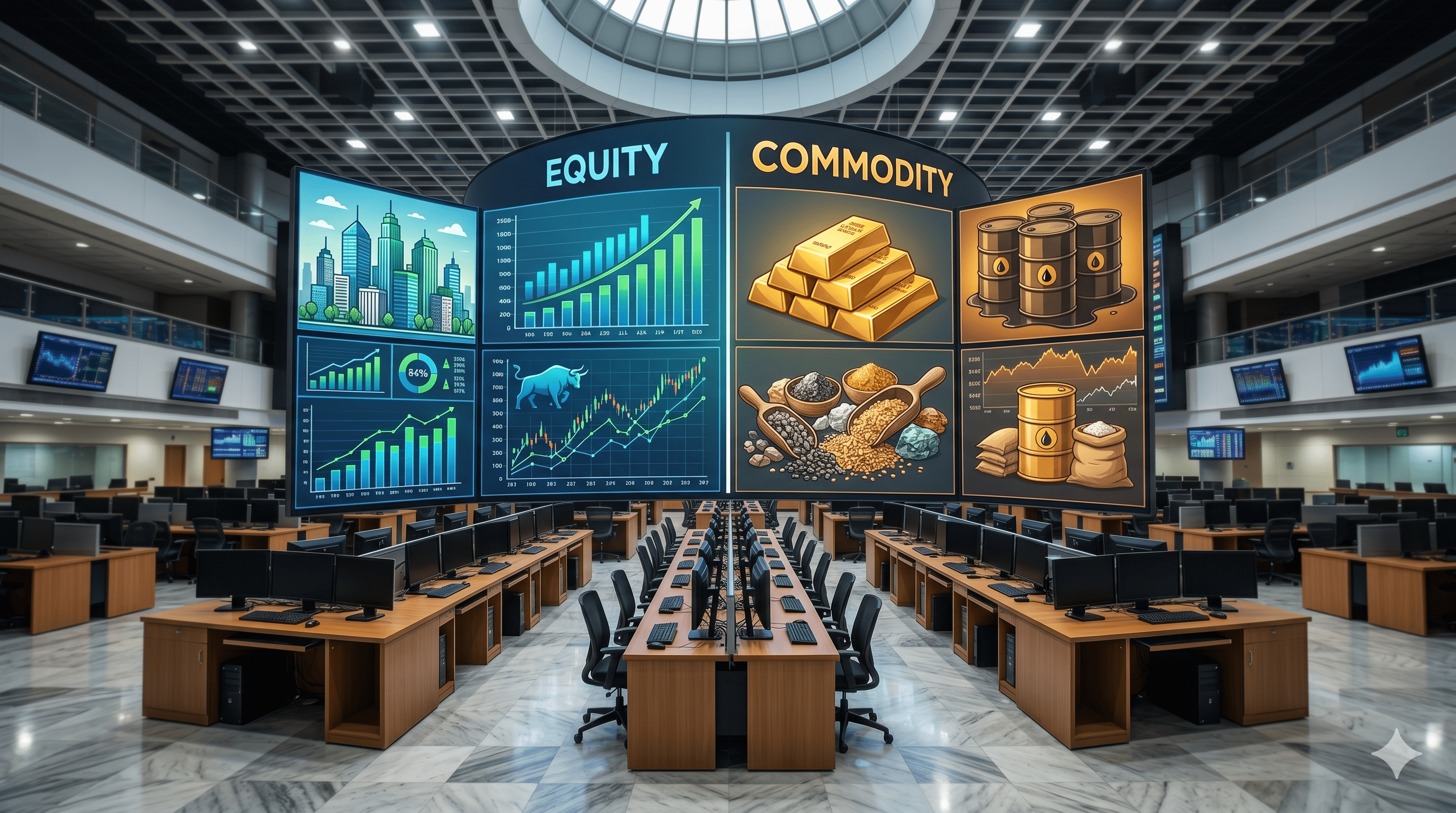
If you have ever bought shares of a company or put money into a mutual fund, you have dealt with equity. If you have ever bought gold, even in the form of jewellery, you have had commodity exposure without necessarily thinking of it that way. These two asset classes sit at the centre of most Indian investment portfolios, yet most people could not explain clearly how they differ, why they behave differently, or when one makes more sense than the other. That clarity is worth building.
What is equity?
When you buy shares of a company on the NSE or BSE, you are buying a slice of ownership. You become a part-owner of that business, however small the fraction. If the company grows and earns more and the market recognises that, your shares become more valuable. If it struggles, the opposite happens.
That ownership comes with rights. In most cases, that means voting rights at shareholder meetings and eligibility for dividends if the company distributes profits. In practice, most retail investors are not exercising voting rights, but the legal claim on a share of the business is real.
Equity exists in two broad forms. Listed or public equity trades on stock exchanges, which are accessible to anyone with a demat account and a few hundred rupees. Private equity means ownership in unlisted companies, which is largely the territory of institutional investors, venture capital, and high-net-worth individuals. When most people say "equity investing", they mean the listed kind.
What moves equity prices
A company's share price is ultimately a reflection of what investors believe the business is worth today and in the future. That belief is shaped by earnings, revenue growth, margins, debt levels, management quality, competitive position, and broader economic conditions. Sentiment plays a role too. Stocks can overshoot in both directions based on fear and enthusiasm, sometimes disconnected from the underlying business for extended periods.
What equity returns look like
Returns from equity come through two channels. Capital appreciation, which is the rise in share price over time, is the primary driver for most investors. Dividends are a secondary income stream, more relevant for mature businesses than for high-growth companies that reinvest most of their profits.
Over long periods, equity has historically been among the strongest-performing asset classes in India. The compounding available to patient investors in well-run businesses has been meaningful. The cost of that return is accepting volatility along the way, sometimes sharp and sustained.
Risks that come with equity
Market risk is the most obvious one. Share prices move, sometimes dramatically and without warning. Company-specific risk is equally real. A business can deteriorate due to management failures, competitive pressure, regulatory changes, or sector disruption regardless of what the broader market is doing. Liquidity risk exists particularly in smaller companies where the volume of buyers and sellers is thin, making it hard to exit a position quickly at a fair price.
What is a commodity?
A commodity is a raw material or agricultural product, like gold, silver, crude oil, natural gas, copper, wheat, cotton, or soybeans. Unlike equity, buying a commodity gives you no ownership of anything. You are not a stakeholder in a business. You have no claim on profits, no voting rights, no management accountability. What you have is exposure to the price of a physical good.
In India, commodity trading happens primarily on the MCX and NCDEX through futures contracts. A futures contract is an agreement to buy or sell a commodity at a predetermined price on a specific future date. Most retail trades are cash-settled, which means you are not arranging actual physical delivery of barrels of crude oil or sacks of wheat.
What moves commodity prices
The drivers are fundamentally different from what moves equities. Supply and demand is the primary force. A drought reduces wheat supply and prices rise; OPEC cuts oil production and crude moves; a gold mining disruption in South Africa affects global supply. Geopolitical events matter enormously for energy commodities. Currency movements, particularly the rupee-dollar rate, affect the price of imported commodities in Indian rupee terms. Weather patterns drive agricultural commodity prices more than any financial analysis can account for.
What commodity returns look like
Commodities do not pay dividends or interest. Returns come entirely from price movement. Gold has delivered strong returns during periods of global uncertainty, currency weakness, and equity market stress, which is precisely why it works as a portfolio hedge. Energy and agricultural commodities can deliver sharp short-term gains but are less suited to the buy-and-hold approach that works well for equity.
Risks that come with commodities
Price volatility in commodities can be extreme and fast. Crude oil has historically seen moves of 30 to 40% in short windows. Unlike equity, where a bad quarter might dent a share price modestly, commodity prices can gap sharply on a single news event, like a geopolitical flashpoint, a policy change, or a weather report. Futures trading involves leverage and margin requirements that can amplify losses significantly if positions move against you. And unlike equity, there is no compounding of returns over time, because the commodity itself generates nothing. It just sits there, worth whatever the market says it is worth on any given day.
Difference between Equity and Commodity
| Feature | Equity | Commodity |
| Ownership | Stake in a company | Price exposure only |
| Traded on | NSE, BSE | MCX, NCDEX |
| Value driver | Company fundamentals | Global supply and demand |
| Income | Dividends possible | None |
| Volatility | Medium to high | High, can be extreme |
| Regulation | SEBI | SEBI and commodity bodies |
| Typical role | Long-term wealth creation | Hedging, diversification |
How each fits into a portfolio
For most Indian retail investors building long-term wealth, equity is the core. Over 7 to 10 year horizons, well-chosen equity exposure, whether direct stocks or through diversified mutual funds, has compounded meaningfully. The volatility is real, but time tends to work in the investor's favour.
Commodities, for most retail investors, means gold. Gold tends to hold value or appreciate when equity markets fall, currencies weaken, or inflation rises. That counter-cyclical behaviour makes it a useful stabiliser in a portfolio, not a primary growth driver. Allocating 10 to 15% of a portfolio to gold is a commonly suggested range, enough to provide some cushion during equity downturns without meaningfully dragging on long-term returns.
Energy and agricultural commodities are more relevant for traders, or for businesses hedging actual operational exposure, like a jeweller hedging gold prices, or an airline hedging fuel costs, than for a typical retail investor trying to build a retirement corpus.
Common myths worth addressing
Commodity trading means taking physical delivery.
Most trades on Indian commodity exchanges settle in cash. The futures mechanism allows price exposure without anyone actually moving a truckload of soybeans.
Commodities are too complex for retail investors.
The trading mechanics of futures require understanding, and leverage makes them riskier than direct equity. But gold ETFs and sovereign gold bonds give retail investors gold price exposure through familiar equity-market accounts without needing a commodity trading setup.
Equities always outperform over time.
The long-term track record is strong, but there are specific windows, including sustained inflation cycles, major geopolitical disruptions, and prolonged bear markets, where gold and other commodities have outperformed equity indices by a significant margin. The "always" is doing too much work in that sentence.
PMS portfolios include only equities.
Many PMS strategies include commodity-linked instruments and alternative assets. The lines are blurrier in sophisticated portfolios than in retail conversations.
How to access each in India
Equity
A demat and trading account with a SEBI-registered broker. For most retail investors, diversified equity mutual funds through SIP remain the most practical entry point due to professional management, built-in diversification, and low entry cost.
Commodity
A commodity trading account for futures on MCX or NCDEX. For gold specifically, gold ETFs or sovereign gold bonds are more practical for most retail investors. They track gold prices without requiring a separate account, margin management, or understanding of futures roll-overs.
Conclusion
Equity and commodity are tools built for different jobs. One gives you a claim on business growth over time. The other gives you exposure to raw material prices that move with global forces no single investor can predict or control.
Most Indian investors are better served by making equity the foundation and using commodities, primarily gold, as a portfolio hedge rather than a core holding. The right mix depends on your goals, timeline, and honest assessment of how much volatility you can sit through without making decisions you will regret when markets recover.
Neither asset class needs to dominate. Both have a place. Knowing which place is the work.