Summary:
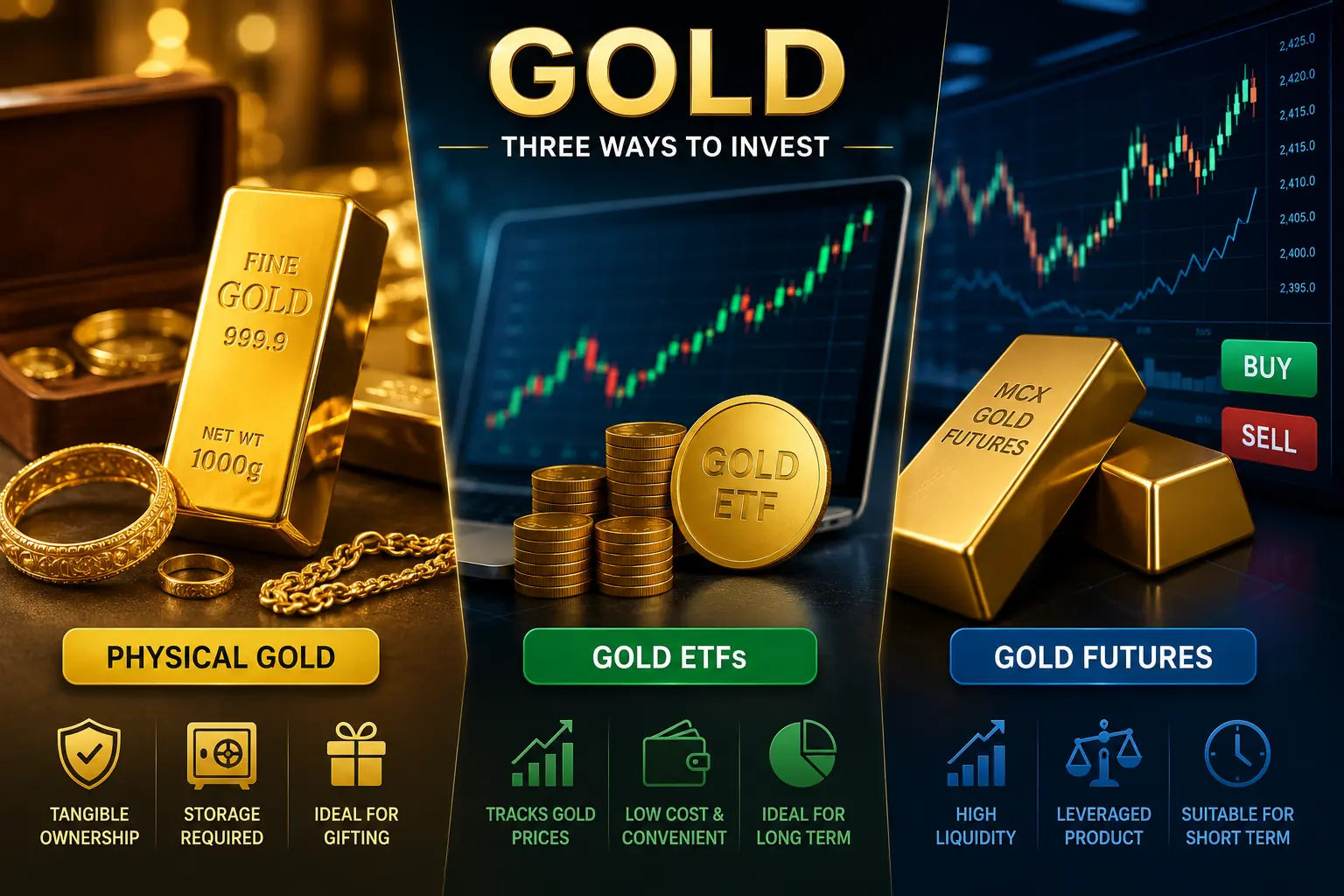
Indian investors can gain exposure to gold through physical gold, Gold ETFs and gold futures, each suited to different objectives. Physical gold offers tangible ownership but involves making charges, GST and storage costs. Gold ETFs provide a low-cost, convenient investment option without concerns around purity or storage. Gold futures are leveraged instruments designed for experienced traders seeking short-term opportunities.
Gold has always held a special place in the Indian household, and not just emotionally. With domestic gold prices touching ₹97,000 per 10 grams in early 2025 and the country importing over 800 tonnes annually, we are clearly not done buying. But here is the thing: the way of owning gold has changed dramatically. Today, you have three distinct routes, namely physical gold, digital gold via Gold ETFs, and gold futures on the MCX. Each works very differently, and choosing the wrong one can quietly cost you money.
Physical Gold: The Traditional Route
Most Indian families default to jewellery or coins. It feels tangible, it is culturally significant, and it doubles as an emergency asset. But the numbers are not always flattering. Jewellery comes with making charges of 8-20% on top of the gold price, which you lose the moment you sell. Add GST at 3%, and your entry cost alone can be 11-23% above market value.
Storing physical gold safely costs money too. A bank locker in most public sector banks runs between ₹2,000 and ₹10,000 per year depending on the size. If you are holding gold purely as an investment rather than for a daughter's wedding or a cultural occasion, the math is tough to justify.
Digital Gold: Gold ETFs and Gold Funds
Digital gold is where the equation starts making more sense for the modern investor. Gold ETFs, traded live on the NSE and BSE, let you buy gold at real-time market prices without ever touching a physical bar. You can start with as little as ₹100 via fractional units, and there are no making charges, no locker fees, and no purity worries.
The cost of holding a Gold ETF is largely the expense ratio, typically 0.5-1% per year across most fund houses. That is far lower than the implicit costs of physical gold. Between April 2023 and March 2024, Gold ETF AUM in India jumped from ₹22,000 crore to over ₹35,000 crore, a clear signal that retail investors are warming up to the format. Folios grew from roughly 40 lakh to over 56 lakh in the same period.
Gold Fund of Funds (FoFs) are another variant. They invest in Gold ETFs and allow SIP-based investing without needing a demat account. Expense ratios are slightly higher at around 0.1-0.2% extra, but they are useful for investors who do not have or want to manage a demat account.
One thing to keep in mind: Gold ETFs are subject to LTCG tax at 20% with indexation if held for more than 3 years, or 12.5% without indexation post the 2024 Union Budget revision. Still better than carrying physical gold with all its overhead.
Gold Futures: For Traders, Not Savers
Gold futures on the MCX are a different beast entirely. A standard lot of 1 kg requires a margin of roughly ₹4-5 lakh at current prices, though mini lots of 100 grams reduce that threshold. You are not really buying gold here. You are taking a leveraged position on its price movement.
The leverage cuts both ways. A 2% move in gold prices can mean a 10-15% gain or loss on your margin, depending on the position. Rollover costs, STT, and brokerage add up over time. For a retail investor trying to hedge a long-term portfolio, futures are rarely the right vehicle. For traders who understand momentum, technical levels, and risk management, they offer unmatched liquidity, with MCX gold seeing daily turnover in the thousands of crores.
Quick Comparison
| Feature | Physical Gold | Digital Gold (ETF) | Gold Futures |
| Min. Investment | ~₹5,000+ (coin) | ₹100 (Gold ETF) | ~₹4-5 lakh (1 lot) |
| Storage Cost | 0.5-1% p.a. (locker) | Nil | Nil |
| Liquidity | Moderate | High (exchange) | Very High |
| Making Charges | 8-20% | None | None |
| Interest Income | None | None | None |
| LTCG Tax (3yr+) | 20% with indexation | 20% with indexation | Slab rate (STCG) |
| Leverage | No | No | Yes (high risk) |
| Counterparty Risk | None | Low (AMC backed) | Exchange guarantee |
So, Which One Should You Pick?
There is no universal answer, but some practical rules of thumb help. If you are a long-term investor who wants clean, low-cost gold exposure without operational hassle, Gold ETFs are the sharpest tool in the box. Low expense ratios, real-time liquidity, no storage risk, and no purity concerns make them tick most boxes for the disciplined retail investor.
If you are buying gold for cultural or gifting purposes, physical gold still serves that need. Just do not mistake it for a high-return investment after accounting for making charges and storage. And if you are an active trader who understands derivatives, gold futures on MCX offer unmatched liquidity and price discovery. Use only risk capital you can afford to lose.
Bottom Line: Gold has rewarded Indian investors over decades, but not all gold is equal. Understand what you are buying, why you are buying it, and what it actually costs you. That clarity separates informed investing from financial folklore.