Summary:
eMudhra shares fell 40% over three sessions after a security incident involving eight intermediate CA certificates and the company’s decision to exit global SSL/TLS certificates. Its Indian digital signature and eSign services remain unaffected, while investors await investigations and updates.
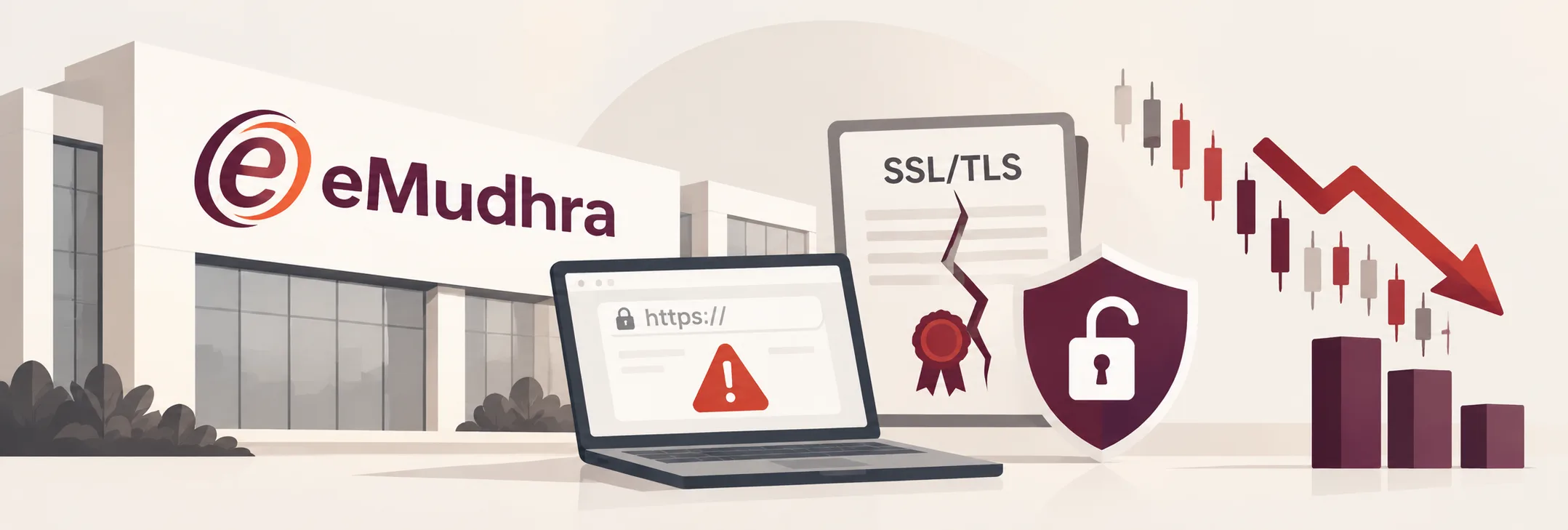
On Friday, October 23, 2026, eMudhra Limited (NSE: EMUDHRA) shares continued to decline sharply, falling another 4% to approximately ₹331 on the BSE. The stock has lost around 40% of its value in three trading sessions following a security incident involving digital certificates issued by the company. The latest decline came after eMudhra announced its decision to exit the global SSL/TLS certificate business.
Why Is eMudhra Share Price Falling Today?
The eMudhra share price started declining following the discovery of a security flaw involving eight intermediate Certificate Authority (CA) certificates linked to its global Transport Layer Security (TLS) business.
The issue involved weak private cryptographic keys that could potentially allow malicious actors to impersonate legitimate websites.
Major technology platforms, including Google, Microsoft, Apple and Mozilla, moved to distrust the affected certificates following the discovery. This raised concerns about the security of certificates issued through the company's global infrastructure.
Subsequently, India's Computer Emergency Response Team (CERT-In) issued an advisory, while the Ministry of Electronics and Information Technology (MeitY) constituted a special team to investigate the incident.
Heavy selling was witnessed in eMudhra shares as the stock hit its 20% lower circuit on October 21 and declined another 20% in the following session.
eMudhra Exits Global SSL/TLS Certificate Business
eMudhra announced on October 22 that its board had approved a voluntary exit from the global SSL/TLS certificate business.
The company stated that the affected business contributes approximately 1% of its global revenue.
According to the company's announcement, the decision also reflects increasing compliance requirements, rising operational costs and changing market conditions in the global certificate industry.
Importantly, eMudhra clarified that its core Indian Digital Signature Certificate (DSC), eSign, Public Key Infrastructure (PKI) and enterprise identity businesses remain unaffected.
The company also stated that its infrastructure had not been compromised and that no data breach had occurred. The affected Certificate Authorities were revoked after the issue was identified.
eMudhra Share Price Falls in Three Days
The recent correction has wiped out a substantial portion of the company's market capitalisation.
The key share price movements are presented below:
| Date | Share Price Movement |
| October 20, 2026 | Previous close at ₹540 |
| October 21, 2026 | Down 20% to ₹432 |
| October 22, 2026 | Down 20% to around ₹345 |
| October 23, 2026 | Down around 4% to ₹331 intraday |
The continued weakness suggests that investors remain concerned about the broader implications of the security incident, although the affected business accounts for a relatively small portion of revenue.
What Does This Mean for eMudhra Business?
eMudhra is a digital identity, authentication, cybersecurity and enterprise trust services company. Its solutions provide digital signatures for electronic transactions and secure business communications.
For FY26, the company reported revenue of approximately ₹710 crore and EBITDA of around ₹110 crore. It had previously guided for revenue growth of 15% to 18%.
The incident has raised questions about compliance, operational controls and customer confidence, although the global SSL/TLS segment contributes only about 1% of revenue.
The financial implications of the withdrawal remain to be seen.
eMudhra's Q2FY27 results are scheduled for November 4, and attention will be on the company's financial performance and any further disclosures regarding the incident.
Key developments for investors tracking eMudhra's share price include the outcome of the regulatory investigation, business continuity and potential financial implications. The sharp correction reflects concerns extending beyond the direct revenue contribution of the affected segment.