India just quietly made one of the most significant biofuel policy moves in years, and if you track energy transition stocks, this deserves your full attention.
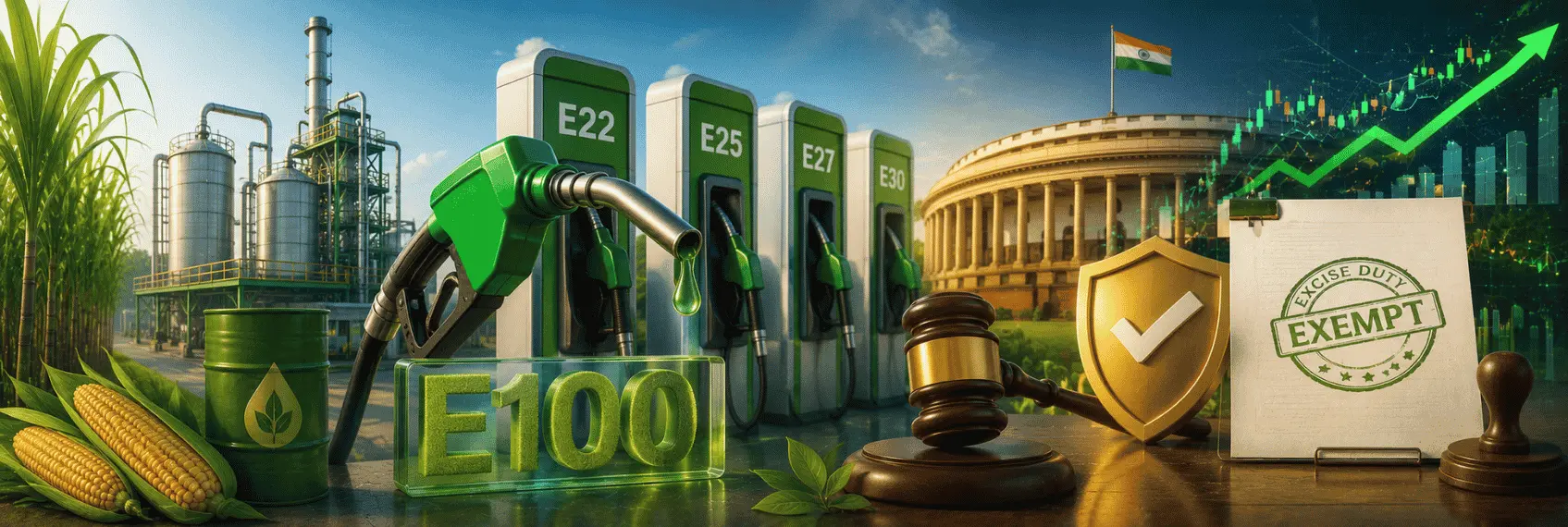
Last week, the Ministry of Finance issued a notification exempting central excise duty on petrol blended with 22%, 25%, 27%, and 30% ethanol, covering fuel grades E22, E25, E27, and E30. All four will now attract a nil rate of excise duty, provided they comply with the Bureau of Indian Standards (BIS) specification IS 19850:2026, which was itself notified just days earlier in May 2026.
And that's not all. In the background, the government is actively exploring E85 and even E100, pure ethanol fuel, for flex-fuel vehicles, in the spirit of what Brazil achieved decades ago. Road Transport Minister Nitin Gadkari has publicly pushed for an E100 target, and on April 28, the Ministry of Road Transport and Highways proposed amendments to the Central Motor Vehicles Rules to formally include E85 and E100 in the regulatory framework.
For Indian investors, this isn't just policy noise.
The Ethanol Blending Ladder: Where We Stand
| Blend | Ethanol % | Petrol % | Excise Duty | Status |
| E20 | 20% | 80% | Exempted (existing) | Widely available |
| E22 | 22% | 78% | Now NIL | Standards set; rollout pending |
| E25 | 25% | 75% | Now NIL | Standards set; rollout pending |
| E27 | 27% | 73% | Now NIL | Standards set; rollout pending |
| E30 | 30% | 70% | Now NIL | Standards set; rollout pending |
| E85 | 85% | 15% | TBD | Launched June 5; 50-100 pilot pumps |
| E100 | 100% | 0% | Under review | Being examined; flex-fuel roadmap |
From 1.5% to 20%, India's Blending Story in Numbers
This didn't happen overnight. India's ethanol blending was stuck at a meagre 1.53% in 2014. Then the National Policy on Biofuels 2018 changed the trajectory entirely, ethanol production surged from 38 crore litres in 2014 to over 661 crore litres by June 2025.
By December 2025, India had formally achieved the E20 milestone, five months ahead of the original schedule. The benefits have been enormous: over ₹1,44,087 crore in forex savings across the last 11 years, crude oil substitution of roughly 245 lakh metric tonnes, and CO2 reductions equivalent to planting 30 crore trees.
At 20% blending alone, the government estimates ₹43,000 crore in annual forex savings and ₹40,000 crore in payments reaching farmers every year. That's the scale of what ethanol policy has become.
What the E22–E30 Duty Exemption Actually Changes
Until now, India's excise framework didn't explicitly cover blends beyond E20. The new notification fills that gap. Under Section 5A of the Central Excise Act, 1944, E22 through E30 blends now attract zero central excise duty, making them commercially viable for oil marketing companies (OMCs) to produce and sell at the pump.
Currently, E20 is priced at around ₹102.12 per litre in Delhi (as of June 11). Higher ethanol blends, with the duty now eliminated, could be priced below that, creating a genuine consumer incentive for adoption once supply infrastructure is ready.
Importantly, E85 has already been launched (June 5) at ₹82.12 per litre, a full ₹20 cheaper than E20. The government plans 50–100 E85 stations initially across Delhi-NCR and the Mumbai-Pune-Nagpur corridor, scaling to 500 by year-end 2026 and 5,000 by 2027.
The missing piece is vehicle compatibility. E22–E30 fuels require vehicles specifically engineered and certified under Automotive Industry Standard (AIS) 171. Maruti Suzuki has already showcased the production-spec Wagon R Flex Fuel, a signal that automakers are preparing for the transition.
Stocks to Watch: Who Benefits the Most?
India's installed ethanol production capacity stands at roughly 20 billion litres, well above the ~11 billion litres needed for E20. As blending moves to E25, E27, and eventually E30, that excess capacity becomes profit. Here's where to look:
| Company | Ethanol Angle | Why Watch |
| Balrampur Chini Mills | Integrated sugar + distillery, OMC supply contracts | UP-based, low debt, rising distillery volumes |
| Triveni Engineering | Largest ethanol producers in India | Best-in-class efficiency; multi-year growth track record |
| Praj Industries | Designs & supplies ethanol plant tech (2G) | Pure-play infrastructure proxy; benefits from every new plant |
| Shree Renuka Sugars | High-volume direct sugarcane juice fermentation | Scales fastest when E30 mandates kick in |
| Dalmia Bharat Sugar | Multiple UP units; rapid capacity growth | Fastest-growing integrated sugar-ethanol play |
| EID Parry | Diversified sugar + efficient distilleries | Southern India footprint, steady earnings visibility |
The Investment Logic, Company by Company
Praj Industries is arguably the cleanest proxy, it doesn't grow sugarcane or get hit by monsoon risk. It designs and engineers ethanol plants. Every new distillery that goes up to meet E25/E30 demand needs Praj's technology. With a ROCE of ~20.4%, it's the infrastructure play in the theme.
Balrampur Chini Mills brings a strong combination of balance sheet discipline (market cap ~₹9,834 crore, low debt), long-term OMC contracts, and UP geography, India's densest sugarcane belt. Its distillery volumes have risen steadily, with price realisation improving ~5% to ₹67.75/litre YTD December 2025.
Triveni Engineering stands out on returns, an ROE of 67.23% is exceptional for a capital-intensive business. It's one of India's most efficient ethanol producers, with the kind of multi-year earnings growth that tends to hold up across ethanol supply year cycles.
For those with higher risk appetite, Shree Renuka Sugars and Dalmia Bharat Sugar offer more leveraged exposure, they scale aggressively when blending mandates move up, but carry more crop-cycle risk.
The Bottom Line
India has gone from 1.5% ethanol blending in 2014 to 20% by end-2025, and the government is clearly not stopping there. The excise exemption on E22-E30 is the first concrete tax incentive above E20. E85 is already at the pump. E100 is being formally examined.
The trajectory is clear even if the exact timeline isn't. For long-term investors, the sugar-distillery sector, anchored by names like Triveni, Balrampur, and Praj, is no longer just a cyclical sugar play. It's increasingly a biofuel infrastructure story with policy tailwinds that look durable.
The smart money is watching these stocks not just for quarterly results, but for distillery capacity numbers, OMC contract renewals, and BIS notifications. Because with ethanol, in India, every percentage point added to the blend is a percentage point less of imported crude, and that's a theme that's only going to grow.