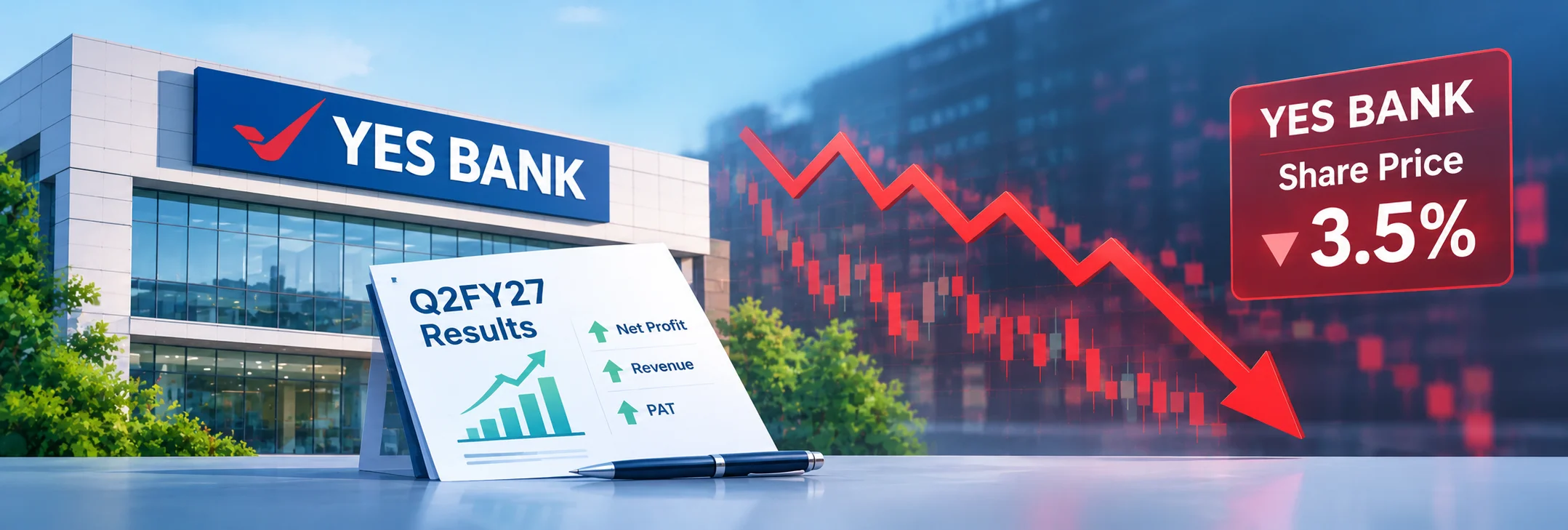
Summary:
YES Bank reported a 65% year-on-year rise in Q2FY27 net profit to ₹1,080 crore, but shares faced pressure amid uncertainty over a Supreme Court ruling on ₹8,415 crore of AT1 bonds written off during its 2020 reconstruction.
Why did YES Bank shares fall despite higher Q2FY27 profits?
YES Bank Ltd reported a 65% YoY increase in Q2FY27 net profit, yet its shares remained under pressure around the earnings announcement. The main concern was not its regular lending business. It was the potential financial impact of a Supreme Court ruling involving bonds written off during the bank’s 2020 reconstruction.
The judgment preceded the October 17 results. That timing matters: the share price had already fallen sharply before investors could assess the September-quarter earnings.
YES Bank Q2FY27 Results: Profit Rises 65%
The bank reported standalone net profit of ₹1,080 crore for the quarter ended September 30, 2026, compared with ₹654 crore a year earlier. Net interest income (NII) increased 22.7% YoY to ₹2,822 crore, supported by growth in its loan book.
Advances rose 23.7% YoY to ₹3,09,510 crore, while deposits increased 19.5% to ₹3,54,004 crore. Gross non-performing assets (GNPA) improved to 1.2% from 1.3% in the preceding quarter. These figures show improvement in ordinary banking operations.
The published profit, however, does not incorporate the financial effect of the court decision. This is the central distinction in the latest results.
Supreme Court AT1 Bond Ruling: What Happened?
On October 15, the Supreme Court upheld the decision setting aside the March 2020 write-off of ₹8,415 crore in Additional Tier-1 (AT1) bonds. These instruments can absorb losses under specified conditions, but their treatment during YES Bank’s reconstruction became the subject of a prolonged legal dispute.
In its Q2 disclosures, the bank presented a pro-forma assessment of the ruling. If the financial impact had been recognised, the reported ₹1,080 crore quarterly profit would instead have been a post-tax loss of ₹5,217 crore. That is an illustrative accounting outcome disclosed by the bank, not the loss booked in its reported Q2 accounts.
The bank is examining the judgment and possible further legal steps. Its auditors issued a qualified review because the financial consequences had not been reflected in the results.
Why Did YES Bank Shares Come Under Pressure?
YES Bank shares closed at ₹18.15 on October 15, down 14.43%, as the court ruling became public. Selling continued on October 16, before the weekend results announcement. The stock saw mixed intraday moves on October 19 as the market assessed both developments.
The risk is wider than a single quarter’s profit. Recognition of additional liabilities could affect net worth, borrowing balances and the capital available to support loan growth. The final accounting treatment and timing remain unresolved.
This explains why improving NII and asset quality did not immediately settle concerns over the lender’s balance sheet.
What Should Investors Track After Q2FY27?
Further court proceedings, the bank’s accounting disclosures and any change in regulatory capital will determine how the AT1 matter is resolved. Separately, investors can track deposit growth, NII, margins and fresh loan stress to judge the performance of its core business. YES Bank’s September-quarter operating numbers improved, but the outstanding AT1 issue has introduced uncertainty that ordinary quarterly profit growth cannot remove.
Frequently Asked Questions
YES Bank shares faced pressure amid uncertainty over the Supreme Court’s ruling on ₹8,415 crore of AT1 bonds written off during the bank’s 2020 reconstruction. The potential financial and accounting implications remained unresolved, despite higher reported quarterly profit.
YES Bank reported standalone net profit of ₹1,080 crore for Q2FY27, compared with ₹654 crore in the same quarter a year earlier, representing a 65% year-on-year increase.
The case concerns ₹8,415 crore of Additional Tier-1 bonds written off during YES Bank’s March 2020 reconstruction. According to the supplied article, the Supreme Court upheld a decision setting aside that write-off, creating uncertainty about the financial consequences for the bank.
No. The bank reported a standalone net profit of ₹1,080 crore. Separately, its pro-forma assessment indicated that recognising the ruling’s financial impact would have resulted in a post-tax loss of ₹5,217 crore. That was not the loss recorded in its reported Q2FY27 accounts.
YES Bank reported net interest income of ₹2,822 crore, up 22.7% year-on-year, according to the supplied article.
Key developments include further legal proceedings, the bank’s accounting disclosures, any implications for regulatory capital, deposit growth, net interest income, margins and fresh loan stress. These factors may help investors assess the bank’s financial position as more information becomes available.