Summary:
From October 15, 2026, eligible UPI merchant transactions above ₹2,000 will attract a 0.4% MDR, while capital-market payments such as mutual fund and broker transactions carry a lower 0.02% rate. The framework changes merchant economics without directly charging consumers directly.
UPI has been synonymous with instant and largely free digital payments in India. That model is set to change for a part of the ecosystem from October 15, 2026.
The new framework introduces a Merchant Discount Rate (MDR) on eligible person-to-merchant (P2M) UPI transactions above Rs 2,000. The standard MDR has been set at 0.4%, while the charge will be capped at Rs 300 for transactions above Rs 75,000. The key point for consumers is that the MDR is a merchant-side charge and is not being introduced as a separate fee on individuals making UPI payments.
The change is therefore less about making everyday UPI transfers expensive and more about changing how the payment ecosystem earns revenue from larger commercial transactions.
What Is Changing From October 15?
The new structure separates UPI transactions based on their nature and value.
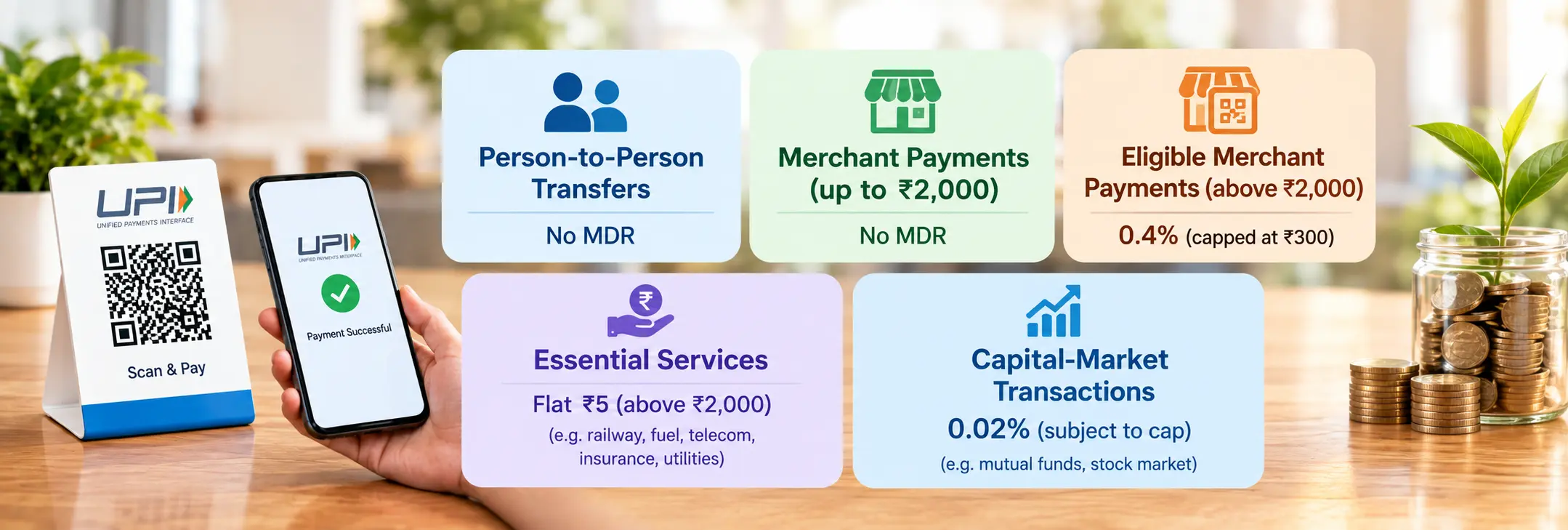
Person-to-person transfers, such as sending money to a friend or family member, remain outside the MDR framework. Merchant payments up to Rs 2,000 will also continue without MDR.
For eligible merchant transactions above Rs 2,000, the standard MDR will be 0.4%. At the same time, certain categories have been given a different treatment, including essential services and capital-market transactions.
| UPI transaction | MDR from October 15 |
| Person-to-person transfer | No MDR |
| Merchant payment up to Rs. 2,000 | No MDR |
| Eligible merchant payment above Rs. 2,000 | 0.4% |
| Eligible transaction above Rs. 75,000 | Capped at Rs. 300 |
| Selected essential-service payments | Flat Rs 5 above Rs. 2,000 |
| Capital-market transactions | 0.02%, subject to applicable cap |
The framework also provides exemptions for certain small merchants, including QR-code merchants below the specified monthly transaction threshold.
A Rs 10,000 UPI Payment Could Mean Rs 40 For The Merchant
Consider a customer paying Rs 10,000 to an eligible merchant through UPI.
At an MDR of 0.4%, the applicable charge works out to Rs 40. The customer is not separately billed Rs 40 as a UPI transaction fee. Instead, the MDR is part of the payment ecosystem's settlement structure and is borne on the merchant side.
This distinction is important because the introduction of MDR does not mean that every UPI user will suddenly see a new charge whenever they scan a QR code.
For smaller payments, the existing zero-MDR arrangement remains in place. That means a large part of routine QR-based spending will not be affected by the standard 0.4% rate.
Why Has UPI MDR Been Introduced?
UPI has expanded at a scale that has made payment infrastructure, cybersecurity, technology and transaction processing increasingly important parts of the digital-payments ecosystem.
The previous zero-MDR structure helped UPI achieve rapid adoption, but it also limited the direct revenue available to participants handling transactions. The revised framework creates a mechanism through which eligible transactions can generate revenue for banks, payment service providers and other participants in the ecosystem.
The timing is significant. UPI processed 24.5 billion transactions worth around Rs 29.82 lakh crore in August 2026, highlighting the scale at which the network now operates.
In other words, the policy change is not aimed at charging users for simply using UPI. It changes the economics of selected merchant transactions as the network becomes larger and more expensive to operate.
What Happens To QR Payments?
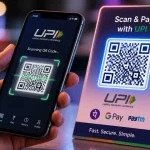
QR payments are among the areas where the change will be easiest to notice from the merchant's perspective.
Suppose a customer purchases goods worth Rs 25,000 and pays through a UPI QR code. If the transaction falls under the standard MDR category, a 0.4% charge would amount to Rs 100.
For a Rs 50,000 transaction, the corresponding amount would be Rs 200.
Once the transaction value crosses Rs 75,000, the MDR is subject to the Rs 300 cap under the framework.
This could become more relevant for businesses handling higher-ticket purchases. Small merchants, however, have been given specific exemptions and low-value transactions remain outside the standard MDR.
One issue to watch after implementation will be whether businesses absorb the cost themselves or attempt to recover it through pricing or other payment options. The framework does not make UPI itself a paid service for consumers.
What About SIP Payments And Mutual Funds?
This is where the new rules become particularly relevant for investors.
A common assumption is that a mutual fund SIP of more than Rs 2,000 would automatically attract the standard 0.4% UPI MDR. That is not how the framework is structured.
Capital-market transactions have been assigned a much lower MDR of 0.02%, with an applicable cap. Reports on the new framework specifically include financial-market transactions such as mutual fund investments and stock-market payments within this separate category.
For example, at 0.02%, a Rs 10,000 eligible capital-market payment would correspond to an MDR of Rs 2.
At Rs 50,000, the same rate would amount to Rs 10.
The difference from the standard 0.4% rate is substantial:
| Payment amount | Standard 0.4% MDR | Capital-market 0.02% MDR |
| Rs 5,000 | Rs 20 | Rs 1 |
| Rs 10,000 | Rs 40 | Rs 2 |
| Rs 25,000 | Rs 100 | Rs 5 |
| Rs 50,000 | Rs 200 | Rs 10 |
| Rs 75,000 | Rs 300 | Rs 15 |
These figures illustrate the MDR rate before considering the precise settlement arrangements and any applicable caps or exemptions.
Will Investors Pay More For SIPs?
Not necessarily.
The MDR is structured as a merchant-side payment charge rather than a direct fee imposed on the individual making the UPI payment. Therefore, an investor should not interpret the new framework as an additional 0.4% charge being deducted from every SIP.
The practical impact will depend on how mutual fund houses, intermediaries, payment platforms and other ecosystem participants handle the MDR.
For a retail investor making a monthly SIP, the direct financial impact is likely to be relatively small because capital-market payments have been assigned the lower 0.02% rate. Payment platforms may also need to modify their systems and settlement processes to accommodate the revised structure.
Investors should therefore distinguish between UPI MDR and an additional investment charge. They are not necessarily the same thing.
What About Stock Purchases And Other Capital-Market Payments?
The separate capital-market rate also matters beyond mutual funds.
Payments linked to stock-market transactions and other eligible capital-market activities fall under the lower MDR structure reported for the sector. This is significant because investment transactions can involve amounts well above Rs 2,000.
At 0.02%, the MDR on a Rs 1 lakh eligible transaction would mathematically be Rs 20, subject to the applicable framework and cap.
The lower rate appears designed to avoid putting the same cost burden on financial transactions that would apply to a regular high-value merchant purchase.
Which Payments Will Have A Flat Rs 5 Charge?
Not every payment above Rs 2,000 will fall under the 0.4% rate.
Certain essential and commonly used categories have been assigned a flat Rs 5 MDR above the threshold. Reports on the framework include areas such as railway ticket payments, fuel, telecom, insurance and selected utility or government-related services.
This creates three broad buckets for users and businesses:
Standard merchant transactions: 0.4% above Rs 2,000, subject to the applicable cap.
Specified essential services: Rs 5 above Rs 2,000.
Capital-market transactions: 0.02%, subject to the applicable cap.
That distinction is important because simply looking at the transaction amount is not enough to determine the MDR.
Will UPI Become A Paid Service?
For consumers, the answer is more nuanced than simply saying that UPI is becoming chargeable.
Person-to-person payments remain free, while payments up to Rs 2,000 remain outside the standard MDR framework. The government has also said that customers should not be directly charged the MDR by banks or UPI providers.
The change is primarily occurring at the merchant and ecosystem level.
However, merchants could still face a business decision over whether to absorb the additional cost or reflect it indirectly in their pricing. That is separate from UPI imposing a direct transaction fee on consumers.
What Does The Change Mean For Payment Companies?
The introduction of MDR creates a new revenue stream within a payment ecosystem that has operated for years under a largely zero-MDR model.
Banks, payment service providers and other participants could receive a share of the MDR generated from eligible transactions. This could alter the economics of high-value UPI transactions and potentially improve monetisation opportunities for companies involved in digital payments.
At the same time, higher transaction-based revenue does not automatically translate into higher profitability. Companies will still have costs related to technology, customer acquisition, infrastructure, compliance and transaction processing.
For investors tracking payment-related businesses, the implementation of the new structure could therefore become an area to monitor in upcoming quarterly disclosures.
What Should UPI Users Keep In Mind?
The October 15 change does not mean that users need to stop using UPI for everyday payments.
Instead, the important distinction is between P2P transfers, ordinary merchant payments, essential services and capital-market transactions.
A person sending Rs 5,000 to a family member remains outside the MDR framework. A Rs 1,500 purchase from a merchant remains outside the standard MDR. A Rs 10,000 eligible commercial payment falls under the 0.4% structure, while an eligible Rs 10,000 capital-market payment falls under the much lower 0.02% rate.
For mutual fund investors, the key takeaway is that a SIP above Rs 2,000 should not automatically be assumed to carry a 0.4% UPI charge.
The bigger change is happening behind the QR code: UPI is moving from a model where merchant transactions generated little or no MDR revenue to one where selected higher-value transactions can contribute to the cost of running the payment network.