Summary:
UPI has transformed India’s digital payments landscape in a decade, with transaction value rising from ₹0.07 lakh crore in FY17 to ₹314 lakh crore in FY26. Transaction volumes have also surged to 24,162 crore annually, making UPI a dominant part of India’s retail payments ecosystem. As UPI enters its second decade, international expansion, security and new monetisation opportunities are likely to shape its next phase.
India’s Unified Payments Interface (UPI) has come a long way in a decade - from being a digital payments experiment, it has grown to becoming one of the world’s largest real-time payment systems. UPI has fundamentally changed the way people and entities in India interact with money.
UPI’s success could be seen in its adoption by consumers and businesses and the volume of money being pushed through the system. The unified payments interface was launched in 2016 by the National Payments Corporation of India (NPCI).
UPI’s Journey and Growth Spree
UPI’s transaction value jumped from ₹0.07 lakh crore in FY17 to ₹314 lakh crore in FY26, registering a growth of more than 4,465 times in 10 years.
UPI’s transaction numbers grew from 2 crore in FY17 to 24,162 crore in FY26 - a jump of more than 12,000 times in the same period.
The payments infrastructure witnessed a year-on-year (YoY) transaction growth of 30 per cent in value and 20.59 per cent in volume in FY26. Moreover, the UPI processed close to 66 crore transactions on a daily basis as of FY26.
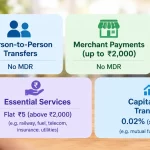
UPI Charges Explained: Will user have to pay more?
UPI’s Dominance in India’s Digital Payments Ecosystem
UPI has overtaken other digital payment methods in India and today processes 85 per cent of digital payments made in the country. At the time of its launch, only 21 banks were on board UPI, compared to more than 700 at present.
Currently, UPI is also witnessing increased adoption across countries. Multiple nations have either adapted UPI as their local payments infrastructure or enabled cross-border payments via UPI.
There is a huge impact on businesses enabled by UPI. Street hawkers, local kiranas, restaurants, and other small businesses have seen a surge in sales enabled by the QR-based payments platform.
UPI Transaction Value Dip Post-Pandemic
Even though UPI’s value and volume of transactions jumped, the worth of each transaction has nose-dived in the post-pandemic period. The value per transaction peaked at ₹1,836 in FY21, before dropping to ₹1,300 in FY26.
The fall in value can be attributed to the increased use of UPI for smaller payments as opposed to high-value transactions. People are using UPI for daily commute, grocery shopping, food delivery, and utility payments.
UPI has turned from being a digital wallet into a retail payments ecosystem, with the majority of the transactions being small-value.
How UPI made a mark in the Financial Systems
Impact of UPI on Banks, Fintechs, and Payment Banks
UPI has created opportunities for banks, fintechs, payment banks, and other NBFCs to drive their business. The UPI story, however, has created questions about the future of the free transactions model.
The rapid rise in UPI transactions has forced several payment banks and NBFCs to rethink their business models. In addition, the payments interface has led to a surge in competition among banks and fintechs.
A new set of opportunities will emerge for fintechs as the ecosystem evolves and matures, with transaction-level data being leveraged to offer products and services to businesses and customers. There is an opportunity to monetize the UPI data and offer value-added services such as loans to businesses.
What Lies Ahead for UPI?
UPI has seen phenomenal growth in its first decade, and now the focus will be on international expansion, security, and business development. The UPI story is one of India’s digital public infrastructure enablers and has had a massive impact on the way Indians use money.
From processing only a few transactions when it was launched, NPCI’s UPI is today processing payments worth ₹314 lakh crore every year.