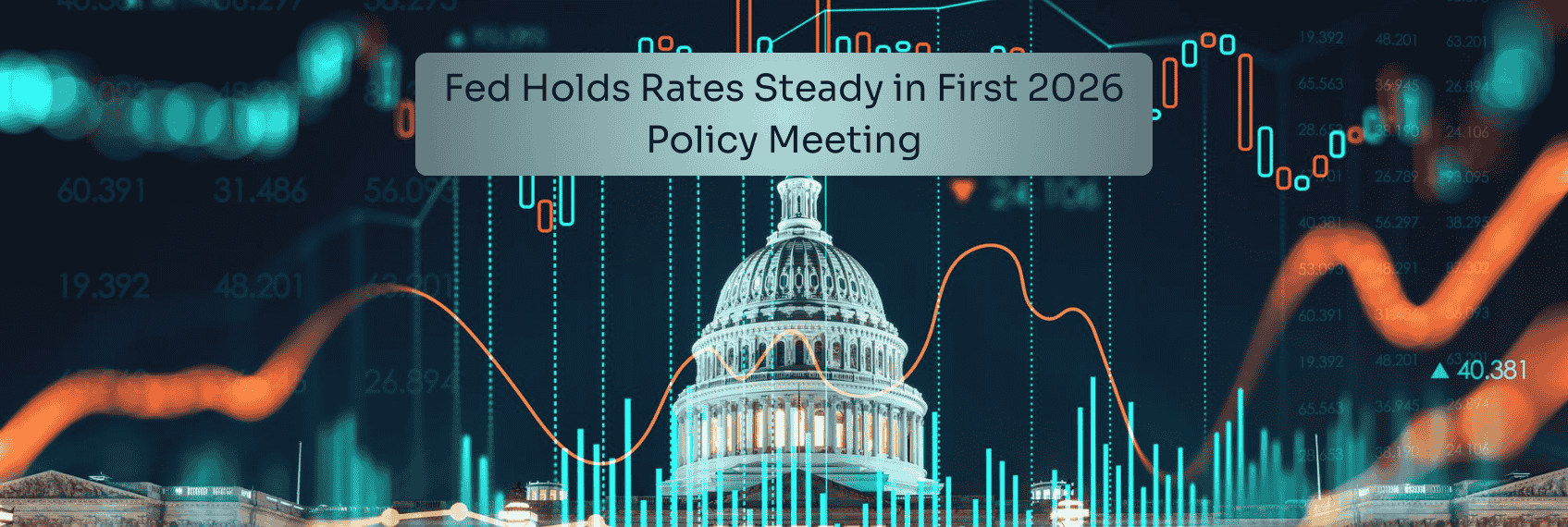
The US Federal Reserve began the year with a cautious and widely anticipated policy move, opting to pause further changes to interest rates as it weighs persistent inflation pressures against signs of stabilisation in the labour market.
After a two-day meeting, the Jerome Powell-led Federal Open Market Committee (FOMC) signalled a wait-and-watch approach, underscoring its data-dependent stance while keeping the focus firmly on balancing economic growth, employment conditions, and price stability.
The US Federal Reserve, led by Chair Jerome Powell, announced its first monetary policy decision of 2026 on January 28, following a two-day meeting of the Federal Open Market Committee (FOMC). As widely expected by markets, the central bank kept the benchmark federal funds rate unchanged in the range of 3.50% to 3.75%, opting for a wait-and-watch approach after a cumulative 75 basis points of rate cuts in 2025.
“In support of its goals, the Committee decided to maintain the target range for the federal funds rate at 3-½ to 3-¾ percent,” the FOMC said in its policy statement.
The decision came amid still-elevated inflation, slowing but stabilising job growth, and solid overall economic activity, prompting policymakers to pause further easing while assessing incoming data.
While the majority of FOMC members voted to keep rates unchanged, the decision was not unanimous. Governors Christopher Waller and Stephen Miran dissented, preferring a 25-basis-point rate cut at this meeting.
“Voting for the monetary policy action were Jerome H. Powell, Chair; John C. Williams, Vice Chair; Michael S. Barr; Michelle W. Bowman; Lisa D. Cook; Beth M. Hammack; Philip N. Jefferson; Neel Kashkari; Lorie K. Logan; and Anna Paulson. Voting against this action were Stephen I. Miran and Christopher J. Waller, who preferred to lower the target range for the federal funds rate by 0.25 percentage point at this meeting,” the Federal Reserve said.
The dissent highlights an emerging internal debate within the Fed over the timing of the next phase of monetary easing.
In its statement, the FOMC said the US economy continues to expand at a solid pace, supported by resilient consumer spending and steady business investment, even as housing activity remains weak.
“Available indicators suggest that economic activity has been expanding at a solid pace. While job gains have remained low, and the unemployment rate has shown some signs of stabilisation, the central bank said inflation remains somewhat elevated,” the Fed noted.
According to recent data:
Addressing the press conference, Jerome Powell emphasised that after lowering rates by 75 basis points over the previous three meetings, the Fed believes the current stance is appropriate.
“Having lowered our policy rate by 75 basis points over the course of our previous three meetings, we see the current stance of monetary policy as appropriate to promote progress toward both our maximum employment and 2% inflation goals,” Powell said.
He added that the US economy is entering 2026 on a firm footing.
“The US economy expanded at a solid pace last year and is coming into 2026 on a firm footing. While job gains have remained low, the unemployment rate has shown some signs of stabilisation and inflation remains somewhat elevated.”
Powell acknowledged that the labour market is showing signs of stabilisation, though underlying softness remains.
“In the labour market, indicators suggest that conditions may be stabilising after a period of gradual softening. The unemployment rate was 4.4% in December and has changed little in recent months,” he said.
He further explained the slowdown in hiring:
“A good part of the slowing in the pace of job growth over the past year reflects a decline in the growth of the labour force due to lower immigration and labour force participation, though labour demand has clearly softened as well.”
Powell also flagged the growing impact of artificial intelligence on hiring decisions:
“You hear large companies, though, saying that they either won't be hiring for some time, or that they're hiring less, or they're throwing people off, and they tend to refer to AI when they do that.”
The Fed chair reiterated that much of the recent inflation overshoot has been driven by tariffs rather than demand pressures.
“Most of the overrun in goods prices is from tariffs. And that's actually good, because if it weren't from tariffs, it might mean it's from demand, and you know, that's a harder problem to solve.”
Powell added that tariff-related inflation is likely to be temporary.
“We do think tariffs are likely to move through and be a one-time price.”
Powell made it clear that the Fed has not pre-committed to future rate cuts and will remain strictly data-dependent.
“Not made a decision on future rate cuts,” Powell said when asked directly.
He emphasised:
“We are well-positioned to determine the extent and timing of additional adjustments to our policy rate based on the incoming data, the evolving outlook, and the balance of risks. Monetary policy is not on a pre-set course, and we will make our decisions on a meeting-by-meeting basis.”
Reiterating the Fed’s core objectives, Powell said:
“The Fed has been assigned two goals for monetary policy: maximum employment and stable prices. We remain committed to supporting maximum employment, bringing inflation sustainably to our 2% goal and keeping longer-term inflation expectations well anchored.”
On questions surrounding political pressure and institutional autonomy, Powell firmly defended the Fed’s independence.
“We haven't lost it,” Powell said of Fed independence. “I don't believe we will. I certainly hope we won't.”
US equity markets reacted positively to the Fed’s decision, with major indices ending mostly higher.
The US dollar strengthened, while Treasury yields remained stable. Meanwhile, gold surged over 2%, reflecting lingering policy and fiscal uncertainty.
In India, the rupee slipped to a fresh all-time low of ₹91.9850 per dollar, pressured by foreign fund outflows and increased hedging demand, despite strong domestic growth.
Indian equity markets opened lower, with investors turning cautious ahead of the Union Budget 2026–27, even as global cues remained largely supportive.
The FOMC acknowledged that uncertainty around the economic outlook remains high.
“Uncertainty about the economic outlook remains elevated. The Committee is attentive to the risks to both sides of its dual mandate,” the Fed said.
Going forward, policymakers will closely monitor:
For now, the Fed appears firmly in pause mode, keeping rates steady while retaining flexibility to act if conditions change.
US Fed Meeting Today: 25 bps Cut Expected; Commodities Brace for Dollar Reaction
2 min Read Oct 29, 2025
Fed Governor Miran Calls for Aggressive Rate Cuts; Markets Await Powell’s Speech
3 min Read Sep 23, 2025
State Bank of India Subsidiary SBI Funds Management Limited Files DRHP for IPO; SBI to Divest 6.3% Stake via OFS
5 min Read Mar 20, 2026
Rupee Hits Record Low Near 93 vs US Dollar as Oil Prices Surge and Foreign Outflows Rise
5 min Read Mar 20, 2026
Top Gainers & Losers: Nifty 500 Rebounds 1.24% After Sell-Off
5 min Read Mar 20, 2026
Why Gold and Silver Prices Are Falling Despite US-Iran War and Market Volatility
5 min Read Mar 20, 2026
Nifty & Sensex Crash Over 3%; BSE Market Cap Erodes ₹12.5 Lakh Crore Amid Rising Crude Oil
5 min Read Mar 19, 2026
For android only