Summary:
The GST Council's 57th meeting recommended changes to arrest powers, prosecution thresholds, tax penalties, refund processing, input tax credit and business registration. The proposed reforms aim to reduce compliance costs, ease working-capital pressures and limit unnecessary disputes.
What changes did the GST Council recommend in its 57th meeting?
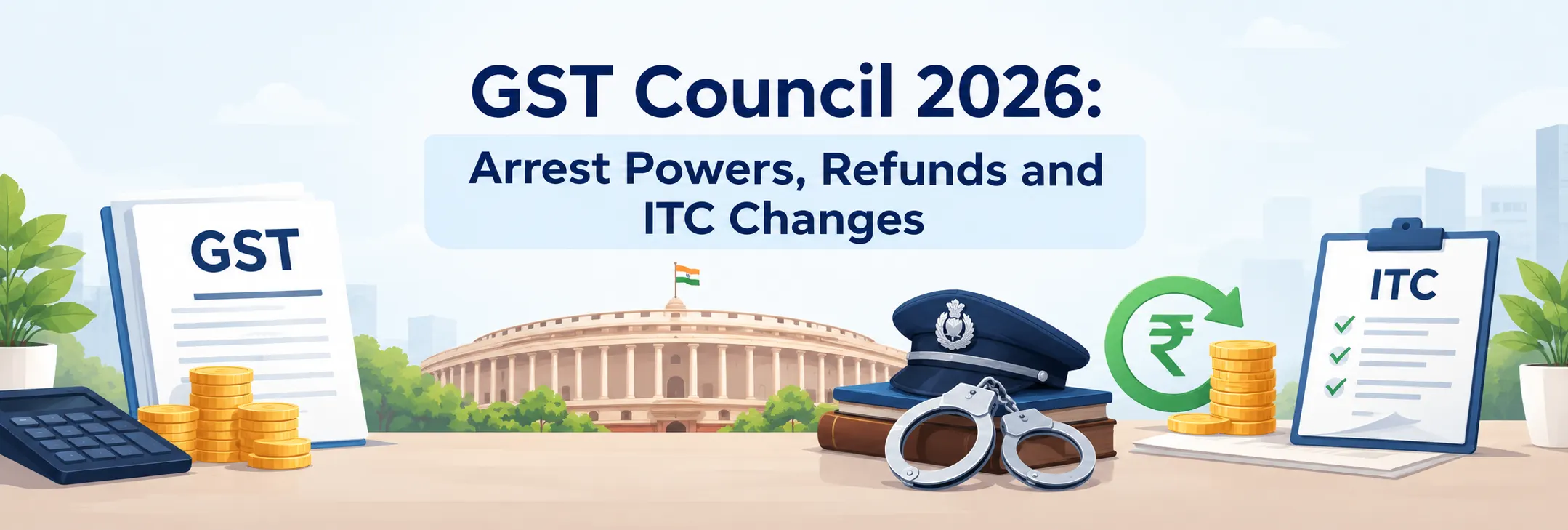
Major changes in India’s Goods and Services Tax (GST) framework to ease compliance and reduce disputes were recommended by the GST Council in its 57th meeting held on October 8, 2026. Key decisions include withdrawal of powers to arrest under GST, raising the threshold for prosecution to Rs 5 crore, fast tracking refunds and raising input tax credit (ITC) benefits to businesses.
GST - No Arrest Authority, Lesser Penalties
One of the major changes is the proposed withdrawal of the power to arrest under Section 69 of the Central GST Act, 2017. The Council also recommended raising the monetary threshold for prosecution from Rs 1 crore to Rs 5 crore which would give relief from criminal proceedings in smaller cases.
The minimum punishment would be removed and the courts would decide the punishment according to the case.
“The maximum general penalty for minor violations will be reduced from Rs 25,000 to Rs 10,000. The Council had recommended that no notices of demand for tax should be issued where the amount involved is less than Rs 10,000.
The changes are aimed at reducing unnecessary litigation while maintaining provisions to address serious tax fraud and evasion.
Faster GST Refunds to Enhance Business Cash Flow
GST refunds have been a long-standing concern for exporters and businesses with limited working capital. The Council has recommended a more automated system of refunds to reduce processing delays.
Time limit to acknowledge refund applications or to issue deficiency notices to be reduced from 15 days to 10 days under proposed framework. Applications will be considered acknowledged if no response is received by that date.
90% of the refund amount for eligible zero rated supplies and inverted duty structure claims could be provisionally sanctioned through an automated risk based process.
Businesses will also benefit from the wider eligibility for refunds on the accumulated ITC on input services, machinery and capital goods.
More comprehensive tax credit incentives to companies
Council recommended to allow refund of accumulated ITC under inverted duty structure, where taxes paid on inputs are higher than the taxes charged on finished products, on input services and capital goods.
The refunds on eligible input services are proposed to be applicable to credits availed from 1 November 2026. In this regard, the proposed benefit would be on account of credits availed from April 1, 2027, with refunds spread over 60 months.
It also suggests relaxing restrictions on ITC on some expenses such as employee health and life insurance, outdoor catering, telecommunications towers and pipelines.
These changes may reduce the blocked working capital and effective tax burden for qualifying businesses.
Small Business, E-Commerce Sellers to See Benefits
The Council also recommended quicker GST registration and cancelation processes with more use of automated approvals. Small sellers who sell through e-commerce platforms may designate an eligible platform warehouse as their principal place of business and register in states where they have no physical presence.
It may become easier to move goods across states, too. The new rules mean that vehicles can only generally be intercepted on specific intelligence and with the authorization of a senior officer, reducing the number of routine checks during transit.
An optional annual return and quarterly payment scheme has also been given in-principle approval for eligible consumer-facing businesses with an annual turnover of up to ₹5 crore.
The reforms are coming after GST rate rationalization measures announced in September 2025. The October meeting was mostly about procedures, but implementation will require the necessary legal amendments and notifications.
In general, the proposed changes could reduce compliance costs, improve cash flow and make GST administration more predictable for businesses.