
Recent data from the World Gold Council showed that central banks were net sellers of approximately 30 tonnes of gold in March 2026. The development immediately sparked speculation across financial markets about whether the powerful multi-year trend of central bank gold accumulation is beginning to reverse.
However, a single month of modest net selling is far too small to signal the end of a structural trend that has been building for years.
Since 2022, central banks have remained among the strongest buyers of gold globally as countries increasingly diversify reserves away from the US dollar and strengthen financial resilience amid rising geopolitical uncertainty.
Why Are Some Central Banks Selling Gold?
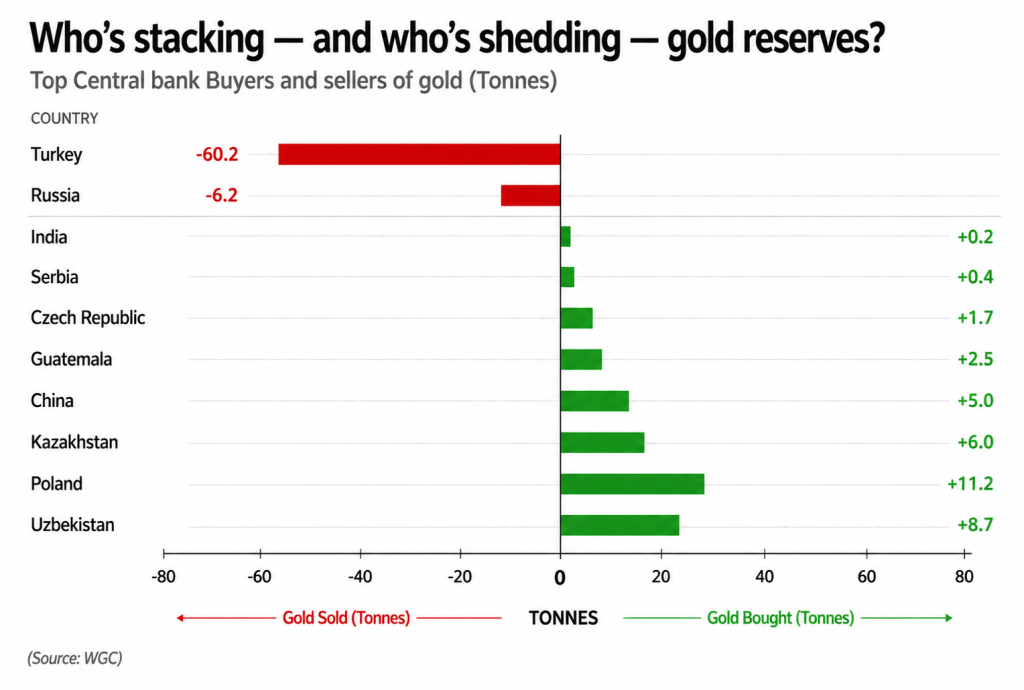
Two countries dominated the selling activity in March 2026: Russia and Turkey.
Turkey was the largest net seller, reducing its gold reserves by approximately 60 tonnes during the month. Russia also reported net sales of around 6 tonnes.
Turkey Gold Sales: Turkey’s gold sales appear to be largely driven by domestic financial pressures and efforts to stabilize the Turkish lira, which has depreciated by more than 5% against the US dollar since the beginning of 2026. Alongside currency weakness, the country is also facing rising external debt obligations, persistent inflationary pressures, elevated geopolitical uncertainty, and increasing demand for hard-currency liquidity. In such an environment, gold reserves have become an important financial buffer for supporting liquidity and managing broader economic stability.
Russia’s Gold Sales: Russia’s gold sales are widely viewed as part of broader wartime financing and fiscal management efforts amid continuing geopolitical tensions and sanctions-related pressures.
Unlike traditional reserve management, these sales appear more tactical and necessity-driven rather than a strategic shift away from gold.
The Broader Central Bank Buying Trend Remains Intact
However, despite selling by a few countries, the broader trend of central bank gold accumulation remains firmly intact. China continued to be a steady buyer, adding around 5 tonnes of gold in March 2026, while Poland increased its reserves by approximately 11 tonnes during the month.
According to data from the World Gold Council, the National Bank of Poland remained one of the world’s largest gold buyers in Q1 2026, adding around 31 tonnes and lifting total reserves to approximately 582 tonnes as it moves toward its long-term 700-tonne target. The People's Bank of China added roughly 7 tonnes during the quarter, taking total reserves to around 2,313 tonnes as China continues diversifying away from US dollar assets. Meanwhile, the Central Bank of Uzbekistan increased its holdings by approximately 25 tonnes, with gold now accounting for nearly 87% of the country’s total reserves.
Other notable buyers during the quarter included the National Bank of Kazakhstan (+12t), Czech National Bank (+5t), and Bank Negara Malaysia (+5t), alongside smaller purchases by the central banks of Guatemala, Cambodia, Indonesia, Serbia, and the UAE.
Conclusion
While March 2026 recorded net central bank gold selling, the broader long-term trend of sovereign gold accumulation remains intact.
Most of the recent selling appears to be driven by country-specific economic and geopolitical pressures rather than a coordinated shift away from gold as a reserve asset.
Unless central banks move into sustained net selling over multiple consecutive quarters, it would be premature to conclude that the global central bank gold-buying cycle has ended.
For now, gold continues to play a critical role in the evolving global reserve system, particularly at a time when geopolitical uncertainty, de-dollarization trends, and reserve diversification remain central themes in international finance.