Summary:
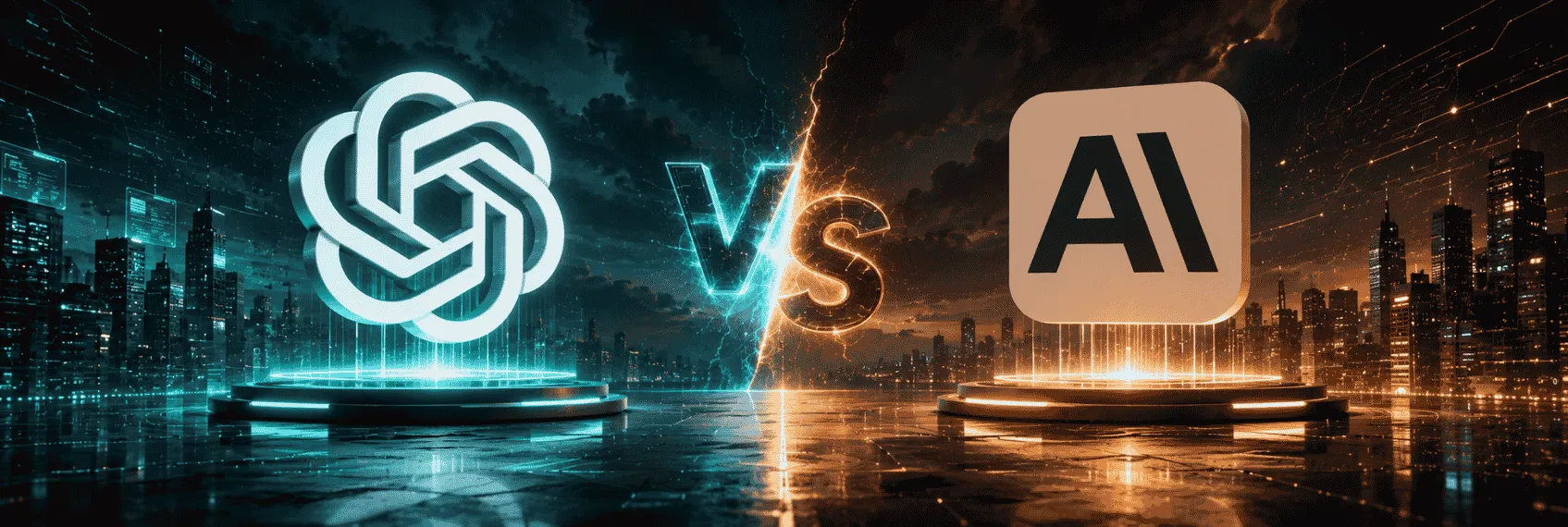
OpenAI and Anthropic have emerged as the leading contenders in the global AI race, with both companies nearing trillion-dollar valuations ahead of potential IPOs. While OpenAI dominates consumer AI through ChatGPT, Anthropic has built a strong enterprise-focused business with rapid revenue growth. Their public listings could reshape AI investing, influence technology valuations, and create ripple effects across Indian IT stocks and global markets.
Let's be honest, when we talk about the next big wealth-creation event in global markets, very few things come close to what's unfolding right now between OpenAI and Anthropic. Two AI giants, both burning billions, both chasing a trillion-dollar valuation, and both eyeing a public listing before the year ends. For us as Indian investors, this is not a distant Silicon Valley story, it's a signal that will reshape how Indian IT stocks, AI-linked mutual funds, and global tech ETFs behave over the next 12–18 months.
The Scoreboard: Where Things Stand Today
The numbers are staggering and they keep moving. OpenAI, the maker of ChatGPT, was last valued at $852 billion after closing a record $122 billion funding round in late March 2026. Its revenues grew from roughly $2 billion annualised in 2023 to over $20 billion by end-2025, a 10x jump in two years. ChatGPT crossed 900 million weekly active users in early 2026.
But here's the twist: Anthropic, the younger and quieter rival, quietly stole the crown. On May 28, 2026, Anthropic closed a $65 billion Series H round led by Altimeter Capital, Sequoia, Dragoneer, and Greenoaks, valuing the company at $965 billion post-money. That's more than OpenAI. Its annualised revenue run-rate hit $47 billion at the time of the announcement, up from just $9 billion at end-2025. That's a 5x jump in under six months.
Investor Takeaway: In eight months, Anthropic's valuation went from $183 billion to $965 billion, a 5.3x increase. IPO specialist Jay Ritter called this pace 'unprecedented for a startup at this scale.'
Head-to-Head: The Numbers That Matter
| Metric | OpenAI | Anthropic |
| Valuation (Jun 2026) | $852B (OpenAI) | $965B (Anthropic) |
| Revenue Run-Rate | $20B+ (2025 end) | $47B (May 2026) |
| Monthly Active Users | ~900M (ChatGPT) | ~134M (Claude) |
| Revenue Mix | Consumer + Enterprise | 80%+ Enterprise |
| Expected IPO Window | Q3/Q4 2026 | Oct–Nov 2026 |
| Key Backer | Microsoft, SoftBank | Google, Amazon |
| Profitable? | No (until ~2030) | ~Q2 2026 (operating) |
| Restructuring Risk | Non-profit → PBC | None |
The most important difference sits in that 'Revenue Mix' row. OpenAI is a consumer business at heart, it depends on ChatGPT subscriptions and API usage. Anthropic has quietly built an enterprise fortress. About 80% of its revenue comes from businesses embedding Claude into their products and workflows. Enterprise contracts are stickier, higher-margin, and far less volatile than subscription churn. Indian investors familiar with TCS or Infosys know the power of long-term enterprise deals, Anthropic is building exactly that playbook in AI.
The IPO Race: Who Goes First?
Both companies have filed confidential S-1 paperwork with the SEC, OpenAI reportedly with Goldman Sachs and Morgan Stanley targeting a Q3/Q4 2026 listing, potentially at a $1 trillion valuation. Anthropic is eyeing October to November 2026 and has hired Wilson Sonsini, the same law firm that handled Google's 2004 IPO, to manage its public-market readiness.
The sequencing matters enormously. Whoever lists first sets the valuation benchmark for pure-play AI companies globally. Goldman Sachs analysts project total 2026 US IPO proceeds could hit $160 billion, four times 2025 levels, and OpenAI and Anthropic together could account for a significant chunk of that.
There's a wrinkle for OpenAI though. It still needs to complete its structural transformation from a non-profit to a for-profit public benefit corporation (PBC). Analysts have flagged a $207 billion funding gap through 2030 and noted that ChatGPT user growth has stalled around 900 million, below internal targets. That's not a dealbreaker, but it's a risk investors will price in.
India Angle: Indian investors don't yet have direct access to pre-IPO shares of either company, but platforms like INDmoney and Vested Finance offer US stock investing. Once listed, both stocks will be accessible via these routes. More immediately, watch how Nifty IT and tech-heavy US ETFs like Mirae Asset NYSE FANG+ETF react to IPO news.
Why This Changes the AI Investment Map
Here's what should concern, and excite, us as Indian investors. The Magnificent 7 (Apple, Microsoft, Nvidia, Alphabet, Amazon, Meta, Tesla) have acted as proxy AI plays for retail investors globally. Once OpenAI and Anthropic list as standalone entities, money will rotate. Microsoft, which holds a major stake in OpenAI, and Amazon, which has committed $5 billion to Anthropic's latest round, face mark-to-market events that could trigger outflows from their stocks.
For Indian IT companies, this creates a dual narrative. On one hand, rising AI adoption means more enterprise software spending, good for companies like Infosys and Wipro that are building AI service layers. On the other, if AI models automate the kind of work these firms sell, the long-term disruption risk is real. TCS was trading at roughly 23x PE as recently as Q1 2026, in a world where Anthropic lists at 20x revenue and posts operating profits in Q2, that multiple conversation is going to get uncomfortable.
The Bottomline: Place Your Bets Carefully
Two companies with combined revenues approaching $70 billion annualised, racing toward a trillion-dollar valuation each, in the middle of the most significant technology shift since the internet, that is not background noise. It is the headline.
As investors, our job is not to chase the IPO pop (which could be significant but also fleeting). The smarter play is to understand what these listings signal: AI infrastructure is maturing, enterprise adoption is accelerating, and the valuation language of tech has permanently changed.
Watch the IPO filings. Watch the S-1 revenue disclosures carefully, especially gross margins and customer concentration. And watch what happens to Nvidia, which supplies chips to both companies. If this race ends in a trillion-dollar listing, every piece of the AI supply chain moves with it, and some of that story will be written right here in Indian markets too.