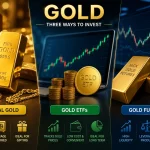
Summary
Indian investors are increasingly shifting from physical gold jewelry to digital gold and Gold ETFs due to lower costs, improved security, transparency, and ease of access. Rising prices and changing investor preferences are accelerating the move toward regulated and efficient gold investment avenues.
Investors are shifting from traditional jewelry to digital gold primarily due to cost- efficiency, accessibility and security. While jewelry remains culturally significant for weddings and festivals, it is increasingly viewed as an inefficient investment vehicle compared to digital alternatives like Digital Gold, Gold ETFs, and Sovereign Gold Bonds (SGBs).
Transition Drivers
- Buying Jewelry involves making and wastage charges (typically 8% to 25%), which are not recoverable upon resale. Digital gold represents pure investment in the metal itself, avoiding these overheads.
- Safety and Storage: Physical jewelry carries the risk of theft and often requires the recurring cost of a bank locker which is minimized in case of Digital Gold.
- Traditional gold purchases of 1-gram coin or ornament require a significant upfront cost. Digital platforms allow fractional ownership.
- Purity - Jewelry purity can be subjective without official hallmarking. Digital gold is typically 24-carat (99.9% pure).
- Millennials and Gen Z are leading this shift, preferring app-based SIP aligning with digital-first lifestyle
| Comparison of Investment Avenues | |||
| Feature | Physical Jewellery | Digital Gold | Gold ETFs |
| Primary Use | Adornment / Cultural | Pure Investment | Market Trading |
| Extra Costs | 8–25% Making Charges | ~3% GST + Spreads | Expense Ratio (0.5–1%) |
| Min. Investment | High (ornament price) | Very Low (from ₹1) | 1 unit (~1 gram) |
| Regulation | Indirect (BIS/GST) | Unregulated (self-governed) | SEBI Regulated |
| Liquidity | Moderate (resale) | High (24/7 online) | High (Market hours) |
- Both are popular but work differently as regards the Investment Process, Cost Structure, Regulatory Framework and Taxation. The choice between Gold ETFs and digital gold depends on one’s investment goals, risk tolerance, and preferred investment channel.
- Gold ETFs trade like stocks on stock exchanges. They follow gold’s price, letting you invest in gold without owning it physically. Their features include Transparency (Daily NAV), Liquidity and Cost-Effectiveness.
- Digital Gold is a digital form of physical gold thru online platforms and backed by real gold stored in safe vaults. Their features include Convenience C Flexibility.
- Understanding the pros and cons of gold ETFs and digital gold is key. A shift from the physical gold, the digital form of investing in gold is easier, cheaper, and safer.
| Feature | Gold ETF | Digital Gold |
| Regulation | Regulated by SEBI | Unregulated; governed by private platform terms |
| Minimum Investment | Typically 1 unit (approx. 0.1g to 1g gold value) | As low as ₹1 on many platforms |
| Physical Delivery | Generally not available; redeemed in cash | Available as coins or bars (subject to charges) |
| Demat Account | Mandatory for trading | Not required |
| Trading Hours | Stock market hours only | 24/7 accessibility |
| GST | 0% at purchase | 3% GST at purchase |
Performance Matrix – Gold ETF
- In 2025 net inflows surged by 283% year-on-year to a record ₹429.6 billion. India emerged as the 3rd largest gold ETF market globally, trailing only the US and China.
- Assets under management (AUM) by June 2025 rose by 88% to Rs 64,777 crore.
- Total gold ETF holdings jumped 65%, reaching a historic high of 95 tons by Dec’25.
- Investment demand (ETFs, bars, and coins) accounted for roughly 40% of total Indian gold consumption.
2026: Outlook
- ETF demand to remain “key driver” with continued growth offsetting weakness in Jewelry Demand.
- Jan’26 recorded an inflow of all-time monthly high of Rs.24040 Crore surpassing equity mutual fund inflows. Feb’26 had a moderate inflow due to profit booking following a sharp price rally.
- AUM Milestone - In Jan’26 hit Rs.1.84 lakh crores ($22 billion).
Market Influencers
- Price Performance - Gold delivered returns @76.50% in 2025 outperforming Nifty 50 @10.50%
- Safe-Haven Appeal: Persistent geopolitical tensions, global trade policy uncertainty (US tariffs), and a weakening rupee have pushed investors toward defensive assets.
- Financialization: A growing segment of younger investors is shifting from physical jewelry to regulated, liquid "paper gold" formats like ETFs.
Physical Gold Jewelry
- Volume Decline - India’s physical gold jewelry demand fell 24% YOY to 430.50 tons in 2025 (Total Gold demand fell 11% to 710.90 tons). For 2026, demand is projected to remain weak (Expected to drop to 600-650 tons) as record-high prices continue to constrain consumer budgets and would suppress jewelry sales.
- Value Growth - Despite the volume drop, the total value of sales rose 30% to
- ₹7,51,490 crore, driven by a 76.5% surge in domestic gold prices.
- Consumer Adaptation - High prices forced buyers to shift toward lightweight jewelry and lower-purity options (18k and 14k).
- Old Gold Exchange - Approximately 40% of retail sales were driven by consumers exchanging old jewelry for new designs.
Shifting Preferences: The World Gold Council predicts a gradual structural shift where investment demand (ETFs, bars, and coins) continues to outpace traditional jewelry consumption