Summary:
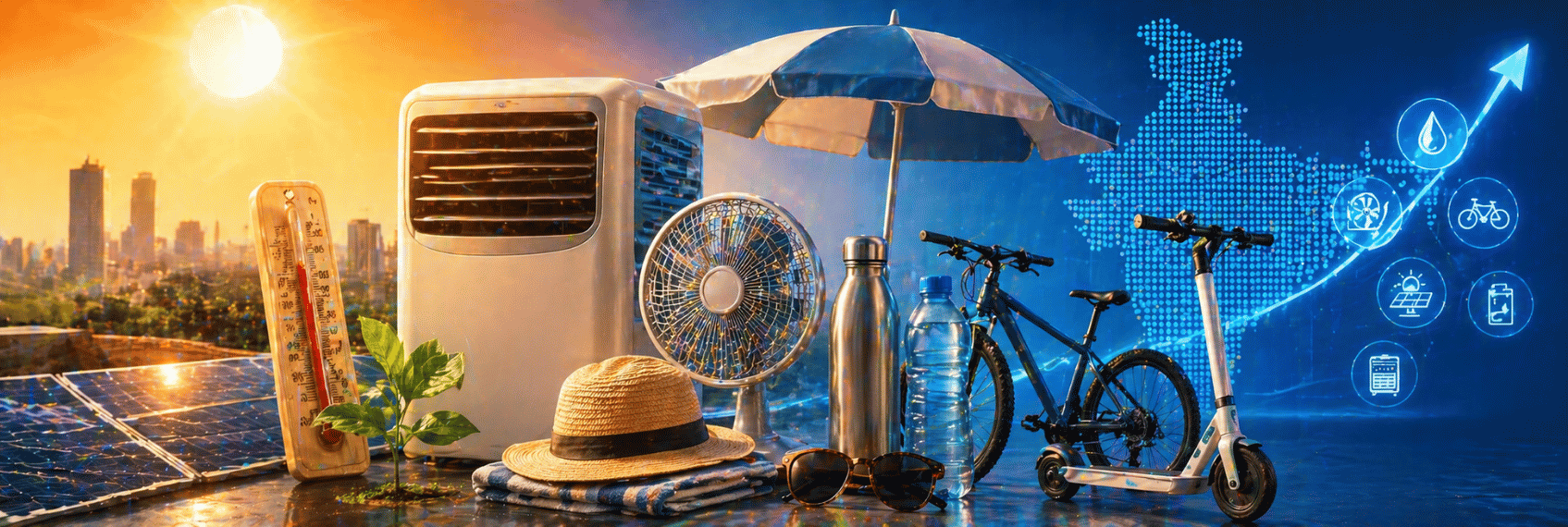
India's intense 2026 summer unlocks stock opportunities across five themes beyond ACs and power. Varun Beverages and Dabur ride beverage demand; Emami and HUL lead personal care. Consumer durable retailers like Aditya Vision capture cooling appliance sales. VA Tech Wabag benefits from water infrastructure spending under Jal Jeevan Mission 2.0. Exide and Amara Raja gain from inverter-battery demand driven by frequent power cuts.
Why Indian Summers Are a Stock Market Event
Anyone who has spent a summer in Nagpur or Jaipur knows the drill, by late March, the heat is already unbearable, fans are running at full speed, and the neighbourhood kirana has doubled its stock of cold drinks and ORS sachets. What most people don't realise is that this seasonal shift isn't just a lifestyle inconvenience. For India's stock market, summer is a genuine earnings catalyst.
February 2026 officially became the hottest February in 125 years, and the India Meteorological Department has since flagged an intense heatwave season ahead, with peak power demand expected to touch 270 GW, up from 238 GW in February alone. That kind of heat doesn't just stress the grid. It reshapes consumer behaviour across dozens of product categories, creates visible bumps in quarterly earnings, and opens up seasonal opportunities for investors who know where to look.
Most media coverage defaults to ACs and power stocks when talking about summer investing. Fair enough, Voltas, Blue Star, and NTPC do benefit. But the real story is wider. From cold drinks at a highway dhaba to water treatment plants in rural Karnataka, summer is quietly moving money across five distinct themes that deserve investor attention.
Theme 1: Beverages and Cold Drink Demand - The Thirst Economy
Every summer, Indians collectively go on a hydration spree. It is almost algorithmic in its predictability.
Carbonated drinks, packaged juices, ORS powders, bottled water, and energy drinks all see sales volumes surge starting April and continuing through June. This isn't just about Pepsi and Coke — the category is larger and more layered than most investors appreciate.
Varun Beverages (VBL) is arguably the cleanest seasonal play in this space. As the master franchisee for PepsiCo products across most of India and several international markets, its business is intensely seasonal. In Q1FY26, Varun Beverages reported a 26% quarter-on-quarter jump in sales, crossing ₹7,017 crore, with profits surging 81% in the same period, only to normalize as the season cooled. That Q1 spike is now a near-annual pattern. The company's aggressive expansion into Africa and the Middle East also means its summer exposure is becoming structurally larger each year.
Dabur India presents a different flavour of summer demand. Its Real fruit juice range and Dabur Glucose products find consistent takers in both urban and rural India during peak heat months. The company's Ayurvedic positioning appeals to health-conscious buyers who want something "less chemical" than carbonated drinks, a segment that has been growing steadily.
United Breweries (UBL), the maker of Kingfisher, treats summer as its "golden quarter." Beer consumption in India peaks sharply from March through June, and UBL, which controls the dominant share of the organised beer market, benefits disproportionately. It's worth noting that newer entrants like Reliance's Campa Cola are also competing aggressively in the mass beverage space, suggesting the overall category is expanding rather than just redistributing.
Quick take: Among beverages, Varun Beverages has historically delivered the most consistent and measurable summer earnings bump. Dabur is a steadier, lower-volatility play on the same theme.
Theme 2: FMCG Personal Care - Sunscreen, Talc, and Cooling Oils
India's FMCG market is projected to approach USD 615 billion in total revenue by 2027, growing at a pace most consumer markets globally can't match. But within that broad story, summer creates very specific demand spikes for a subset of personal care products.
Cooling talcum powder, sunscreen lotions, prickly heat powders, anti-tanning creams, and hair oils designed to combat scalp heat are all deeply seasonal. Rural and semi-urban India, often overlooked in standard market analysis, has been one of the fastest-growing contributors to FMCG volume, rural volumes grew 8.4% versus urban volumes of 2.6% in recent quarters.
Emami Limited is perhaps the most direct summer play in personal care. Its Navratna brand, the cooling hair oil range, is one of India's most recognisable summer products. The company consistently enters its peak revenue season during these months, and Navratna's distribution reach into smaller towns gives it exposure to exactly the markets that are growing fastest.
Hindustan Unilever (HUL) covers this ground through its Ponds and Lakme ranges, which include sun protection and cooling variants. HUL's sheer distribution muscle, over 8 million retail outlets, means its seasonal products reach places most competitors simply cannot. The company manages over 50 brands across 16 FMCG categories, making it one of the most diversified businesses in Indian retail.
Marico benefits from its summer-specific positioning in hair care and skincare. Its Parachute range and Nihar brands have strong rural recall, and the company has been systematically building its premium personal care portfolio for urban consumers.
Quick take: Emami is the most direct seasonal play. HUL is the defensive, large-cap option for investors who want summer exposure without excessive concentration risk.
Theme 3: Consumer Durables - Fans, Coolers, and Appliances
Beyond ACs (which are covered extensively elsewhere), summer creates demand across a wider durables spectrum: ceiling fans, desert coolers, refrigerators, and the retailers who sell all of these.
This year, that demand is running into a complication. Several consumer durable manufacturers have already announced price hikes of 3% to 10% starting April 2026, driven by input cost inflation. Air conditioner companies like Blue Star and Godrej have raised prices by 6–15%. Whether higher prices dampen volumes or simply compress margins will be the key question when Q1 earnings come in.
Among the less-obvious plays, Aditya Vision, a consumer electronics retail chain based in Bihar — has delivered sales and net profit growth at a CAGR of 23% and 50% respectively over the past five years. As a retailer rather than a manufacturer, it benefits from all summer durables categories simultaneously. Bihar and eastern India, where Aditya Vision operates, are among India's most intensely hot regions, making its business acutely summer-sensitive.
Electronics Mart India, the largest consumer electronics retailer in South India, operates over 215 stores across Andhra Pradesh, Telangana, Delhi, and Kerala. Its revenue and profit have grown at healthy CAGRs, supported by new store additions. The summer cooling appliance season directly boosts footfalls across its stores.
Havells India, through its Lloyd brand, has a meaningful position in both fans and ACs. With PLI scheme support for white goods increasing to ₹1,004 crore in FY26-27 from ₹304 crore the previous year, manufacturers in this segment have a structural tailwind beyond just seasonal demand.
Quick take: The retailer-side plays (Aditya Vision, Electronics Mart) are interesting because they capture summer demand across multiple categories and brands, reducing single-product risk.
Theme 4: Water Scarcity and Water Management - The Slow Burn Opportunity
This is the summer theme that most retail investors miss entirely, and it may be the most durable one.
NITI Aayog has flagged 21 major Indian cities as being at risk of depleting their groundwater resources. India currently treats only about 27% of the sewage it generates, creating a massive gap between what exists and what's needed. Jal Jeevan Mission 2.0, approved by the Union Cabinet in March 2026 with a total outlay of ₹8.69 lakh crore and central assistance of ₹3.59 lakh crore, is one of the largest rural water infrastructure programmes ever undertaken in India. The Department of Water Resources saw a 55% increase in budget allocation compared to the previous year.
All of this creates multi-year order books for companies in water treatment, water infrastructure, and distribution.
VA Tech Wabag is the most prominent pure-play water company in India — a global leader in water and wastewater treatment with operations across 63 countries and over 6,500 completed projects. Its current order book exceeds ₹16,300 crore, providing strong multi-year revenue visibility. Institutional investors like Abakkus have recently added positions, adding credibility to the growth thesis.
Ion Exchange (India) has over 60 years of experience in water management solutions, catering to industries like pharmaceuticals, power, and food and beverages. It is both a product and service company, which makes its revenue profile more resilient than pure EPC players.
Denta Water and Infra Solutions is a smaller, emerging player worth watching. Its order book stood at ₹838 crore as of January 2026, with nearly 93% derived from water management projects. Most of its current pipeline is tied to Jal Jeevan Mission projects in Karnataka, giving it near-term revenue certainty.
Welspun Corp and Srikalahasthi Pipes are infrastructure and pipe manufacturers who supply the physical plumbing that water distribution projects require — a supporting cast that benefits every time a new water project is greenlit.
Quick take: Water stocks are less of a seasonal play and more of a structural multi-year opportunity. VA Tech Wabag and Ion Exchange are the strongest anchors for a long-term position.
Theme 5: Batteries, Inverters, and Energy Backup - The Power-Cut Economy
If you've lived through a summer in Patna, Lucknow, or any Tier II city in UP, you know that inverters aren't a luxury — they're a necessity. Every additional degree of heat brings more appliances running simultaneously, stretching grid capacity and making power cuts more frequent. That's a direct revenue trigger for the battery and inverter ecosystem.
Exide Industries is India's largest battery manufacturer, with a product range spanning inverter batteries, automotive batteries, and an emerging EV battery segment. Its distribution network is arguably its strongest moat, Exide is available in markets where most of its competitors simply don't reach. The company is also building out its lithium-ion battery capacity through partnerships and new manufacturing facilities.
Amara Raja Batteries (parent of the Amaron brand) is the other heavyweight in this category. Amaron is known for low-maintenance products with long life cycles, and the company is actively building lithium-ion gigafactories to position itself for the EV transition. This makes it a play on both the current summer demand cycle and the longer-term energy storage opportunity.
Luminous Power Technologies (now part of the Schneider Electric ecosystem) holds one of the strongest brand positions in home inverters and batteries. Luminous is considered the most popular inverter brand in India for home use, and its combination of inverter and battery products makes it a natural first call for consumers dealing with power disruption.
The broader backup power market benefits from the same dynamics — as India adds more ACs and cooling appliances, peak grid demand increases, load shedding becomes more likely in stressed distribution zones, and every household becomes a potential inverter customer.
Quick take: Exide and Amara Raja are the listed plays in this space. Both offer summer tailwinds from inverter battery demand AND a longer-term growth story from EV energy storage, a useful combination.
Risks and What to Watch Before Investing
Summer stocks are seductive precisely because the thesis is so intuitive, it's hot, people buy cold drinks and cooling appliances, companies make money. But reality is messier.
Seasonal concentration risk is real. Companies like Varun Beverages can see Q1 profits jump 80% and then fall 44% in Q2. If you buy after the summer spike is already priced in, you're left holding the off-season.
Input cost inflation is actively squeezing margins in 2026. Consumer durable manufacturers have already announced price hikes, and the question of whether consumers will absorb those higher prices or defer purchases is genuinely open. Hindustan Unilever's P/E is around 33x, Varun Beverages trades near 54x, these aren't bargain valuations.
Monsoon risk cuts both ways. A poor monsoon, as feared from El Niño conditions, keeps summer demand elevated but creates downstream rural distress that can hurt FMCG volumes in H2. A strong monsoon cools things down faster than expected, cutting the summer earnings window short.
Project execution risk applies specifically to water stocks. Government infrastructure spending often gets delayed, and companies with large order books don't always translate those into revenue on schedule.
Valuation entry points matter more than the theme. The summer story isn't new — institutional investors have been playing it for years. The alpha comes from finding stocks where the seasonal tailwind isn't yet fully reflected in the price.
Final Takeaway for Investors
India's summer of 2026 is shaping up to be one of the more intense ones in recent memory, and the investment opportunities that flow from that heat go well beyond the usual ACs-and-power conversation.
The five themes covered here, beverages, FMCG personal care, consumer durables retail, water infrastructure, and energy backup, each have different risk profiles and time horizons. Beverages and consumer durables are seasonal, meaning they reward investors who position before the peak and exit before the market prices in the post-monsoon slowdown. Water infrastructure is a structural multi-year story that summer awareness helps bring into focus, but the real thesis extends well beyond three months.
For a diversified summer portfolio, combining a seasonal play like Varun Beverages or Emami with a structural play like VA Tech Wabag or Exide gives you both near-term catalysts and longer-term staying power.
The mercury is rising. The question is whether your portfolio is dressed for it.