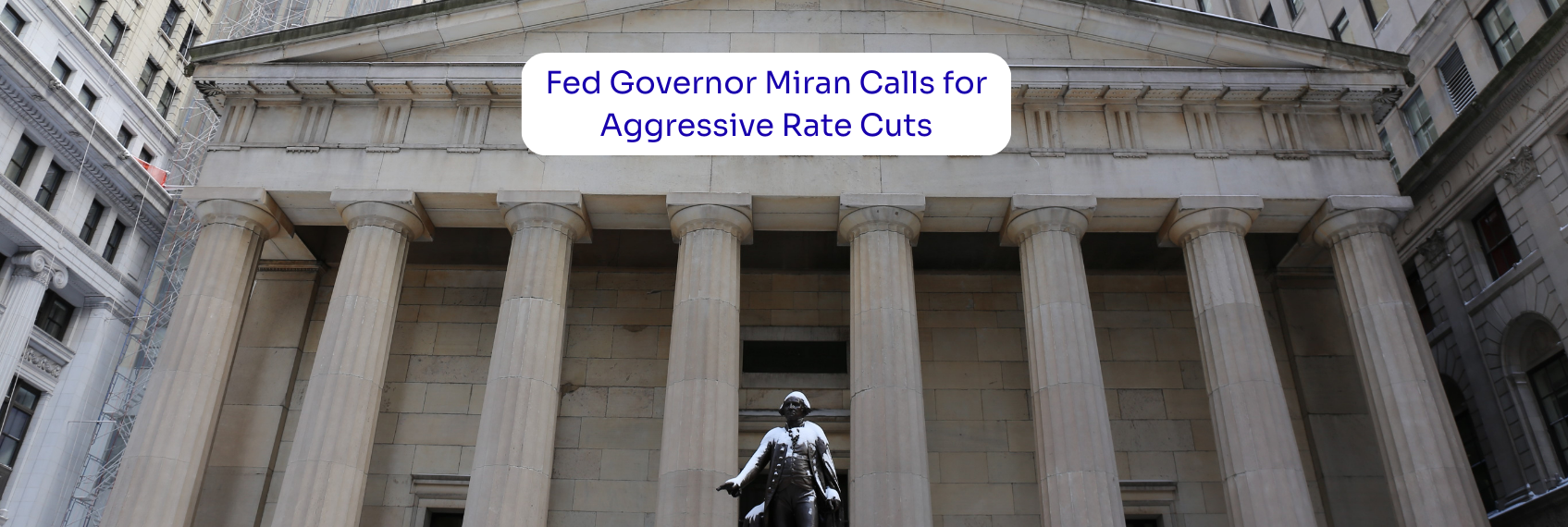
Federal Reserve Governor Stephen Miran delivered his first major policy speech on September 22, 2025, urging aggressive interest rate cuts and arguing that current policy is excessively restrictive, risking higher unemployment and economic slowdown.
Miran, a recent appointee by US President Donald Trump, stated that the Federal Reserve’s benchmark rate should be nearly two percentage points lower, pointing to recent changes in tax, immigration, and tariff policies as factors that have reduced the “neutral” interest rate—meaning the rate that neither stimulates nor restrains growth.
US Markets On Monday
US equities extended their winning streak on Monday, with all three key indexes closing at fresh record highs for the third straight session.
The Dow Jones Industrial Average rose 66.27 points, or 0.14%, to finish at 46,381.54. The S&P 500 advanced 29.39 points, or 0.44%, to 6,693.75, while the Nasdaq Composite climbed 157.50 points, or 0.70%, to settle at 22,788.98.
Stephen Miran Pushes for Steep Rate Cuts
Speaking to the Economic Club of New York, Miran argued that recent changes in tax policy, immigration rules, lower rental costs, deregulation, and new tariff revenues have created economic conditions that justify a nearly 2-percentage-point reduction in the federal funds rate.
“The Federal Reserve has been entrusted with the important goal of promoting price stability for the good of all American households and businesses, and I am committed to bringing inflation sustainably back to 2%,” Miran said. “However, leaving policy restrictive by such a large degree brings significant risks for the Fed’s employment mandate.”
Miran noted that these policy changes have effectively lowered the neutral interest rate—the rate at which monetary policy neither stimulates nor slows growth. Drawing on economic models like the Taylor Rule, he stated that the current stance of the Fed is far more restrictive than his colleagues on the FOMC generally perceive. He suggested that the federal funds rate should be around the low-2% range, whereas it currently stands at 4%-4.25% after last week’s quarter-point cut.
“The upshot is that monetary policy is well into restrictive territory,” Miran said. “Leaving short-term interest rates roughly 2 percentage points too tight risks unnecessary layoffs and higher unemployment.”
His perspective is out of step with the majority of the Federal Open Market Committee, which favours a more cautious approach and gradual rate reductions. At last week’s meeting, the FOMC voted 11-1 for a 0.25% cut, with Miran dissenting in favour of a 0.5% reduction and projecting further cuts totalling 1.25 percentage points this year.
Other Fed officials, including St. Louis Fed President Alberto Musalem and Atlanta Fed President Raphael Bostic, expressed reluctance to support additional rate reductions.
Miran cited falling inflation pressures in the housing market, easing rents, and other administration policies—such as tax cuts, deregulation, immigration restrictions, and tariff revenues—as factors that reduce inflation risks.
“Even though I am expecting growth to be a little better in the future, that could get derailed unnecessarily so and create an output gap where one need not exist if we don’t get policy closer to neutral.” he noted.
While other economists remain concerned that tariffs could push inflation higher over the long term, Miran argued that recent price increases are modest and should not cause undue alarm.
Miran will serve the remainder of the term ending January 31, 2026, after which he is expected to return as chair of the Council of Economic Advisers, referencing CEA research throughout his remarks.
Wall Street Awaits Powell Speech
Wall Street was seen turning rangebound (US Futures) before an address by Powell on Tuesday, with the Fed Chair likely to offer more insight into the central bank’s plans to cut interest rates.
Last week, the Federal Reserve lowered interest rates by 0.25% and intimated that it might cut rates at least two more times this year, citing weakness in the labour market. However, Fed Chair Powell warned that inflation is somewhat elevated.
On Monday, two Fed officials said the recent rate cut might be enough, while Stephen Miran disagreed and said rates should be lowered more.