Summary:
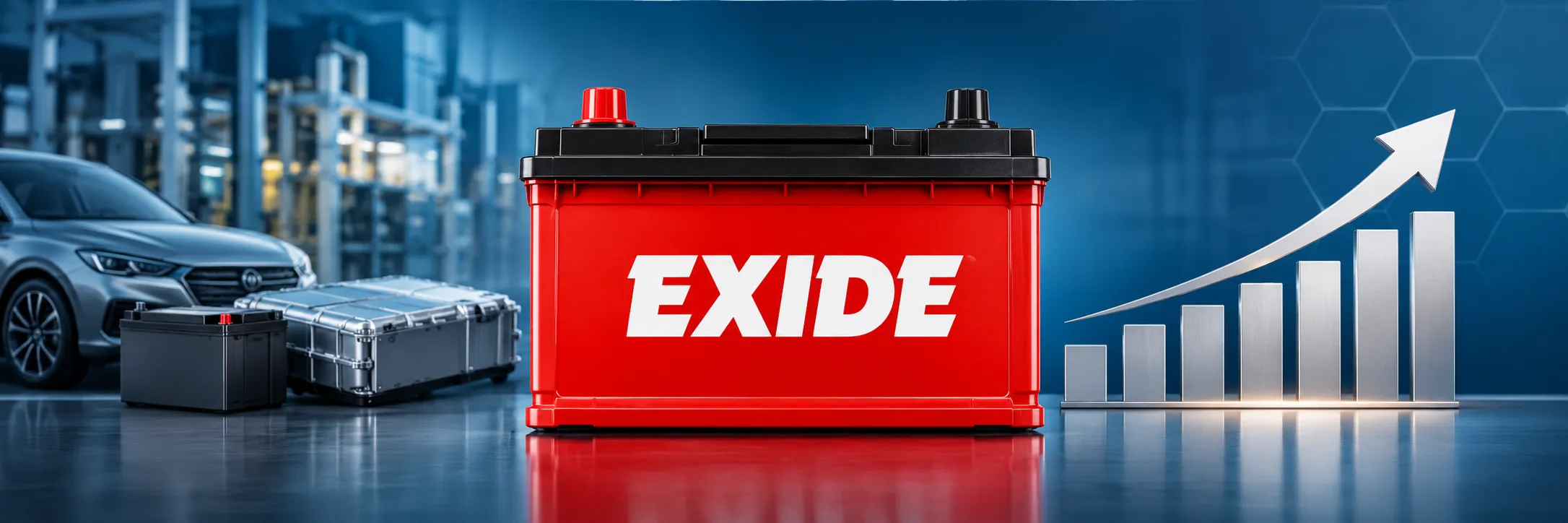
Exide Industries’ standalone Q2 FY27 profit rose 75.1% to ₹386 crore as revenue and EBITDA margins improved. Consolidated profit was ₹287 crore, while its lithium-ion subsidiary’s ramp-up remains uncertain. Customer approvals, yields, cash flow and valuation are key watchpoints ahead.
Key takeaways:
- Exide’s Q2 FY27 standalone PAT rose 75.1% to ₹386 crore, supported by 20.3% sales growth and a 270-basis-point EBITDA margin expansion.
- Consolidated PAT increased about 65% to ₹287 crore; the lithium-ion subsidiary recorded a ₹24.82 crore quarterly loss before consolidation adjustments.
- EESL commissioned its 6 GWh Bengaluru cell plant in September, but manufacturing yields, customer qualification and commercial scale remain key tests.
- Another ₹249.99 crore equity infusion lifted cumulative EESL investment to ₹5,602.23 crore as of 26 November 2026.
- A roughly 31x trailing P/E requires meaningful returns from new capacity; traders should watch consolidated cash flow and battery-cell sales progress.
Exide Industries’ Q2 FY27 standalone profit rose 75.1% year on year to ₹386 crore, helped by stronger sales and margins. Yet its lithium-ion subsidiary, Exide Energy Solutions (EESL), remains loss-making even after commissioning a 6 GWh battery-cell plant. For traders, the debate is whether a recovering traditional battery franchise can fund the next growth engine without prolonged pressure on consolidated profitability.
Exide Q2 FY27 Results: Core Battery Margins Improve
For the September quarter, standalone revenue grew 20.3% to ₹5,026 crore and EBITDA climbed 53.6% to ₹606 crore. EBITDA margin expanded 270 basis points to 12.1%, helped by volume growth, cost control and calibrated price increases despite elevated input costs. Automotive original-equipment business grew more than 25% for the fourth consecutive quarter, while replacement batteries, home inverters and solar applications also recorded healthy demand. The earnings improvement is therefore supported by operating performance rather than a single exceptional gain.
Exide Energy Solutions Losses Cloud Consolidated Earnings
Consolidated Q2 net profit was ₹287 crore, up about 65% year on year, notably below standalone profit of ₹386 crore. EESL recorded a ₹24.82 crore quarterly net loss before consolidation adjustments. Its 6 GWh Bengaluru lithium-ion cell gigafactory was commissioned on 23 September, but commissioning does not mean stable production yields or full customer utilisation. The company’s near-term task is to stabilise lines and complete customer qualifications before meaningful scale benefits can be judged.
₹5,602 Crore Battery Investment Raises the Returns Test
On 26 November, Exide invested another ₹249.99 crore in EESL through a rights subscription, lifting its cumulative equity investment to ₹5,602.23 crore. EESL reported an FY26 loss of ₹248.16 crore. These losses reflect a capital-intensive transition where plant depreciation, validation costs and initial capacity utilisation can weigh on returns. The parent’s debt-free standalone position offers financial flexibility, but investors need evidence of commercially qualified cells, customer orders, improved yields and operating cash flow before assuming the gigafactory will lift earnings.
Exide Share Valuation: Recovery Versus Execution Risk
Exide closed around ₹387 on 26 November, implying a market capitalisation near ₹32,900 crore and a trailing earnings multiple of approximately 31 times. That is not a valuation at which the lithium-ion investment can remain a distant promise indefinitely. Strong lead-acid battery profitability supports near-term earnings, but raw-material prices, competition and future capital needs remain risks. Any sustained rerating should be tied to battery-cell commercialisation and returns, not simply another equity infusion into EESL.
Analyst Takeaway
The core battery turnaround supports a constructive medium-term view, but the lithium-ion venture still needs to earn its cost of capital. For traders, a wait-and-watch stance is reasonable until stronger consolidated cash generation and evidence of customer qualification emerge. A profitable ramp-up could improve the investment case; persistent losses and further funding needs would limit upside.