Summary:
India’s 2026 capital gains tax rules vary by asset type, holding period and acquisition date. Equity gains may qualify for special rates and exemptions, while debt funds, gold, bonds and property follow distinct rules, including important transitional relief for eligible property owners.
Budget 2024 has brought a major change in the capital gains tax rules in India, which has impacted the taxation of investors’ gains from shares, mutual funds, bonds, gold and property. Short-term profits on shares are taxed at 20%, and long-term profits are normally taxed at 12.5%, depending on the circumstances and any reliefs that may be available.
The type of investment, holding period and purchase date for FY27 continue to be key distinctions. Some investments are given a special treatment whereas others are taxed at the investor’s applicable income-tax slab rate.
Mutual Funds & Equity Shares – What’s Changed?
In case of listed equity shares and equity-oriented mutual funds, any gains that are realised within a period of 12 months are treated as short term capital gains (STCG). They are taxable at 20% under Section 111A, provided the conditions of Securities Transaction Tax (STT) are met.
Long-term capital gains (LTCG) treatment applies to holdings exceeding 12 months. "If you make a profit of more than ₹1.25 lakh in a financial year, you will have to pay a tax of 12.5% on it. This is under Section 112A."
The exemption is on the total amount of eligible LTCG in a year and not on individual stock or fund.
For instance, if an investor has ₹2 lakh of eligible long-term equity gains, then the taxable gains would be ₹75,000. The basic tax liability at 12.5% would be ₹9,375, excluding applicable cess and surcharge.
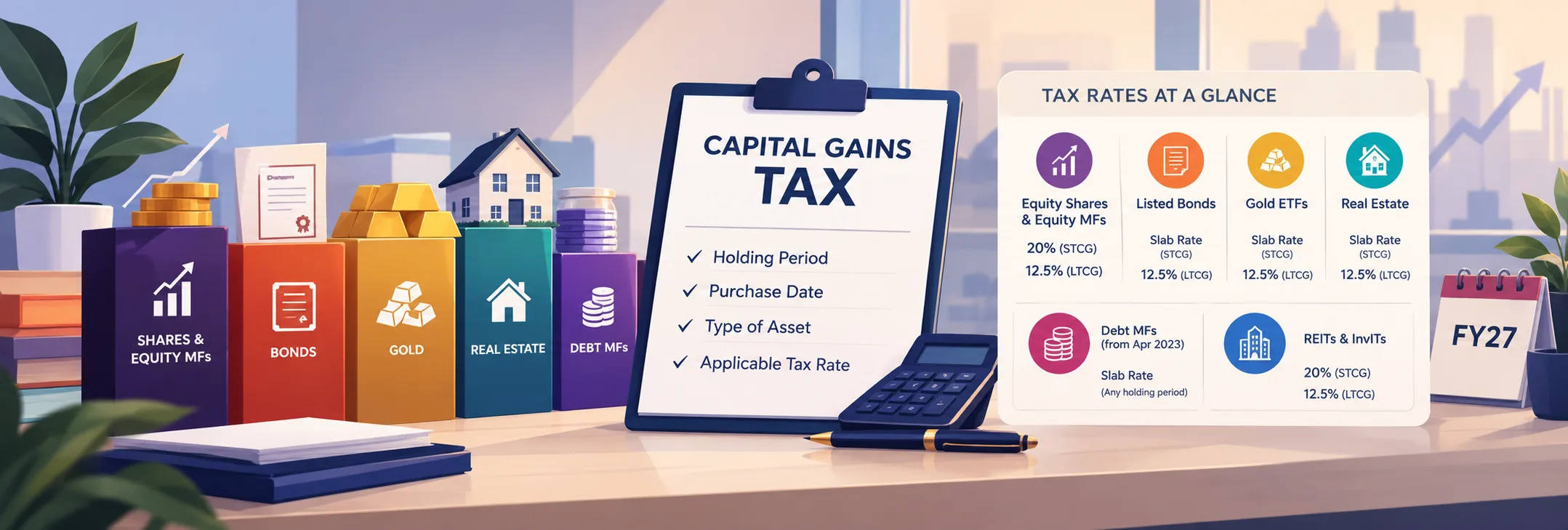
Capital Gains Tax Rate Comparison by Asset in 2026
The table below outlines the main tax treatment applicable to common investments.
| Asset category | LTCG holding period | STCG tax | LTCG tax |
| Listed equity shares & equity MFs | Over 12 months | 20%* | 12.5%* |
| Listed REITs & InvITs units | Over 12 months | 20%* | 12.5%* |
| Listed bonds | Over 12 months | Slab rate | 12.5% |
| Gold ETFs | Over 12 months | Slab rate | 12.5% |
| Physical gold | Over 24 months | Slab rate | 12.5% |
| Real estate | Over 24 months | Slab rate | 12.5%** |
| Specified debt MFs acquired from April 2023 | Not applicable | Slab rate | Not applicable |
*Subject to eligibility conditions including applicable STT. The ₹1.25 lakh annual LTCG exemption is for specified assets under Section 112A. Grandfathering relief may be available to eligible resident individuals and HUFs in respect of property acquired prior to 23rd July, 2024. Rates are exclusive of surcharge and cess.
Why Date of Purchase Matters: Gold & Debt Funds
The debt mutual funds need to be looked at.
Any specified mutual fund purchased on or after 1st April 2023 will be taxed as per the slab rates irrespective of the holding period.
From 1 April 2026, the definition of specified mutual funds will cover schemes that invest more than 65% in debt and money-market instruments and certain funds that invest in such schemes.
The new definition will make investors look at the actual asset allocation of a fund, rather than just its category name.
Older debt fund investments may be eligible for different treatment depending on the acquisition date and applicable provisions.
Gold is also treated specially. Listed gold ETFs generally qualify for LTCG tax after 12 months, while for physical gold it is over 24 months. Long term qualifying gains are taxed at 12.5% without indexation.
Real Estate Taxes: The Advantage of Grandfathering
Real estate still has the 24 month holding period.
If you sell the property after this period, you will have to pay LTCG tax @ 12.5% without indexation. However, resident individuals and Hindu undivided families selling property acquired before 23 July 2024 can compare with the earlier 20% tax calculation using indexation.
This protection may reduce the final tax liability if the older calculation leads to a lower amount.
So What Does This Mean for Investors?
The new rules don’t directly cause individual stocks to rise or fall, but they do affect returns after taxes.
However, if the gain is from equity or debt funds or property, then the ₹1 lakh gain can be treated differently for tax purposes. When calculating realized profits, holding periods, exemptions and purchase dates are important.
For investors with asset-class portfolios, the conclusion is simple: the same pre-tax return may not produce the same after-tax return.
The amount of profit investors actually retain on their realization is dependent on the nature of the asset and the capital gains provisions which apply.