Summary:
India and the US are nearing a bilateral trade agreement, with preferential tariffs for Indian exporters remaining a key demand. The proposed deal could improve India’s competitiveness in the US market, particularly for textiles, engineering goods, leather and manufacturing sectors.
India and the United States are on the verge of finalising a bilateral trade agreement (BTA) after the two countries begin to agree on certain terms, including a framework, which will give Indian exporters a tariff edge over other countries.
Commerce secretary Rajesh Agrawal said that there are hardly any issues, which are left to be addressed in the deal, as the agreement will be signed at an appropriate time when there is consensus among both parties. According to the proposed agreement, Indian exporters will have a preferential market access.
India has long stood by the argument that any trade deal with the US should offer a tariff advantage over their competitors like Vietnam, which is an important textile supplier, and others such as Bangladesh and Indonesia.
Commerce and Industry minister Piyush Goyal had last month said that India will finalise the deal with the US, once Washington offers preferential tariffs, which will give the exporters an edge. Talks on the trade deal had been held between Indian Commerce minister Piyush Goyal and US Secretary of Commerce Gina Raimondo.
India-Us Trade Talks Focus On Tariff Edge For Exporters
India-US trade deal: Key points covered
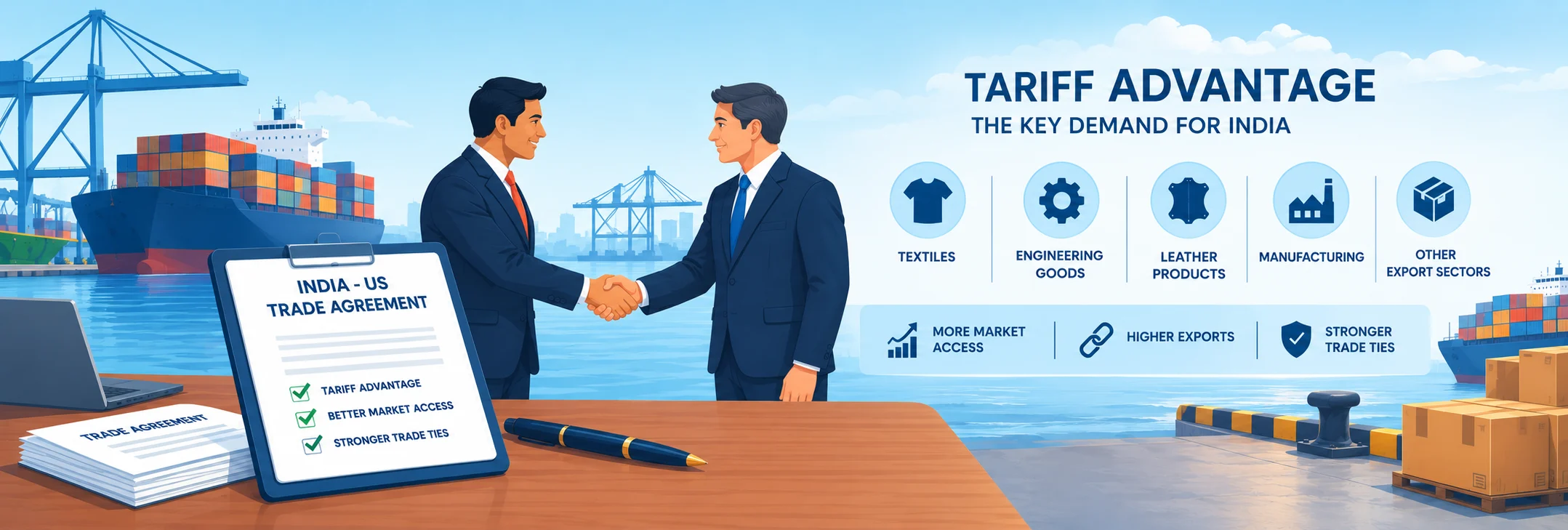
India’s main demand in the trade deal with the US is not only about lowering the tariffs, but also about giving Indian exporters preferential treatment as compared to other countries. A preferential tariff can work as a catalyst to boost textile exports, along with engineering goods, leather products, manufacturing, and other export-relevant sectors. US is one of India’s largest trading partners and a preferential trade deal could further enhance bilateral trade.
India-US trade talks focus on tariff edge for exporters
India and the US have already agreed to a framework for an interim agreement, and both countries are working towards a broader BTA, which covers more market access and cooperation on supply chains, apart from tariff reductions.
Exporter competitiveness
With a favourable tariff regime in place, Indian exporters could get a competitive edge in the US, which is a highly competitive market as compared to their counterparts in Vietnam, Bangladesh, and Indonesia. A preferential tariff agreement could help Indian manufacturers and exporters to gain market share, as lower tariffs make their products cheaper than those of their competitors.
Indian textile industry is facing a challenging situation as it contends with cheap imports from various developing nations. Therefore, Indian textiles could be one of the biggest beneficiaries of a preferential tariff agreement with the US. However, the benefits would accrue only if the textile sector is included in the deal, as there is a strong demand for Indian textiles.
Besides goods trade, services, investment, and other items that could contribute to bilateral trade, are also on the agenda of the negotiations.
What Could Delay The India-Us Trade Deal?
While discussions are ongoing, tariffs remain the main negotiating issue between the two countries. India seeks an assurance that the agreement will give them an advantage over trade partners, rather than just reducing tariffs. The government is seeking to balance exports on the one hand and protectionism against certain imports, which are vital for the domestic economy. On the other hand, tariff reductions and market access would help the export sector. Other issues that need to be ironed out before announcing the deal include market access, regulations, and issues, specific to certain sectors.