Summary:
India is increasing purchases of Venezuelan crude oil as refiners diversify supplies amid changing Russian oil economics. Reliance Industries could benefit from discounted heavy crude, although higher shipping costs, refinery compatibility and geopolitical uncertainties may limit further import growth.
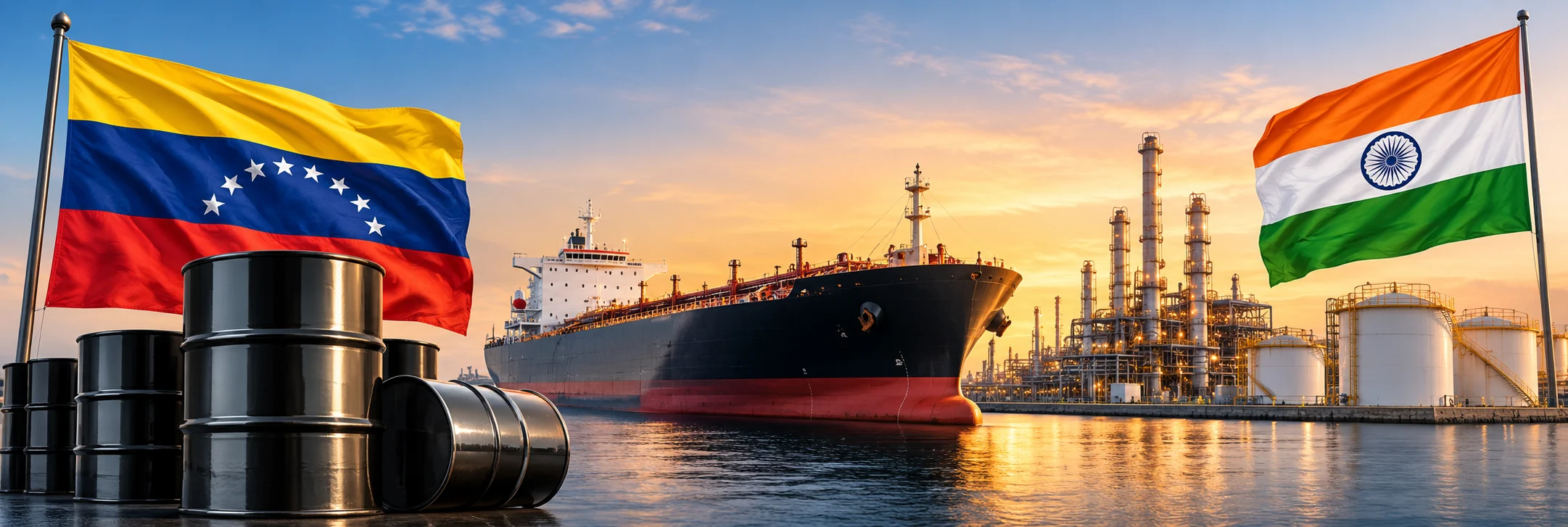
India’s crude oil imports from Venezuela could rise as Indian refiners diversify their purchases following changes in Russian oil pricing and international trade restrictions.
India has already stepped up its purchases of Venezuelan crude for 2026, with shipments recovering after a long period of limited trade. But higher freight costs, refinery compatibility and competition from other suppliers could limit further growth.
Why Is India Importing More Oil From Venezuela?
India is one of the world's largest importers of crude oil and relies heavily on imports to meet domestic petroleum demand.
The country imports crude from various regions such as West Asia, Russia, Africa and South America.
Discounted prices made Russian oil supplies commercially attractive for India and thus became an important part of its import basket after 2022.
But the pricing advantage has been eroding during 2026.
Changes in international sanctions, stronger competition for Russian cargoes and higher freight rates have influenced purchasing decisions.
Some Venezuelan crude grades are being offered at competitive prices and thus it has become an alternative.
Earlier this year, India restarted buys which led to a surge in import volumes.
The diversification gives refiners more options for sourcing, especially if conditions affecting supply in other regions change.
India is buying how much of Venezuela oil?
India’s imports of Venezuelan crude have risen substantially since January 2026.
Purchases were around 345,000 bpd on average in July, according to trade-based estimates, and then fluctuated in the following months.
September shipments were pegged at around 1,96,000 barrels a day, while October deliveries were initially forecast to exceed 3,50,000 barrels a day.
The estimates differ based on shipment tracking, arrival schedules and reporting methods.
India’s crude imports hit record 5.54 mn barrels per day in October 2026
| Import indicator | Reported Amount |
| Total imports of crude, October 2026 | 5.54 mln barrels/day |
| September Imports of Venezuela | ~1.96,000 bbl/day |
| Oct Venezuelan deliveries estimate revised down | ~350,000 bbls/day |
| Russian crude imports, Oct 4 | ~2.1 mb/d |
The figures show Venezuela is still a relatively small supplier compared with Russia and West Asian producers.
Which Indian Companies Will Benefit?
Reliance Industries (NSE: RELIANCE) runs the Jamnagar refining complex that is technically capable of processing heavier and higher-sulphur crude grades.
Venezuelan Merey crude is an example of this.
The company’s refinery configuration permits it to process more complex crude oil, making it a big buyer of Venezuelan supplies.
Other Indian refiners like Indian Oil Corporation (NSE: IOC) and Hindustan Petroleum Corporation (NSE: HINDPETRO) also have exposure to imported crude markets.
But not all refineries can process large volumes of heavy Venezuelan oil without operational constraints.
The economics of refining are a function of the price of crude delivered, the cost of processing, the yields of products, and the international fuel margins.
What next?
But if it wants to boost its market share in India, Venezuela will have to price competitively and have reliable shipping arrangements.
Longer voyages from South America also add to freight and insurance costs compared to crude from nearby West Asian countries.
Changes to US sanctions and international trading arrangements may also impact cargo availability.
Diversified sourcing of crude can reduce dependence on individual suppliers and give India flexibility during global disruptions.
But lower purchase prices do not necessarily mean higher profits from refining.
The final effect is determined by landed costs, refinery efficiency and petroleum product prices.
India’s import mix will change with the global crude markets, freight rates and geopolitical conditions.