Summary:
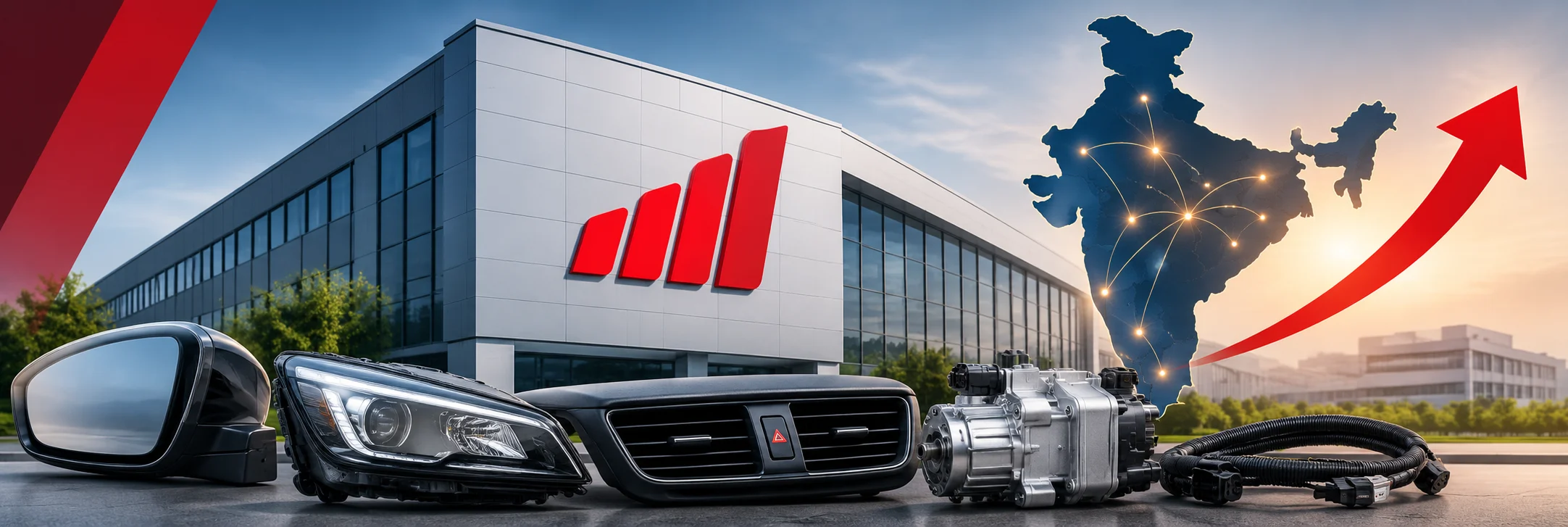
Samvardhana Motherson is strengthening its India focus by leveraging global technology and manufacturing capabilities to tap rising demand for advanced automotive components. The company targets $108 billion gross revenue by FY30 under Vision 2030, supported by record orders, capacity expansion and diversification.
Samvardhana Motherson International (NSE: MOTHERSON) is leveraging technology developed through its global operations and acquisitions to expand its focus on India’s auto market.
The company’s strategy is aligned with its Vision 2030 plan, targeting $108 bn gross revenue by FY30. The requirements of rising vehicle technology combined with growing demand for high-end automobile components and tough emission standards have created opportunities in the domestic market.
Why is Motherson focusing more on India?
India’s automobile manufacturing industry is evolving as manufacturers are adopting more advanced electrical systems, electronics and emission-control technologies.
The ever more sophisticated components required by passenger cars, commercial vehicles and electric vehicles.
Motherson deals in various categories of automotive components like wiring systems, vision systems, modules and other engineered products.
In the course of the years, its international acquisitions have broadened its technology portfolio and manufacturing capabilities.
Now the company plans to use these capabilities to serve customers in India.
This may assist indigenous car manufacturers in sourcing more sophisticated parts from within the country.
Tougher emission rules and stricter vehicle safety standards are also raising the technological requirements of suppliers.
But increasing domestic operations will require more investment in manufacturing, product development and customer partnerships.
Q2FY27 Financial Results
Motherson posted its highest-ever quarterly consolidated revenue in the September 2026 quarter.
Revenue grew 27% YoY to ₹38,280 crore, driven by contributions from its international and domestic businesses.
The consolidated EBITDA was ₹3,353 crore and normalised profit after tax was ₹1,175 crore.
| Financial measure | Q2FY27E |
| Consolidated revenues | ₹38,280 crore |
| revenue increase | +27% year-over-year |
| EBITDA | 3,353 crore |
| Normalised PAT | 1.175 crore |
| H1 FY27 revenue | ₹73,524 crore |
| Reserved commercial | $106 billion |
The company’s booked business was a record $106 bn, indicating a strong pipeline of customer programs.
Capital Expenditure: H1FY27 capital expenditure was ₹3,585 crore.
Motherson has planned capital expenditure of around ₹6,000 crore for FY27, subject to a variation of 10%.
It had a leverage ratio of 0.8 times, indicating a relatively moderate amount of debt compared with its operating earnings.
Growth in Automotive & Other Industries
Motherson’s long-term strategy also involves diversification away from auto components.
The company has branched out into aerospace, defence, consumer electronics and other manufacturing categories.
Its aerospace business grew more than 20% YoY in Q2FY27.
The company also announced that it has acquired Rotary Connectors in India, expanding its capabilities for aerospace and defence-related applications.
Expansion of manufacturing is a priority too.
One new facility was commissioned in Q2FY27, and five more expansions were announced.
Seventeen facilities were in various stages of development.
These investments could lead to increased production capacity and new customer programs, but financial benefits will depend on execution and demand.
Motherson: What to Expect?
Vision 2030 aims to generate gross revenues of $108 bn and achieve a group return on capital employed of 40%. It intends to distribute dividends equivalent to up to 40% of consolidated profit.
The company also plans to diversify its dependence away from individual customers, countries and categories of components.
But its global footprint makes it vulnerable to currency fluctuations, international demand for cars and the costs of manufacturing.
Trends in automobile production in Europe, North America and Asia will remain important.
Its India operations see opportunities in the space of localised manufacturing, advanced technologies and evolving vehicle requirements.
The growth of Motherson will depend on its ability to convert its huge order pipeline into profitable revenue and keep a lid on costs across its global operations.