Summary
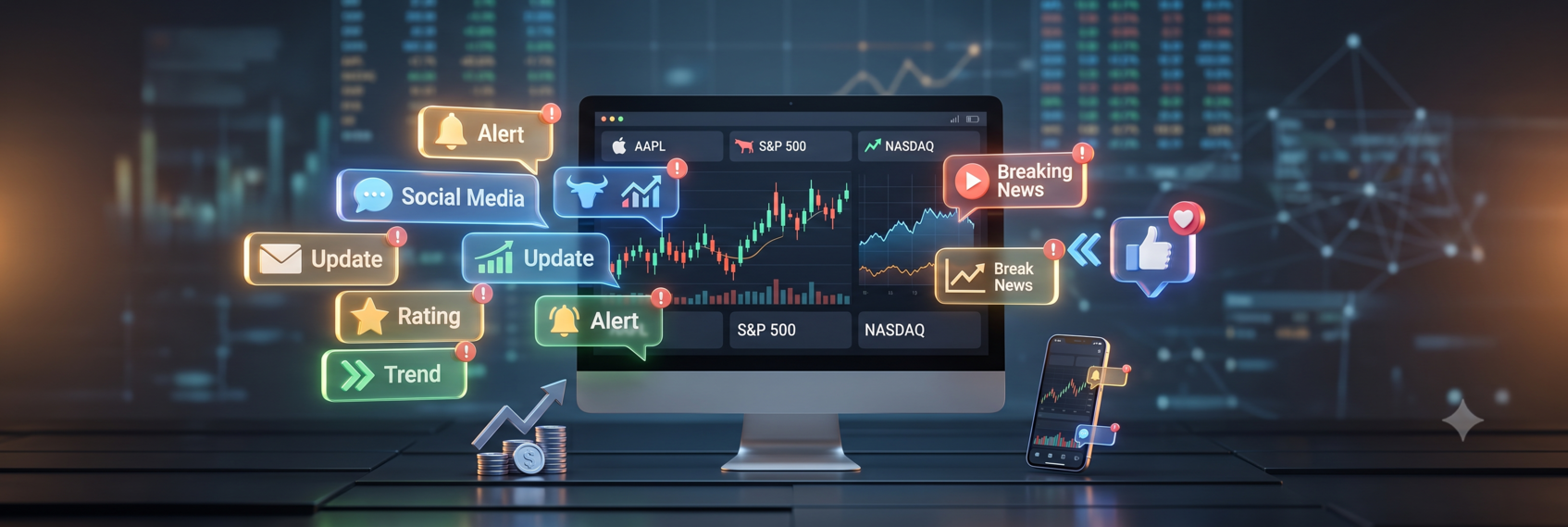
Push notifications, price alerts, and social media feeds have become a constant presence in how retail investors experience markets. It has become necessary to examine how attention-driven design shapes investment behaviour, where it helps investors stay informed, and where it nudges them toward reactive decisions that may not serve their actual goals.
Introduction
A price alert buzzes. A stock is trending on a finance forum. A notification says a portfolio has moved by a certain percentage today. None of this existed in the same form a decade ago, and all of it now competes for a retail investor's attention multiple times a day.
The question worth asking is not whether this attention economy exists. It clearly does. The question worth asking is whether it is actually improving investment decisions or just increasing the frequency with which people check and react to markets.
How investing became part of the attention economy
| Source | What it delivers |
| App push notifications | Price movements, portfolio value changes, market news |
| Price and volume alerts | User-set triggers for specific stocks or indices |
| Social media and forums | Opinions, trending stocks, screenshots of gains |
| Finance influencers | Commentary, predictions, and simplified explanations |
Each of these was designed, at least in part, to bring users back to an app or platform more frequently. That is not unique to finance. It is the same engagement logic used across most consumer apps, applied to a domain where frequent checking is not always in the user's interest.
Where this genuinely helps
- Faster access to relevant information: An investor holding a stock can learn about material news, earnings, regulatory action, faster than waiting for a newspaper or evening broadcast
- Custom alerts for specific goals: Someone waiting for a particular price level to buy or sell can automate that instead of manually checking throughout the day
- Lower barrier to financial literacy: Social media has genuinely introduced investing concepts to people who would not have encountered them through traditional channels
Used deliberately, these tools reduce the effort required to stay informed about specific positions or goals.
Where it tends to work against investors
- Reactive decision-making: A notification about a sharp price drop can trigger a sell decision made in seconds, without the context a more deliberate review would provide
- Recency bias amplification: Constant exposure to short-term price movements makes it harder to hold a long-term view, since every dip or spike feels immediately significant
- Social proof over research: A stock trending on social media can influence buying decisions more than the underlying business fundamentals warrant
- FOMO-driven entries: Screenshots of large gains circulate far more than losses do, creating a skewed sense of how common quick profits actually are
The common thread here is that attention-driven tools compress the time between seeing information and acting on it, often at the cost of the reflection that better decisions usually require.
The gap between staying informed and staying reactive
There is a meaningful difference between an investor who checks a monthly SIP statement and adjusts allocation once a year and one who checks portfolio value five times a day and makes decisions based on short-term swings. Both are "informed", but only one is arguably making decisions aligned with a long-term goal.
Notifications and alerts are not inherently the problem. The issue is when the frequency of exposure to market information outpaces the frequency at which meaningful decisions actually need to be made.
What more deliberate engagement could look like
| Reactive pattern | More deliberate alternative |
| Checking portfolio value multiple times a day | Reviewing at fixed intervals, monthly or quarterly |
| Acting on every price alert immediately | Using alerts as a prompt to review, not an instruction to act |
| Following social media sentiment for stock picks | Treating social content as one input, not the primary basis for decisions |
| Reacting to single-day volatility | Anchoring decisions to a pre-set investment plan or goal |
None of this requires abandoning digital tools. It requires using them with more intention than they are typically designed to encourage.
Conclusion
Notifications, alerts, and social media have not replaced investment research, but they have changed the rhythm at which investors are prompted to engage with markets. That rhythm often favours frequency over reflection, which is not necessarily aligned with what long-term investing actually requires.
The tools themselves are not the issue. How deliberately they are used is what determines whether they support better decisions or simply produce more of them.