Summary:
Large-cap, mid-cap and small-cap stocks offer different risk-return profiles for 2027. While mid-caps have delivered stronger five-year returns, large-caps offer lower volatility and valuations. Investors should consider market conditions, risk appetite and diversification before allocating their equity portfolios.
After months of selling, foreign institutional investors (FIIs) have made a strong comeback to Indian equities in November 2026. Large-cap stocks have attracted renewed buying interest, bringing portfolio allocation back into focus as investors prepare for 2027.
While mid-cap and small-cap stocks have delivered superior returns over the past five years, large-cap stocks offer relatively lower volatility. But which segment offers a better balance between risk and growth?
Why Large-Cap Stocks Benefit From Returning FII Inflows
Foreign investors have returned to Dalal Street in a big way. According to data from the National Securities Depository Limited (NSDL), foreign investors poured approximately ₹1.42 lakh crore into Indian equities through November 24, 2026.
Banking and financial services stocks attracted ₹43,102 crore in foreign investment during the first half of November alone.
Large-cap companies are often the immediate beneficiaries of institutional buying because of their higher trading liquidity, established business models and substantial representation in domestic and global benchmark indices.
Liquidity allows institutional investors to execute large transactions without significantly affecting stock prices. Smaller companies generally have lower trading volumes, making it relatively difficult for large funds to build or exit substantial positions.
However, sustained foreign inflows could eventually support buying interest across mid-cap and small-cap companies as well.
Large-Cap vs Mid-Cap vs Small-Cap: Five-Year Return Comparison
Historical performance highlights the different risk and return characteristics of the three market-cap segments.
According to the NSE Indices dashboard dated October 31, 2026, mid-cap stocks have generated the highest annualised returns over the past five years, while large-cap stocks have recorded the lowest volatility over the past year.
| Particulars | Nifty 100 | Nifty Midcap 150 | Nifty Smallcap 250 |
| 1-Year Return | -8.18% | -3.90% | -2.61% |
| 3-Year CAGR | 9.17% | 13.73% | 12.39% |
| 5-Year CAGR | 7.22% | 13.84% | 13.11% |
| 1-Year Volatility | 14.17% | 16.75% | 18.14% |
| P/E Ratio | 18.87x | 26.27x | 31.28x |
| P/B Ratio | 2.90x | 3.69x | 3.23x |
| Dividend Yield | 1.43% | 1.03% | 0.78% |
Source: NSE Indices, October 31, 2026. Returns are based on Total Return Indices (TRI).
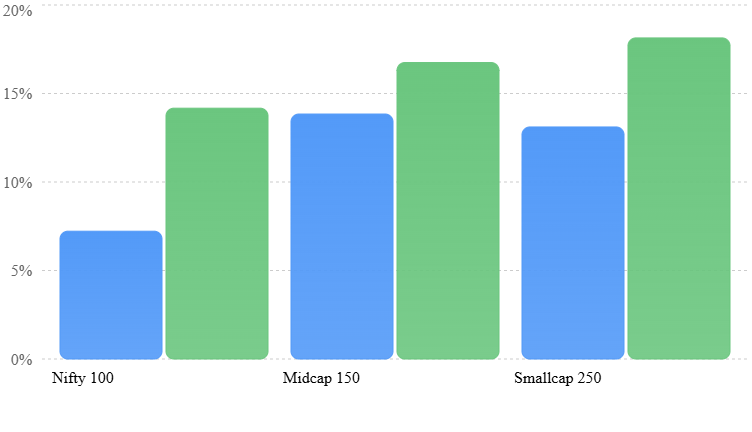
■ 5-Year CAGR
■ 1-Year Volatility
Large-cap stocks were also trading at relatively lower valuations at the end of October. Small-cap stocks commanded a substantially higher P/E multiple, making future earnings growth particularly important in justifying their valuations.
Understanding the Risk of Market Corrections
Higher historical returns do not necessarily make smaller companies a better investment across every market cycle.
Data from the NSE's Nifty 500 whitepaper illustrates how different market-cap segments performed during previous periods of weakness.
| Calendar Year | Nifty 100 | Nifty Midcap 150 | Nifty Smallcap 250 |
| 2008 | -53.07% | -64.94% | -68.58% |
| 2011 | -24.93% | -31.01% | -35.07% |
| 2018 | +2.56% | -12.62% | -26.15% |
| 2022 | +4.94% | +3.91% | -2.64% |
Source: NSE Indices, Nifty 500 Whitepaper 2025.
The figures demonstrate how mid-cap and small-cap stocks can experience deeper losses during unfavourable market conditions. For instance, recovering from a 50% decline requires a subsequent gain of 100%.
Investors must therefore consider their ability to withstand temporary losses rather than focusing exclusively on historical returns.
Portfolio Allocation Strategy for 2027
Instead of concentrating investments in a single market-cap segment, investors can build a diversified equity portfolio based on their risk appetite and investment horizon.
The following are illustrative equity allocation scenarios for different investor profiles.
| Investor Profile | Large-Cap | Mid-Cap | Small-Cap |
| Relatively Conservative | 75% | 20% | 5% |
| Moderate | 60% | 25% | 15% |
| Aggressive | 40% | 35% | 25% |
| High Risk | 30% | 40% | 30% |
Large-cap stocks can provide relative stability, while mid-cap companies offer exposure to expanding businesses. Small-cap stocks offer long-term growth opportunities but carry greater liquidity and valuation risks.
These allocations apply only to the equity portion of a portfolio and are not personalised investment recommendations.
Heading into 2027, sustained FII inflows, corporate earnings, interest rates and prevailing valuations will influence market performance. Rather than trying to identify a single winning market-cap segment, a disciplined allocation strategy can help investors balance growth opportunities with downside risks.