Successful stock market trading demands a deep understanding of price fluctuations, market trends, and technical indicators. One such powerful tool is the Displaced Moving Average (DMA), which plays a crucial role in identifying trends and smoothing price fluctuations.
But what is DMA in the stock market, and how does it help traders make informed decisions? This blog will cover DMA's full form in trading, how it differs from other moving averages, and its significance in stock market analysis. Read on to learn how to integrate DMA into your trading strategy for more efficient transactions.
What is DMA in the share market?
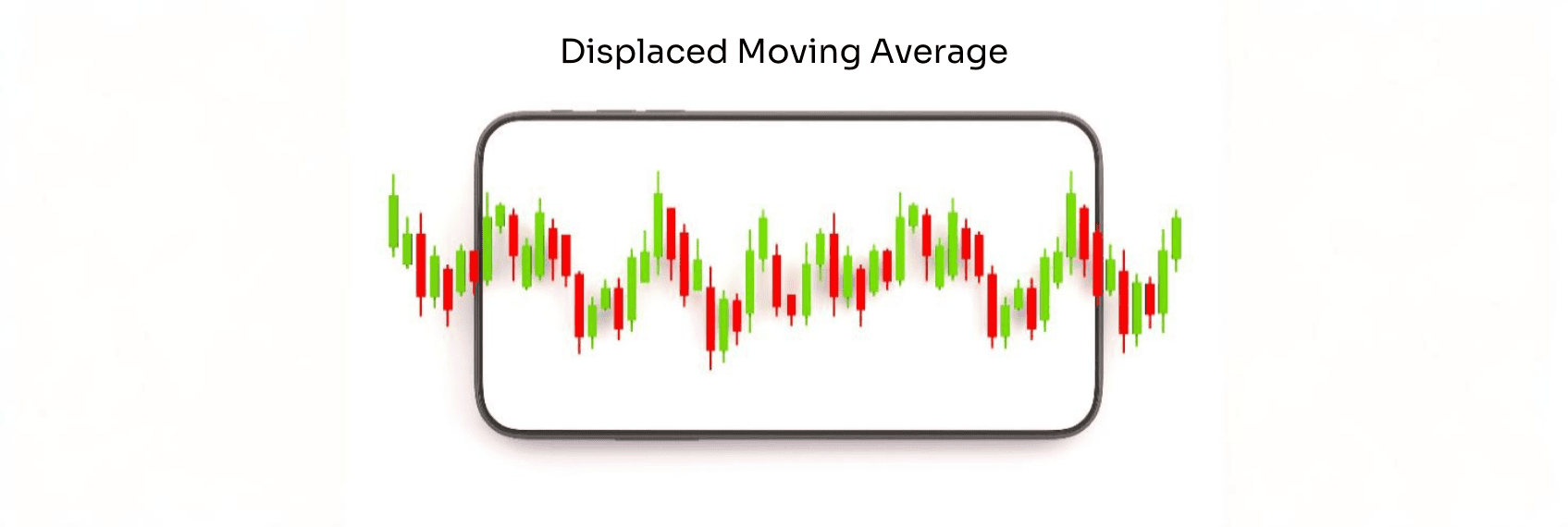
DMA is a technical analysis tool that allows traders to identify market trends by plotting an average of past closing prices at a specified displacement. Unlike a standard moving average, which aligns with the current price, DMA in stocks is shifted backwards by a specific number of bars, creating a lag effect.
For example, a 15-day DMA takes the average of the last 15 closing prices and plots it 15 bars back, providing insights into price momentum. This time lag makes DMA valuable in identifying support and resistance levels, allowing traders to plan their entries and exits strategically. When used on an online trading platform, DMA helps traders analyse trends efficiently, improving decision-making for better trade execution.
Why is DMA used in the stock market?
DMA in the stock market serves as a useful indicator for trend analysis, offering the following advantages:
- Trend identification: DMA helps traders understand whether the market is in an uptrend or downtrend by comparing price action with displaced averages.
- Support and resistance levels: If the DMA is above the price, it signals resistance, while being below the price suggests a support level.
- Smoother price data: By displacing the moving average, DMA reduces short-term fluctuations, allowing traders to focus on the broader trend.
- Enhanced trading strategies: When used with other technical indicators, DMA helps confirm signals, reducing the chances of false trades.
However, while DMA in the share market is valuable, traders must use it alongside other tools to avoid misleading signals.
How does DMA work in the stock market?
DMA is calculated by taking the average of a set number of closing prices and shifting it back by a predetermined number of bars. The time lag introduced by this displacement allows traders to:
- Recognise market trends: When the price is above the DMA, it indicates an uptrend, whereas prices below the DMA signal a downtrend.
- Determine entry and exit points: Traders frequently rely on DMA crossovers with other moving averages or price patterns to validate trade opportunities.
- Filter out short-term noise: The displacement helps smooth price action, making it easier to spot significant trends.
By understanding what DMA is in the stock market, investors can integrate it into their technical analysis for better decision-making.
What does DMA tell you about stock market trends?
Traders rely on DMA to gain key insights into market conditions. Here's what it tells you:
- Market trend direction
- When the price moves above the DMA, it indicates an uptrend, suggesting a buying opportunity.
- If the price falls below the DMA, it signals a downtrend, advising caution or selling.
- Support and resistance levels
- DMA as support: If prices repeatedly bounce off the DMA without breaking below, it suggests strong support.
- DMA as resistance: If prices fail to cross above the DMA, it acts as a resistance level, indicating potential selling pressure.
- Trading momentum
A widening gap between price and DMA suggests strong momentum, while a narrowing gap may indicate consolidation or trend reversal.
What are the limitations of DMA in the stock market?
Despite its advantages, DMA in the share market comes with certain limitations:
- Time lag
Since DMA is plotted backwards, signals may arrive late, making it less effective for short-term trading.
- Limited use in volatile markets
In highly volatile markets, DMA may not effectively reduce noise, causing it to miss significant price moves.
- Not a standalone indicator
Relying solely on DMA can lead to misinterpretations. It should always be used with other indicators like volume analysis or candlestick patterns.
- Prone to whipsaws in sideways markets
When prices trade within a narrow range, DMA may generate misleading signals, resulting in unnecessary trades.
- Sensitivity to outliers
Extreme price movements can distort the DMA, leading to inaccurate trend assessments.
How can you use DMA effectively in stock trading?
To maximise the effectiveness of DMA in the stock market, consider these best practices:
- Understand its time lag before applying it to short-term trades.
- Choose the right displacement value based on market conditions.
- Combine DMA with other indicators like RSI or MACD for a comprehensive analysis.
- Confirm signals with price action before making trading decisions.
- Avoid over-optimising settings just to fit historical data.
- Use risk management strategies like stop-loss and position sizing to protect capital.
- Backtest DMA strategies using historical data before applying them in real trades.
- Stay objective and avoid emotional trading based on DMA signals alone.
By following these steps, investors can use DMA in the share market effectively, improving their decision-making and optimising trade execution.
Enhance your trading strategy with DMA
Gaining insight into DMA in the stock market and its functionality can significantly benefit traders aiming to improve their technical analysis. DMA in stocks serves as a valuable tool for identifying trends, support, and resistance levels. However, it is most effective when used with other indicators and proper risk management.
If you're looking to invest in stocks with a more strategic approach, consider integrating DMA in your trading strategy and explore how it can enhance your investment decisions.
Disclaimer:
- The blog is for information purposes only and anything mentioned herein shouldn’t be construed as a fundamental reason to buy/hold/sell any stock. Furthermore, the information provided in the blog and observations made therefrom shouldn’t be treated as the extension of recommendations made on the other properties of Ventura Securities. If you follow any research recommendations made by our fundamental or technical experts, you should also read associated risk factors and disclaimers.
- We strongly suggest you to consult your financial advisor before taking any decision pertaining to your finances. Asset allocation becomes extremely relevant.
- We, Ventura Securities Ltd, (SEBI Registration Number INH000001634) its Analysts & Associates with regard to blog article hereby solemnly declare & disclose that:
- We do not have any financial interest of any nature in the company. We do not individually or collectively hold 1% or more of the securities of the company. We do not have any other material conflict of interest in the company. We do not act as a market maker in securities of the company. We do not have any directorships or other material relationships with the company.
- We do not have any personal interests in the securities of the company. We do not have any past significant relationships with the company such as Investment Banking or other advisory assignments or intermediary relationships. We are not responsible for the risk associated with the investment/disinvestment decision made on the basis of this blog article.