Summary:
China's AI stock sell-off has wiped out trillions in market value, raising concerns about global technology valuations. Indian AI-linked stocks, including Sterlite Technologies, HFCL and E2E Networks, have corrected sharply, while foreign inflows and domestic earnings offer broader market support.
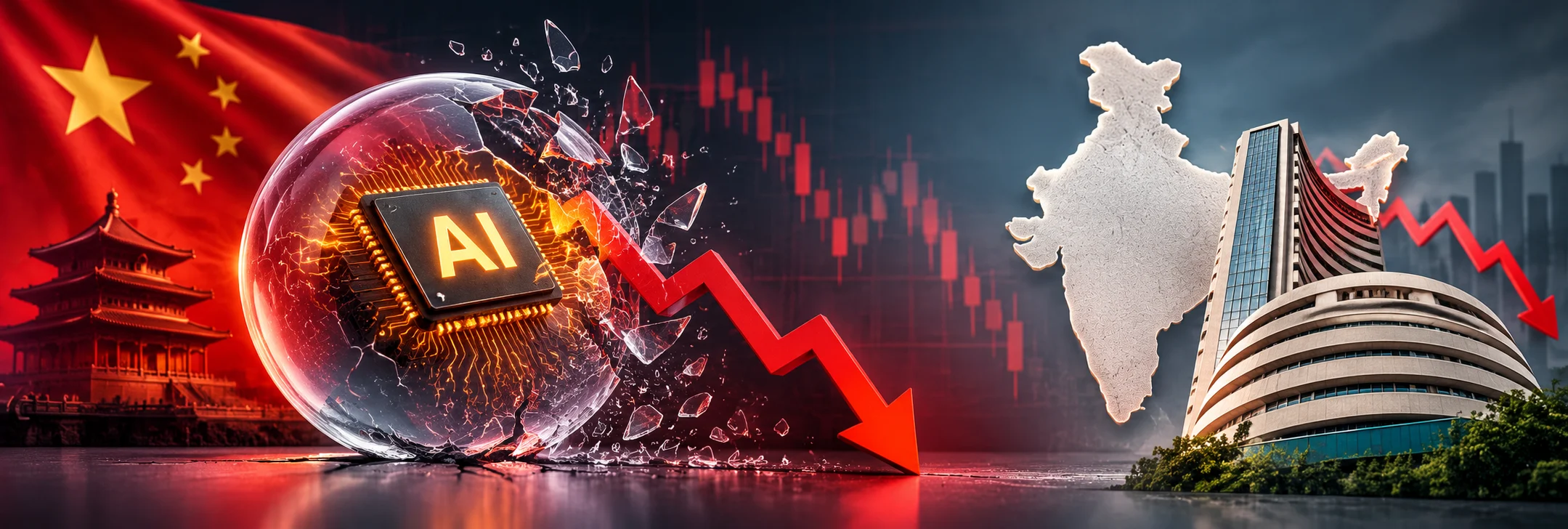
China's artificial intelligence (AI) boom has suffered a sharp reversal, wiping out billions of dollars in market value. The sell-off has now spread across global technology stocks, raising an important question: could India's stock market face a similar correction?
What Happened to China's AI Bubble?
China's AI and semiconductor stocks were among the biggest beneficiaries of the technology rally earlier this year. However, rising valuations, doubts over future earnings and tighter US technology restrictions have triggered heavy selling.
By October 2026, China's STAR 50 index had declined nearly 40% in less than four months, erasing approximately $480 bn in market capitalisation.
The correction has since deepened. By November 22, three major Chinese technology-focused indices had collectively lost around $1.7 trillion in market value since June.
Several companies experienced particularly sharp declines. Optical component manufacturers Zhongji Innolight and Eoptolink Technology had fallen around 60% from their respective peaks by late October.
The correction reflects growing concerns about whether AI companies can generate enough revenue and profits to justify their expensive valuations.
Why Did Chinese AI Stocks Fall?
The sell-off was driven by several developments.
High valuations: China's STAR 50 index was trading at nearly 250 times trailing earnings at its peak. Even after the initial correction, its valuation remained close to 100 times earnings.
US restrictions: Fresh American measures have limited Chinese companies' access to advanced AI chips and overseas computing infrastructure, creating uncertainty around future expansion.
Rising investment costs: Developing AI models requires enormous spending on chips, electricity, servers and data centres. Recovering these investments through commercial revenue remains a challenge.
Slowing growth expectations: Alibaba has indicated that its cloud revenue growth could moderate to 30–45% next year, compared with 53% in its latest reported quarter.
These developments have weakened confidence across the Chinese technology sector.
Has the AI Sell-Off Reached Indian Stocks?
The impact is already visible.
Indian companies connected to global AI infrastructure, optical fibre networks and data centres have experienced significant corrections.
Exchange data covering the month ended November 18, 2026, showed:
| Company | One-month share price change |
| Sterlite Technologies (NSE: STLTECH) | -27% |
| HFCL (NSE: HFCL) | -29% |
| E2E Networks (NSE: E2E) | -24% |
| MTAR Technologies (NSE: MTARTECH) | -17% |
| Netweb Technologies (NSE: NETWEB) | -11% |
The decline reflects fears that slower global AI spending could affect future orders and earnings growth.
For example, Sterlite Technologies' order book had expanded to approximately ₹35,274 crore, supported by demand from large technology and data-centre customers. Any slowdown in their capital expenditure could influence future business opportunities.
Will India's Broader Stock Market Be Affected?
India's exposure differs from China's because its benchmark indices have comparatively fewer companies directly dependent on AI infrastructure spending.
In fact, foreign investors have been shifting capital towards Indian equities as global technology stocks weaken.
Foreign investment inflows reached approximately $13 bn during November 2026, supporting a four-week rally in domestic equities.
However, volatility remains. On November 23, the Nifty 50 fell 0.65% to 25,636 around 10:16 AM IST, while the Sensex declined 0.61% to 83,417.69, mainly due to profit booking in financial stocks.
Conclusion
China's AI correction demonstrates how quickly expensive technology stocks can fall when earnings expectations weaken. India has already experienced selling in several AI-linked companies, although its broader market remains supported by domestic earnings and foreign capital inflows.
The key developments ahead are global AI spending, corporate profitability, data-centre expansion and technology restrictions. Their direction will help determine whether the correction remains concentrated in technology stocks or spreads further across Indian equities.