Summary:
The government is reportedly considering reducing its stakes in Central Bank of India, UCO Bank, Indian Overseas Bank and Punjab & Sind Bank to meet minimum public shareholding norms. Potential OFS or QIP transactions could affect public ownership, liquidity and prices.
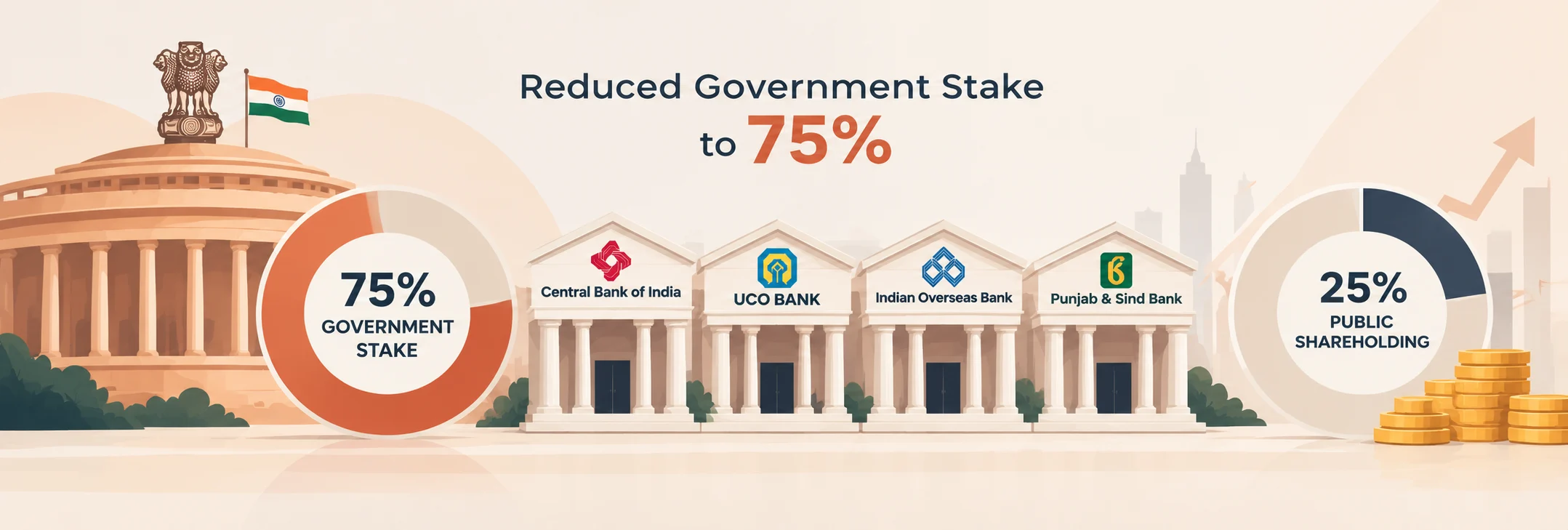
The Central Government is reportedly looking to reduce its shareholding in four public sector banks (PSU banks) to 75% to meet minimum public shareholding requirements. The banks under consideration are Central Bank of India, UCO Bank, Indian Overseas Bank and Punjab & Sind Bank. The move comes as the government is also weighing further consolidation and privatisation in the banking sector.
What Are the Four PSU Banks Being Considered?
The proposed stake reduction aims to increase public ownership in banks where the government's shareholding remains above the permitted 75% level.
The four lenders are Central Bank of India, UCO Bank, Indian Overseas Bank and Punjab & Sind Bank.
The latest available government shareholding levels, as of September 2026, are:
| PSU Bank | Government Stake |
| Central Bank of India | 81.19% |
| UCO Bank | 90.95% |
| Indian Overseas Bank | Above 75% |
| Punjab & Sind Bank | 93.85%* |
Punjab & Sind Bank figure is based on the latest individually verified holding available in the reviewed information.
Meanwhile, these banks require further dilution to meet the minimum public shareholding requirement of 25%. Central Bank of India has already reduced government ownership through an earlier offer for sale (OFS).
Why Is the Government Reducing Its Share?
Minimum public shareholding norms generally require listed companies to have at least 25% of their shares held by public shareholders.
Earlier, the government had granted exemptions to public sector enterprises, including financial institutions, until August 1, 2026. A further extension is reportedly under review.
The reduction can be carried out through OFS transactions or qualified institutional placements (QIPs), depending on market conditions and the capital requirements of individual banks.
OFS enables the government to sell its existing shares, while QIP involves fresh equity issuance that can raise capital for the bank while diluting government ownership.
Higher public shareholding in these lenders could improve trading liquidity and attract greater institutional participation.
Why Are Shares of UCO Bank and Central Bank of India in Focus?
The development has renewed interest in UCO Bank and Central Bank of India shares, particularly as further government stake sales could increase the number of shares available for trading.
UCO Bank shares settled at ₹22.55 on October 22, down 2.25%, tracking weakness in banking stocks ahead of the latest report.
In contrast, Central Bank of India has already diluted an 8.08% government stake during FY27, raising approximately ₹2,266 crore through an OFS.
Further stake sales could affect share prices in the short term, depending on the offer price, number of shares issued or sold and market demand.
However, the proposed dilution should not be confused with complete privatisation. The stated objective of the exercise is compliance with public shareholding requirements.
What Does This Mean for PSU Bank Stocks?
The latest development is part of broader plans to restructure India's public sector banking system.
The government is reportedly planning another round of consolidation and considering more banks for possible privatisation. Such a process would involve separate decisions, regulatory requirements and, where necessary, legislative changes.
Increasing public ownership in PSU bank stocks could improve liquidity and attract greater institutional participation. At the same time, a large supply of shares through government stake sales could affect short-term valuations.
The timing, price and structure of each individual transaction will remain important. The proposed stake reductions are still plans, not completed transactions, until they are formally announced.