Summary:
Reports of a US suspension affecting eight technology companies in the PERM program have raised concerns about employment-based green card applications. TCS, Infosys, Wipro and other firms are reportedly affected, but the scope and legal details require official verification.
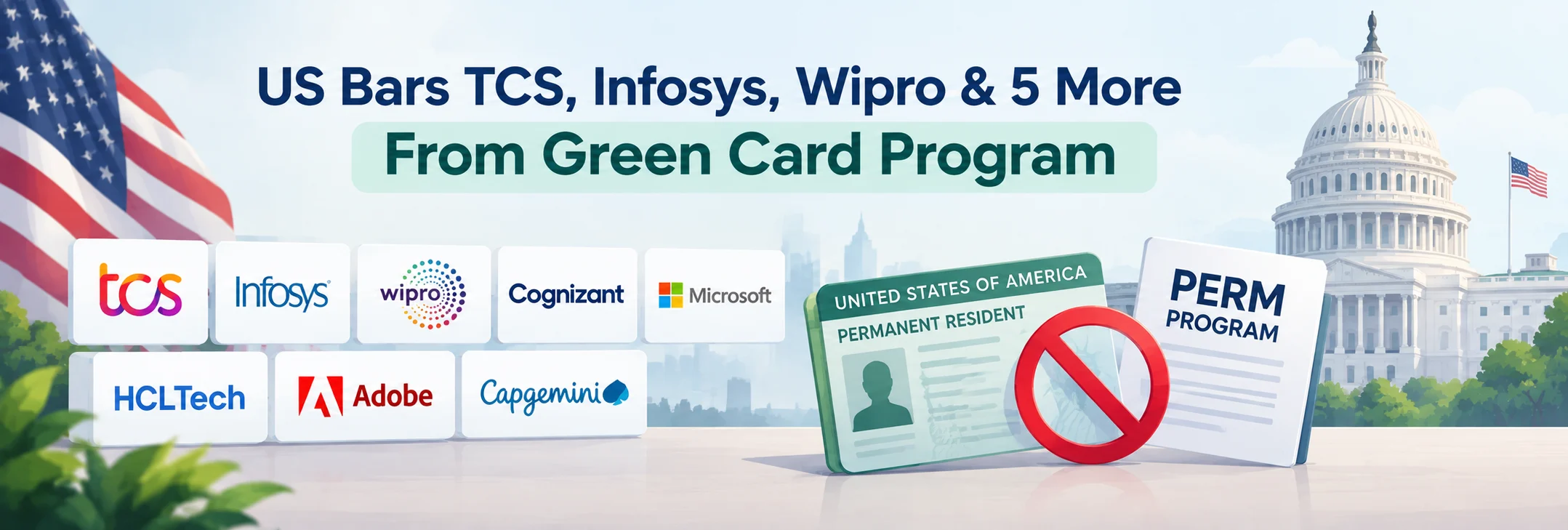
The US government blocked eight major technology firms, including Tata Consultancy Services, Infosys, Wipro, Cognizant and Microsoft, from a key employment-based green card program. The decision, which was announced on October 8, 2026, restricts the companies from filing new applications and processing pending cases under the Permanent Labor Certification (PERM) program.
| Detail | Information |
| Programme | Permanent Labor Certification (PERM) |
| Authority referenced | US Department of Labor |
| Companies named | TCS, Infosys, Wipro, Cognizant, Microsoft, HCL Technologies, Adobe and Capgemini |
| Reported announcement date | October 8, 2026 |
| Potential area of impact | Employer-sponsored employment-based permanent residency applications |
| H-1B visas and existing green cards | The article says these are not automatically revoked by a PERM suspension |
| Verification status | Official announcement and company-specific restrictions require confirmation |
Eight Technology Companies Under PERM Suspension
The US Department of Labor has suspended eight technology and IT services companies from the PERM program for misusing the employment-based immigration provisions.
Apart from TCS, Infosys, Wipro, Cognizant and Microsoft, companies affected include HCL Technologies, Adobe and Capgemini.
The move is part of an effort by the US administration to scrutinize whether employers are complying with recruitment rules designed to protect US workers.
US authorities have raised concerns about alleged irregularities in recruitment, suppression of wages and replacement of domestic workers with foreign workers. These are allegations and the suspension does not prove wrongdoing on the part of every company that is involved.
Affected employers will be unable to file new PERM applications under the restrictions, and pending labor certification cases will also be suspended.
Introduction to the PERM Program
The Permanent Labor Certification process is a critical step toward obtaining employment-based permanent residency in the United States.
Employers seeking to sponsor certain foreign workers for green cards are required to demonstrate that there are no willing and qualified Americans available to fill the positions for which they advertised. They must also prove that the use of the foreign workers will not adversely affect the wages and working conditions of US workers similarly employed.
Let’s take an example: An Indian IT professional is working in the US on an H-1B visa. The employer wants to sponsor the professional for permanent residency. Before the immigration petition can be filed, the employer may need to obtain PERM certification.
But the suspension does not automatically revoke existing H-1B visas or green cards that have already been issued. It mainly affects the labor certification stage of the employment-based permanent residency process.
Effect on Indian IT Companies & Employees
The restrictions may have implications for Indian IT services companies that rely on skilled workers at clients' sites across the United States.
Since North America is a major revenue source for large Indian IT firms, workforce mobility and local hiring policies are major operational considerations.
The suspension could slow down green card processing for employees waiting for employer-sponsored green cards. The wait for those already facing long delays may now be more uncertain as to when their immigration cases will be resolved.
The effect for H-1B workers close to the usual six-year limit on their stay might be more complicated, since some extensions of their visas depend upon the status of their employment-based immigration applications.
Companies may also need to consider their staffing models, recruitment processes and employee immigration arrangements to comply with changing regulatory requirements.
What this means for the India IT industry?
It arrives at a time when Indian IT companies are already grappling with cautious tech spending, slowing growth in some international markets and rising competition for large outsourcing deals.
Companies have beefed up local recruitment and offshore delivery capabilities to reduce dependency on employees traveling to client locations.
The latest restrictions could increase compliance requirements and result in delays in the deployment or retention of certain skilled employees in the United States.
But the immediate financial impact will depend on the number of affected applications, the length of the suspension and the possibility of alternative staffing arrangements.
The next key development will be whether the US government imposes any additional restrictions, or provides a timeline to resume participation in the PERM program.