Summary:
India’s National Household Travel Survey 2025–26 reveals gender differences in urban commuting, with men more likely to use two-wheelers and bicycles, while women have higher representation in walking, cars and public transport across states and Union Territories nationwide.
India's urban commuting patterns reveal significant differences between men and women. The National Household Travel Survey (NHTS) for July 2025 to June 2026 shows that men rely more heavily on two-wheelers and bicycles, while women have greater representation in walking, cars and public transport. The findings highlight differences in everyday mobility across India's 36 states and Union Territories (UTs).
| Indicator | Survey finding |
| Workers travelling over 1 km to a fixed workplace who use two-wheelers | 42.60% |
| States and UTs where men have a higher two-wheeler commuter share | 35 |
| States and UTs where women have a higher public transport commuter share | 34 |
| Average monthly workplace commuting expenditure, urban workers | ₹ 1,044 |
| Average monthly workplace commuting expenditure, rural workers | ₹ 612 |
| National average monthly commuting expenditure per worker | ₹ 785 |
| Workers reaching fixed workplaces within 30 minutes | 83.40% |
| Households covered by the survey | Approximately 4.92 lakh |
| Individuals covered by the survey | Approximately 20.34 lakh |
Two-Wheelers Dominate Urban Men's Daily Commutes
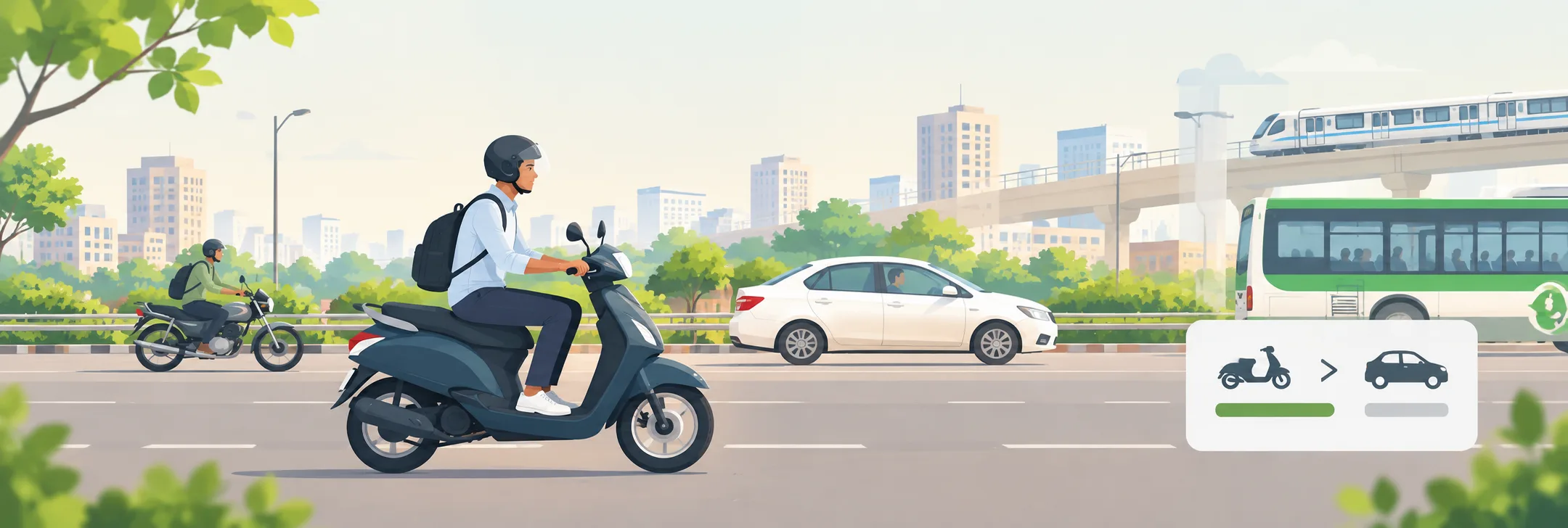
According to the Ministry of Statistics and Programme Implementation (MoSPI), two-wheelers are India's most widely used mode of transport for travelling to fixed workplaces.
The survey found that 42.6% of workers travelling more than 1 km to their workplaces use two-wheelers.
However, the gender-wise distribution reveals substantial differences.
Men have a higher share of two-wheeler commuters than women across 35 states and UTs. Similarly, male bicycle usage exceeds female usage across 32 states and UTs.
In contrast, women account for a higher share of walking commuters in 35 states and UTs.
State-wise comparison of urban commuting preferences:
| Transport mode | Higher share among men | Higher share among women |
| Walking | 1 | 35 |
| Bicycle | 32 | 4 |
| Two-wheeler | 35 | 1 |
| Car | 12 | 24 |
| Autorickshaw | 3 | 33 |
| Bus/monorail/tram | 2 | 34 |
Source: National Household Travel Survey 2025-26, MoSPI. Figures represent states and UTs, not the percentage of commuters.
Why Do More Women Use Cars and Public Transport?
The survey shows that women have a greater share of car-based workplace commuting in 24 states and UTs, despite cars being considerably more expensive than two-wheelers.
Women also demonstrate higher reliance on autorickshaws and public transport across most states.
More than 20% of urban working women use buses to reach their workplaces, compared with a substantially smaller proportion of men.
Safety, accessibility, household responsibilities and transport availability may influence these differences. However, the survey comparisons do not establish the precise reasons behind individual travel choices.
Interestingly, approximately 25% of urban working women use two-wheelers, indicating that motorcycles and scooters remain important for female mobility.
India's Automobile Market Continues to Expand
The commuting trends come as India's automobile industry records strong sales growth.
According to the Society of Indian Automobile Manufacturers (SIAM), domestic two-wheeler sales increased 10.7% YoY to 2.17 crore units in FY26.
Passenger vehicle sales also rose 7.9% YoY to 46.43 lakh units.
The difference in sales volumes reflects the considerably larger domestic market for two-wheelers, supported by affordability, convenience and relatively low operating costs.
Meanwhile, growing urbanisation and changing household income levels continue to influence demand across different vehicle categories.
Urban Workers Spend More on Daily Travel
The NHTS covered approximately 4.92 lakh households and 20.34 lakh individuals across India.
It found that urban workers spend an average of ₹1,044 per month travelling to their workplaces, compared with ₹612 in rural areas.
Nationally, the average monthly commuting expenditure stands at ₹785 per worker.
Additionally, 83.4% of workers travelling to fixed workplaces complete their journeys within 30 minutes.
These figures underline the importance of affordable transport and efficient urban connectivity.
Conclusion
India's commuting patterns reveal different mobility preferences among men and women, with two-wheelers dominating male travel and public transport playing a larger role for women. As cities expand, transport affordability, road infrastructure and public transit accessibility will remain important factors shaping future mobility demand.