Summary:
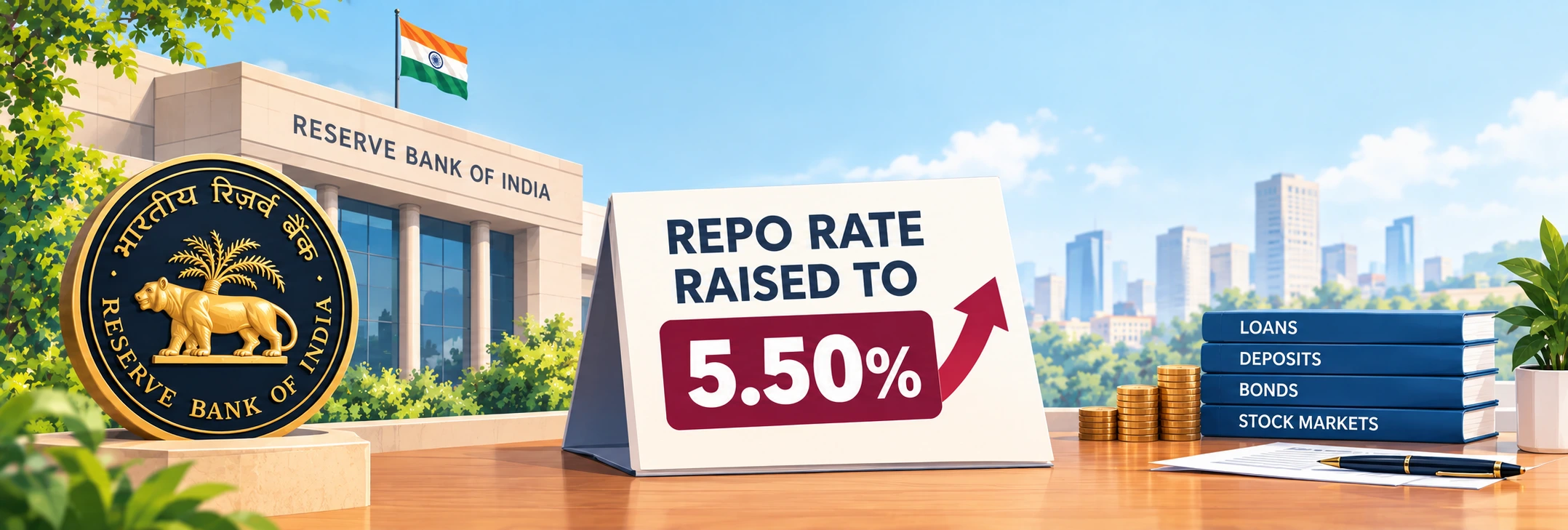
RBI raised the repo rate by 25 basis points to 5.50% on October 7, 2026, its first hike since February 2023. The move affects borrowing costs, fixed deposits, bond yields and equities as the central bank prioritises inflation control.
The Reserve Bank of India has raised the policy repo rate by 25 basis points to 5.50% from 5.25%, marking its first rate hike since February 2023.
The Monetary Policy Committee unanimously voted in favour of the rate increase. At the same time, the RBI shifted its policy stance from neutral to calibrated tightening, reflecting a stronger focus on controlling inflation. The change in stance was approved by a 4 to 2 majority.
The decision comes against a backdrop of rising consumer prices, higher crude oil prices and pressure on the Indian rupee, even as domestic economic growth continues to remain relatively firm.
What Did RBI Change?
A higher repo rate increases the cost at which banks borrow short term funds from the RBI. Banks may, in turn, pass on part of this increase to customers through higher lending rates.
The Standing Deposit Facility rate was also increased by 25 basis points.
| Policy Indicator | Previous Level | Revised Level |
| Repo Rate | 5.25% | 5.50% |
| Standing Deposit Facility Rate | 5.00% | 5.25% |
| Policy Stance | Neutral | Calibrated Tightening |
The rate action follows a rise in consumer inflation. India's CPI inflation stood at 4.82% in August 2026, remaining above the RBI's medium term target of 4% for the third consecutive month.
Food prices, fuel costs and elevated energy prices have contributed to the recent increase in inflationary pressures.
Floating Rate Loan Borrowers May See Higher Costs
The most visible impact of a repo rate hike is usually felt by borrowers whose loans are linked to external benchmark rates.
Home loan rates, in particular, can respond relatively quickly when banks revise their benchmark linked lending rates.
For an existing home loan borrower, a higher interest rate can result in either a larger EMI or a longer repayment period, depending on the lender and loan agreement.
Auto loans, personal loans and fresh business loans may also become more expensive if banks increase lending rates.
Borrowers on fixed rate loans may not see an immediate change, although revised rates could become applicable when the loan comes up for reset, refinancing or renewal.
Fixed Deposits May Become More Attractive
While higher interest rates are generally negative for borrowers, depositors could benefit.
Banks may increase fixed deposit rates if they need to attract more funds to support loan growth. However, the increase in deposit rates may not happen immediately or uniformly across banks.
The extent of any increase will depend on liquidity conditions, deposit requirements and the maturity profile of individual banks.
As a result, the policy creates contrasting outcomes. Borrowing may become more expensive, while savers could receive better returns on deposits.
Bond Yields Move Higher
The bond market also responded to the RBI decision.
India's benchmark 10 year government bond yield moved up to around 7.27% following the announcement.
Bond yields generally move higher when investors expect tighter monetary conditions or a higher interest rate environment.
Higher yields can also raise the cost at which companies and governments borrow money from the market.
Equity Markets React to Rate Hike
Indian equities remained under pressure after the monetary policy announcement.
The Nifty 50 declined around 0.77%, while the Sensex fell approximately 0.65% during the session.
Rate sensitive sectors such as banking, financial services, automobiles, FMCG and real estate were among the areas facing selling pressure.
Higher interest rates can affect stocks in several ways. Companies may face higher financing costs, while consumers may become more cautious about purchases funded through loans.
Sectors such as real estate and automobiles are particularly sensitive because a large part of consumer demand depends on credit availability and borrowing costs.
Higher rates can also influence stock valuations as investors apply a higher discount rate to future earnings.
Growth Remains Strong Despite Inflation Concerns
The RBI's decision comes at a time when India's economic growth remains healthy.
India's GDP expanded by 7.8% year on year in Q1FY27, while the RBI expects the economy to grow by around 7.1% in FY27.
This gives the central bank some room to focus more strongly on inflation without immediately putting economic growth under severe pressure.
What Should Borrowers and Investors Watch Next?
The future direction of interest rates is likely to depend on how inflation evolves over the coming months.
Crude oil prices, food inflation, movement in the rupee and global interest rates will remain important factors for the RBI.
Borrowers should keep a close watch on changes in lending rates, especially if they have large floating rate loans. Depositors may also want to compare fixed deposit rates as banks adjust their funding costs.
For equity investors, interest rate sensitive sectors could remain volatile until there is greater clarity on the inflation outlook and the future path of monetary policy.
The October policy decision therefore marks an important change in the interest rate cycle, with the RBI placing greater emphasis on containing inflation while seeking to maintain overall economic stability.