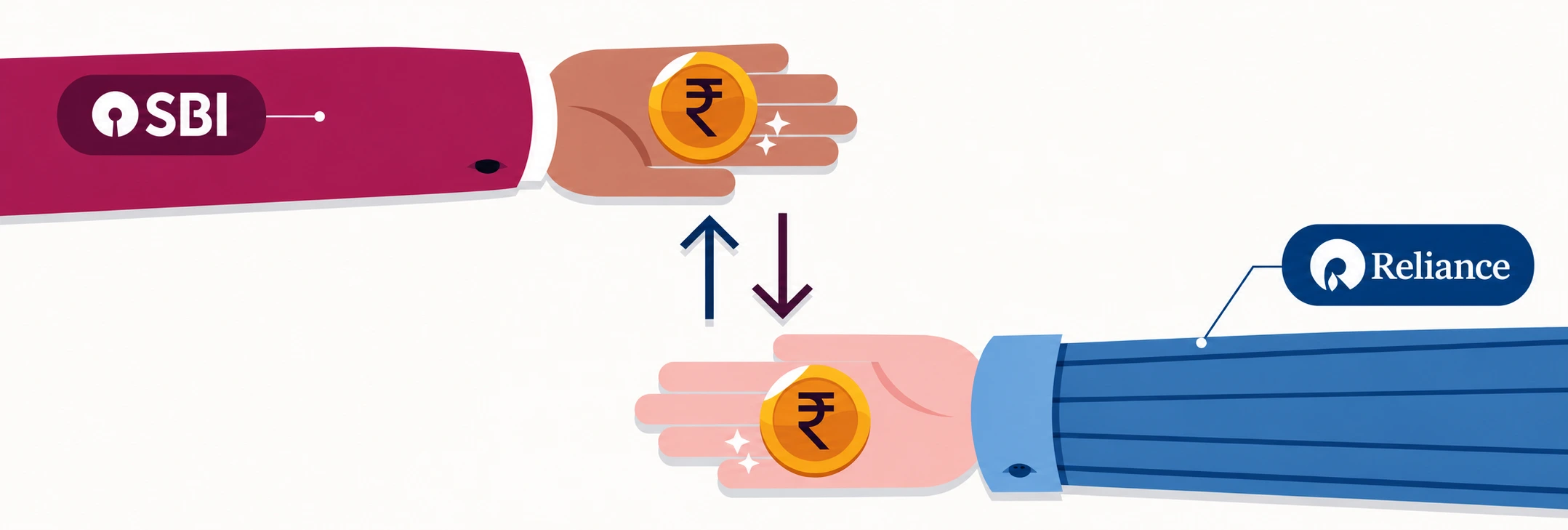
Summary:
State Bank of India bought nearly ₹5,000 crore, or about 40%, of Reliance Industries’ ₹13,000 crore 10-year bond issue. The AAA-rated bonds carry a 7.90% annual coupon, taking Reliance’s recent domestic bond fundraising to approximately ₹25,000 crore.
SBI Buys Nearly ₹5,000 Crore of Reliance's Bond Issue
State Bank of India has emerged as the largest buyer in Reliance Industries Ltd’s latest ₹13,000 crore domestic bond issuance, purchasing bonds worth nearly ₹5,000 crore, or about 40% of the total offering.
The 10-year issue carries an annual coupon of 7.90% and comes just weeks after Reliance raised another ₹12,000 crore through shorter-tenure bonds, highlighting the company’s accelerated use of India’s domestic debt market.
Reliance Raises ₹13,000 Crore Through 10-Year Bonds
Reliance completed the ₹13,000 crore, or roughly $1.35 bn, bond issuance on September 30. SBI accounted for close to ₹5,000 crore of the issue, making it the largest single participant.
The bonds have received the highest domestic credit rating of AAA and carry a fixed annual coupon of 7.90%. The long 10-year maturity indicates strong institutional demand for high-quality corporate debt even as bond yields have risen sharply.
Reliance ₹13,000 Crore Bond Issue: Key Details
| Particular | Details |
| Issue size | ₹13,000 crore |
| Tenure | 10 years |
| Annual coupon | 7.90% |
| SBI purchase | ~₹5,000 crore |
| SBI share of issue | ~40% |
| Credit rating | AAA |
Reliance had returned to the domestic rupee bond market earlier in September after remaining away since November 2023.
Reliance Raises ₹25,000 Crore Raised Within Weeks
The latest transaction follows a ₹12,000 crore five-year bond sale completed about two weeks earlier at an annual coupon of 7.47%. Taken together, the two issuances have allowed Reliance to raise around ₹25,000 crore from India's bond market within a short period.
The 10-year paper carries a higher coupon than the five-year issue, reflecting the additional duration risk as well as the sharp rise in market interest rates.
Reliance had also raised ₹20,000 crore through bonds in November 2023, which was the largest domestic rupee bond issuance by an Indian non-financial company at the time.
The renewed borrowing activity comes as several large Indian companies seek to lock in funding before any further tightening in domestic monetary conditions. Around ₹29,000 crore of corporate bond offerings were being prepared for the market in late September amid expectations that elevated oil prices and inflation could influence future RBI policy decisions.
Reliance Reports ₹23,196 Crore Q1FY27 Profit
The debt issuance comes against the backdrop of a large and diversified balance sheet spanning energy, retail, digital services and new-energy investments.
For Q1FY27, Reliance reported:
- Gross revenue: ₹3,40,257 crore
- EBITDA: ₹54,067 crore
- PAT: ₹23,196 crore
- Capital expenditure: ₹38,682 crore
For FY26, the company had reported gross revenue of ₹11,75,919 crore, EBITDA of ₹2,07,911 crore and PAT of ₹95,754 crore. Its FY26 capital expenditure stood at ₹1,44,271 crore.
Reliance’s large investment requirements across telecom, retail, energy and new businesses mean debt markets remain an important source of long-term capital alongside internal cash generation.
Why Is the 7.90% Coupon Important?
The 7.90% annual coupon represents the fixed interest rate attached to the 10-year Reliance bonds.
The coupon should not be confused with the bond's total return or yield to maturity, because the latter can also depend on the issue price and the price at which the bond is subsequently traded.
The relatively long 10-year maturity also exposes investors to interest-rate and duration risk.
If market interest rates rise further, the prices of existing fixed-rate bonds can come under pressure in the secondary market.
Conversely, if market yields decline, existing higher-coupon bonds can become relatively more attractive.
Rising Yields Drive Corporate Borrowing Rush
The timing of the bond sale is significant. India’s benchmark 10-year government bond yield recently moved above 7.1%, while US Treasury yields have also risen sharply. Higher crude oil prices have increased inflation concerns and strengthened expectations of tighter monetary conditions.
Against this backdrop, companies have been moving quickly to secure borrowing costs before rates potentially rise further.
What Does SBI's ₹5,000 Crore Investment Mean?
For SBI, the nearly ₹5,000 crore investment adds a large AAA-rated long-duration corporate asset to its portfolio. For Reliance, the ₹13,000 crore issue further diversifies funding and extends its debt maturity profile.
The strong absorption of the issue also shows that institutional demand for highly rated corporate debt remains firm despite the recent rise in bond yields.
Reliance Q1 FY27 Financial Performance
The bond issue comes against the backdrop of Reliance's large and diversified business operations.
For Q1 FY27, Reliance Industries reported:
- Gross revenue: ₹3,40,257 crore
- EBITDA: ₹54,067 crore
- Profit after tax: ₹23,196 crore
- Capital expenditure: ₹38,682 crore
For FY26, Reliance reported:
- Gross revenue: ₹11,75,919 crore
- EBITDA: ₹2,07,911 crore
- Profit after tax: ₹95,754 crore
- Capital expenditure: ₹1,44,271 crore
Reliance's capital requirements across energy, telecom, retail and new businesses make access to multiple funding channels important for its investment programme.
Reliance Bond Issue vs Earlier September Bond Sale
Reliance's two September transactions differed in both maturity and coupon.
| Feature | Earlier Issue | September 30 Issue |
|---|---|---|
| Issue size | ₹12,000 crore | ₹13,000 crore |
| Tenure | 5 years | 10 years |
| Coupon | 7.47% | 7.90% |
| Total September fundraising | ₹12,000 crore | ₹25,000 crore cumulative |
What Should Investors Watch Next?
The key factors to monitor following the bond issue include:
Reliance's Capital Expenditure
Future investment requirements across energy, digital services, retail and new businesses will influence funding needs.
Corporate Debt Market Conditions
Changes in benchmark yields will affect the cost of future borrowing.
RBI Monetary Policy
Changes in interest-rate expectations can influence corporate borrowing costs and bond-market yields.
Crude Oil Prices
Higher crude prices can influence inflation expectations and India's broader interest-rate environment.
Reliance's Cash Generation
Operating cash flows remain important for assessing the company's ability to fund investments alongside debt.
SBI's Investment Portfolio
For SBI, investors can monitor the composition and performance of its corporate bond and broader investment portfolio.
SBI-Reliance Bond Deal: Key Takeaways
- SBI bought nearly ₹5,000 crore of Reliance Industries' ₹13,000 crore bond issue.
- SBI's purchase represents approximately 40% of the total issue.
- The Reliance bonds have a 10-year maturity.
- The bonds carry a fixed annual coupon of 7.90%.
- The issue has received a AAA domestic credit rating.
- Reliance had raised another ₹12,000 crore through five-year bonds earlier in September.
- The two September issues together raised approximately ₹25,000 crore.
- Reliance's latest borrowing comes as Indian government bond yields remain elevated.
- For SBI, the transaction adds a large AAA-rated, long-duration corporate debt asset to its investment portfolio.
- The deal highlights the role of India's domestic corporate bond market in funding large companies.
FAQs
SBI purchased bonds worth nearly ₹5,000 crore, representing approximately 40% of Reliance Industries' ₹13,000 crore bond issue.
Reliance's latest 10-year domestic bond carries a fixed annual coupon of 7.90%.
The bond has a 10-year maturity.
The bonds have received a AAA domestic credit rating, the highest domestic rating category.
Reliance has raised approximately ₹25,000 crore through two domestic bond issues in September: ₹12,000 crore through five-year bonds and ₹13,000 crore through 10-year bonds.
The bond issue provides Reliance with long-term domestic funding that can support its capital requirements across businesses including energy, retail, digital services and new-energy investments.
SBI's nearly ₹5,000 crore purchase makes it the largest identified participant in the issue and adds a large AAA-rated corporate debt security to its investment portfolio.
When market yields rise, prices of existing fixed-rate bonds can generally fall because newly issued bonds may offer higher yields. The impact depends on maturity, duration, coupon, credit quality and market liquidity.