Summary:
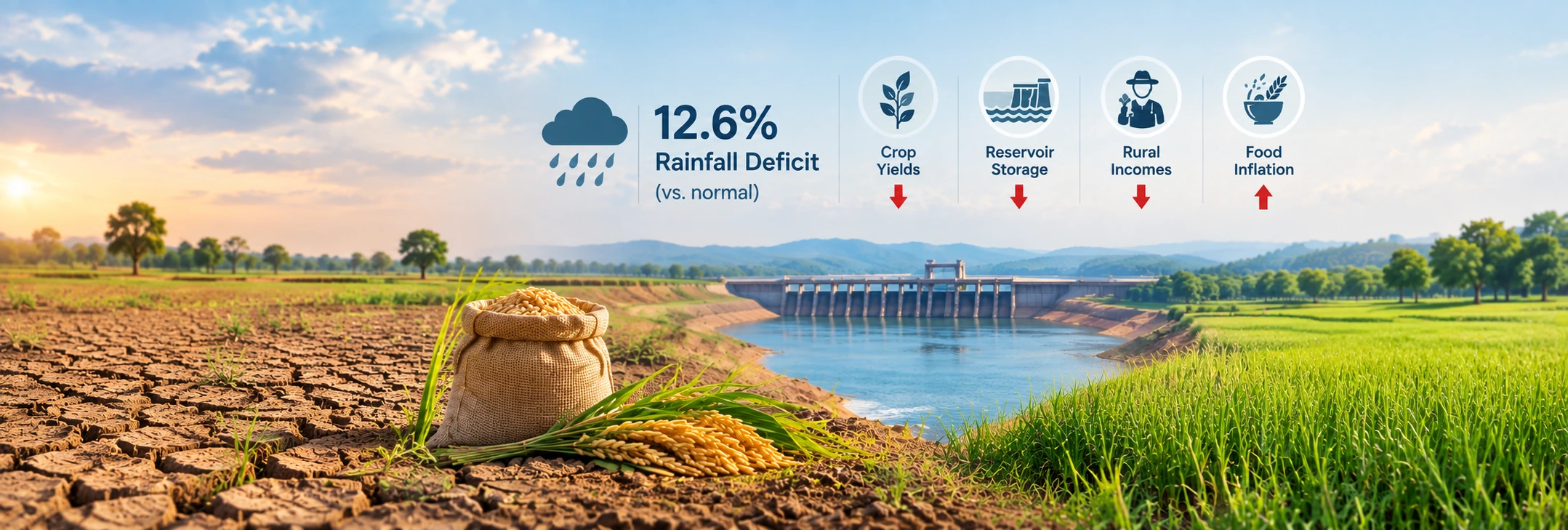
India’s 2026 southwest monsoon ended with a 12.6% rainfall deficit, its weakest season since 2015. The shortfall has increased concerns over crop yields, reservoir storage, rural incomes and food inflation, while kharif sowing recovery shifts attention toward productivity and rabi crops.
India’s 2026 southwest monsoon ended with a 12.6% rainfall deficit, marking the weakest season in more than a decade. The country received 759.4 mm of rainfall during June-September against the long-period average (LPA) of 868.6 mm, according to the India Meteorological Department (IMD).
The shortfall, largely associated with strengthening El Niño conditions, has raised concerns around crop yields, reservoir levels, rural incomes and food prices even though kharif sowing recovered significantly after a weak start.
Rainfall at Lowest Level Since 2015
The June-September rainfall was equivalent to about 87.4% of the LPA, placing the season in the “deficient” category. It was the worst monsoon since 2015, the fourth-lowest since 2001 and the 13th-lowest since 1901.
Rainfall performance was also highly uneven through the season.
| Monsoon Indicator | 2026 Reading |
| Actual June-September rainfall | 759.4 mm |
| Long-period average | 868.6 mm |
| Rainfall departure | -12.6% |
| June rainfall | ~-36% |
| July rainfall | ~+1% |
| August rainfall | ~-14% to -16% |
| September rainfall | ~-8% |
June delivered the biggest shock, with rainfall more than one-third below normal. Conditions improved sharply in July before weakening again during August and September.
Despite El Niño, the season recorded 77 low-pressure-system days, compared with a normal of around 57 days, helping limit the overall rainfall shortfall.
Regional Divide Remains Sharp
Central India performed relatively better and received rainfall broadly within the normal range. Other regions faced significantly larger deficits.
Northwest India ended the season around 5.8% below normal, while east & northeast India recorded a deficit of about 25.6%. South peninsular India was also severely affected, with rainfall around 24.4% below normal.
Across India’s 36 meteorological subdivisions, about 53% recorded normal rainfall, while roughly 42% experienced deficient rainfall.
Some areas faced particularly severe conditions. Karnataka finished the southwest monsoon with a rainfall deficit of about 35%, its largest shortfall in several decades.
Reservoir Levels & Crop Yields Now in Focus
Kharif sowing recovered substantially after falling sharply behind normal levels during June. By early September, overall planting had reached about 98% of the normal area and around 96% of the previous year’s acreage.
This means the bigger risk has shifted from acreage to crop productivity.
Cotton, maize, soybean, groundnut, tur & bajra remain more exposed because inadequate rainfall during critical crop-development stages can affect yields. Rice production is comparatively less vulnerable in areas with stronger irrigation coverage.
Water availability is another concern. As of late September, India’s 178 major reservoirs were holding water equivalent to about 70% of total capacity, the lowest level for this time of year in a decade. That compared with around 79% a year earlier and a 10-year average of 76.6%.
Southern reservoirs were particularly weak at only around 50% of capacity.
Food Inflation & Rabi Season Become Next Test
A deficient monsoon can affect the economy through lower agricultural output, weaker rural incomes and higher food prices. September rainfall is also important for maintaining soil moisture ahead of rabi planting of wheat, mustard and chickpeas.
The impact will therefore extend beyond the completed kharif season. Reservoir storage, October rainfall and winter crop sowing will determine how much of the monsoon weakness carries into FY27 agricultural production.
With El Niño conditions expected to remain influential in the coming months and October rainfall also projected to remain relatively weak, weather risks have not disappeared with the formal end of the southwest monsoon.
For the economy, the key indicators to track now are food inflation, reservoir levels, kharif yields, rabi sowing and rural consumption. A recovery in winter rainfall and irrigation availability could cushion some of the impact, while prolonged dry conditions would increase pressure on agricultural output and food supplies.