Summary:
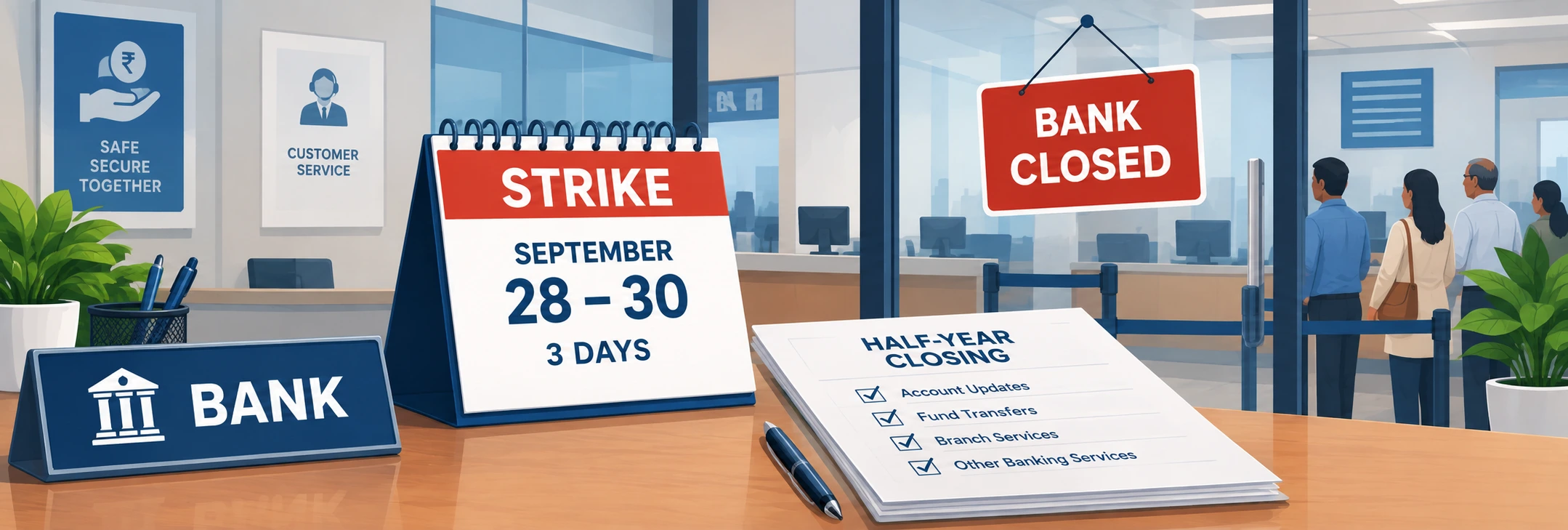
Bank unions have called a three-day nationwide strike from September 28 to 30, 2026, potentially disrupting branch banking during the September 30 half-year closing. Customers may face delays in cheque processing and offline services, while digital banking and ATMs are expected to remain available.
The Finance Ministry has urged employees of public sector banks (PSBs) and regional rural banks (RRBs) to think again about their proposed three-day nationwide strike from September 28 to 30, 2026, which could disrupt banking services for customers, businesses, government transactions and international banking operations.
The proposed strike coincides with the half-yearly closing of banks on September 30, an important period for reconciliation, provisioning, treasury operations and market-related activities. Along with the preceding weekend holidays, the disruption could extend to five days of limited banking services.
The government has asked banks to take measures to ensure continuity of essential services, including maintaining enough cash availability at ATMs and keeping customer-facing operations functional wherever possible.
Reasons Behind Bank Unions' Strike
The strike has been called by the United Forum of Bank Unions (UFBU) and other employee associations representing public sector banks, with support from regional rural banks. The key demands include implementation of a five-day banking week and withdrawal of the Performance Linked Incentive (PLI) scheme.
The government stated that it had already kept the PLI scheme in abeyance after discussions with unions, addressing one of the major concerns of employees. However, discussions continue on the remaining demand relating to a five-day working week.
The latest strike call comes after a one-day nationwide strike on September 11, 2026. Unions have also proposed further action from October 26, 2026, if their remaining demands are not addressed.
Impact on customers and banking operations
Branch-based banking services are expected to be disrupted during the strike period. Activities such as cheque processing, account-related services and certain offline transactions can be impacted. Customers have been advised to complete important banking work before the strike dates.
Digital banking facilities such as internet banking, mobile banking, UPI and ATM services are expected to provide alternative options, although customers may face delays in some banking processes depending on the service requirement.
Banks have started preparing contingency plans to limit the impact. The Finance Ministry held discussions with heads of PSBs, RRBs, the Indian Banks' Association (IBA) and NABARD regarding steps to maintain essential services during the likely disruption.
Why is September 30 important for banks?
The timing of the strike has heightened attention as September 30 marks the end of the first half of the financial year. Banks undertake several critical activities during this period, including financial reconciliation, provisioning adjustments and treasury-related operations.
Any prolonged disruption during this period could create operational challenges for banks, businesses and government-linked transactions. The government has thus emphasised resolving differences through dialogue while ensuring uninterrupted banking services.