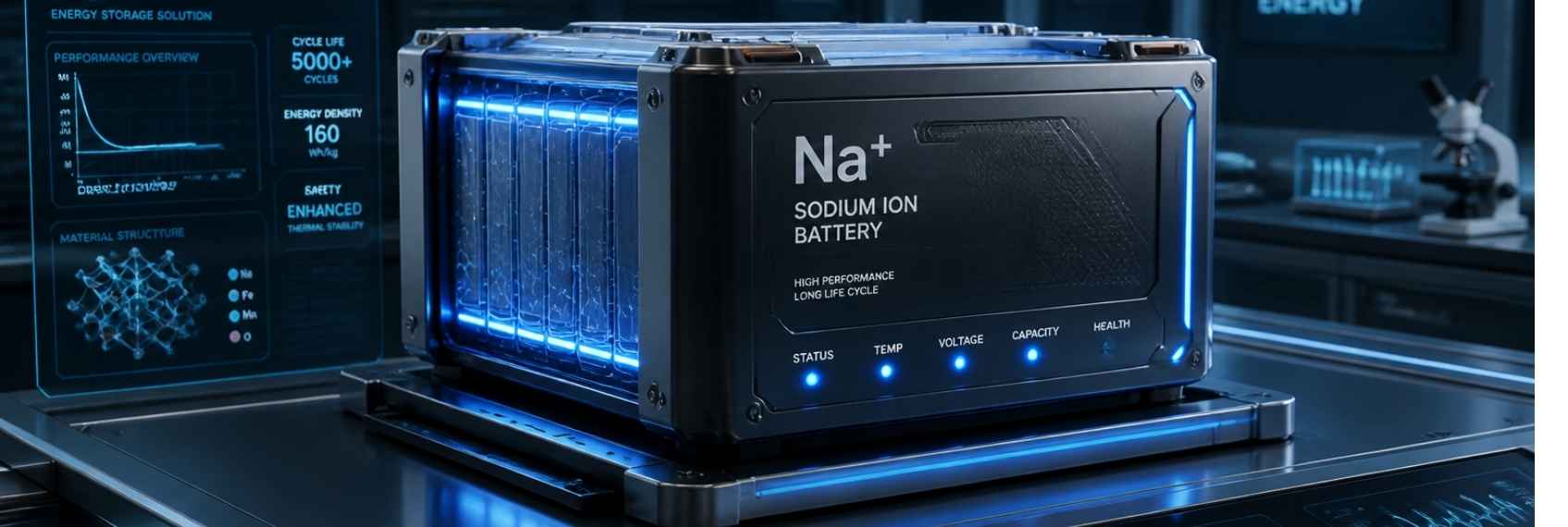
Summary:
China is rapidly commercialising sodium-ion batteries, while India remains in the early stages despite growing interest from companies such as Reliance Industries and KPIT Technologies. The technology offers a lower-cost alternative to lithium-ion batteries and could gain traction in energy storage systems and affordable EVs. India still has an opportunity to build a competitive sodium-ion ecosystem, but faster commercialisation will be key to narrowing the gap with China.
The pace of commercialization of the sodium-ion battery in the case of EVs and BESS has been quite rapid in China whereas in India, it still seems to be in its infancy stages. Indian manufacturers do show some level of interest in the technology but the mass production of the battery has not been initiated and hence concerns are raised regarding competition.
China’s Sodium-Ion Battery Push Gains Momentum
Sodium-ion batteries received an impetus in 2026 when Chinese battery manufacturers, headed by CATL, said that they will commercialize their sodium-ion batteries in both EVs and energy storage systems by the end of the year.
The Changan automaker from China, Nevo A06, is one of the early vehicles to be powered by a sodium-ion battery. Sodium-ion batteries have also been applied in CATL’s BESS solution. The reason for this advancement is because China’s robust battery manufacturing system is helping in advancing the commercialization of sodium-ion batteries.
Elsewhere globally, the technology has also received attention as General Motors partnered with Peak Energy to develop sodium-ion battery storage solutions.
Why Sodium-Ion Batteries Are Gaining Interest
The most significant benefit associated with sodium-ion batteries is the abundance and reduced price of material. Sodium is thought to be 500 times more abundant compared to lithium, which makes the former much more affordable.
Nevertheless, one can note that sodium-ion batteries are less energy dense compared to lithium-ion batteries, hence the necessity to produce larger batteries to store the equivalent energy. Still, there is hope for sodium-ion batteries to become 20-30% cheaper due to their economies of scale.
Other benefits of sodium-ion batteries include higher safety levels, increased temperature range and scalability, which makes this type of batteries useful for battery energy storage, low-end EVs and two/three-wheelers.
Where Does India Stand in Sodium-Ion Battery Development?
India is already testing the technology of sodium-ion batteries in various firms such as Reliance Industries, KPIT Technologies, INDI Energy and GODI Energy.
Reliance Industries made an acquisition deal with a British battery firm Faradion worth £100 million for improving its sodium-ion batteries production. Nevertheless, the commercial production process has not yet started.
According to experts, the sodium-ion battery technology is still in its infancy stage globally and thus presents a chance for India to create its own production facilities before it gets monopolized. Yet, the biggest problem for India is China’s early advantage in battery production industry.
Government Support and Battery Manufacturing Plans
The PLI scheme of ₹18,100 crores for advanced chemistry cells is not based on chemistry, therefore sodium-ion battery manufacturers will be able to avail themselves of the benefits, in addition to lithium-ion battery manufacturers.
However, the vast majority of capacity allocated for this program has been set aside for lithium-ion capacity because of the uncertainty about commercialization of sodium-ion batteries.
Indian companies like Reliance Industries, Tata Group, JSW Group, Amara Raja, Exide Industries and Ola Electric have been investing in the capacity of lithium-ion cells in the next four years.
Market Potential of Sodium-Ion Batteries
Industry experts feel that it is unlikely that sodium-ion batteries will entirely supersede lithium-ion batteries, but will be able to grab some market share in certain segments.
These batteries can prove to be competitive in stationary energy storage systems, low-cost electric cars, commercial vehicles, and two and three-wheeler batteries. The industry estimates indicate that sodium-ion batteries might represent roughly 10% of total global energy storage system additions by 2030.
India has time left to create a sodium-ion battery ecosystem provided companies succeed in commercializing their research quickly.
Why Battery Stocks Could React to Sodium-Ion Developments
The emergence of sodium-ion batteries may pose both opportunities and threats to Indian battery manufacturers. Those companies that are investing a lot in lithium-ion cells manufacturing may be worried about technological change in the future.
Nevertheless, companies working on sodium-ion technology or building their own battery industries can get new chances for development in the field of electric vehicles and energy storage. Now, due to the little application of sodium-ion batteries commercially, the effect on battery-listed companies depends on the scale of production.