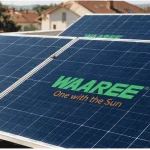
Shares of Indian solar energy companies came under sharp selling pressure on February 25, 2026, after the US Commerce Department imposed preliminary countervailing duties of about 126% on solar cell and module imports from India. The move triggered heavy losses across the sector, with frontline stocks falling up to 15% in early trade as investor sentiment weakened over export uncertainty and trade risks.
Waaree Energies Share Price Slides 15%
Waaree Energies shares slumped as much as 15% to ₹2,570 around 9:30 am, after hitting the lower circuit earlier in the session. In another update during the morning trade, the stock was seen tumbling 15% t on the NSE. The sharp fall reflects concerns over its meaningful exposure to the US market. According to the annual report of FY25, 16.72% of Waaree’s revenue comes from exports, and as perthe Q3 FY26 investor presentation, the company accounted 32.6% revenue from overseas.
Waaree Energies is engaged in manufacturing solar photovoltaic (PV) modules and solar cells, executing engineering, procurement and construction (EPC) contracts, setting up solar projects, and power generation. Its operating segments include solar PV modules, power generation, and EPC services. The company operates manufacturing plants in Tumb, Nandigram, Chikhli, and Surat in Gujarat. Its product portfolio includes HJT modules, N-type modules, mono PERC modules, flexible modules, inverters, solar kits, battery energy storage systems (BESS), and electrolyser stacks, along with green hydrogen solutions.
The company has also established manufacturing capabilities in the United States and had earlier highlighted the importance of the US market in its December quarter earnings call. It recently acquired Meyer Burger and is pursuing both organic and inorganic growth strategies.
Premier Energies Share Price Falls Despite Limited US Exposure
Premier Energies shares declined sharply, falling over 14.18% to ₹666.90 and at one point down 10% to ₹699.35 on the NSE, though the stock saw some recovery later. Despite having negligible export exposure to the US market, the stock witnessed spillover selling due to negative sector sentiment.
Premier Energies is an integrated solar cell and module manufacturing company involved in solar power generation, EPC execution, independent power production, and operations and maintenance (O&M) services. The company has disclosed a total order book of 9.4 GW valued at ₹13,723 crore, with deliveries scheduled up to FY28. Of this, the cell segment accounts for over ₹6,800 crore, while modules contribute around ₹7,000 crore. Management clarified that all cell orders fall under the Domestic Content Requirement (DCR) category, whereas module orders comprise a mix of DCR and non-DCR contracts. The company also manufactures solar water pumps, lanterns, lighting systems, and solar electric vehicles.
Vikram Solar Share Price Drops Over 7%
Vikram Solar shares plunged over 7.76% to ₹171 in early trade. Vikram Solar derives around 16% of its revenue from exports, and approximately 20% of its order book is linked to international markets, making it sensitive to global tariff developments.
Vikram Solar Limited, formerly known as Vikram Solar Private Limited, is one of India’s largest solar PV module manufacturers in terms of operational capacity as of March 31, 2025. The company also provides integrated solar energy solutions including EPC and O&M services.
Other Solar Stocks Trade Lower
The broader solar pack also witnessed declines, though losses were uneven. Waaree Renewable Technologies fell over 6%, Solex Energy slipped 5%, Saatvik Green Energy was down nearly 3%, and Borosil Renewables fell over 1%.
In contrast, Servotech Renewable Power System was marginally higher, while Sterling and Wilson Renewable Energy traded mildly lower, indicating selective rather than uniform selling across the sector. Adani Green Energy was also seen trading lower by around 1.21%.
Details of the US Tariff Decision
The US Commerce Department set preliminary countervailing duty rates at 125.87% for India, 104.38% for Indonesia, and 80.67% for Laos in one determination. In another update, Indonesia was reported to face provisional tariffs ranging between 86% and 143%, while Laos faced tariffs of 81%. The action follows a petition filed last year by the Alliance for American Solar Manufacturing and Trade, which includes Hanwha Qcells, First Solar, and Mission Solar. The petition alleged that foreign subsidies allowed exporters to underprice American solar manufacturers.
The duties are separate from the previously announced global tariffs introduced under US President Donald Trump. Earlier, a universal tariff of 10% was introduced and later increased to 15%. While those broader tariffs were struck down by the US Supreme Court, the newly announced solar-specific duties are distinct and directly target the solar industry.
The current ruling marks the first of two determinations in the case. The Commerce Department is expected to issue a separate decision next month on whether exporters sold products in the US at prices below production costs, which could result in additional anti-dumping duties.
Conclusion
The steep 126% duty significantly increases the cost of Indian solar exports to the US market. The announcement has heightened concerns over export volumes, overseas revenue exposure, shipment costs, and order pipeline stability for Indian manufacturers with international exposure.
While the long-term impact will depend on final determinations and implementation timelines, the immediate reaction in the stock market was clear. Solar stocks fell up to 15% in a sentiment-driven sell-off as investors adjusted valuations to factor in heightened trade risks and uncertainty surrounding US demand.
At present, the headline impact remains dominant: US tariffs have placed Indian solar stocks under pressure, with Waaree Energies, Premier Energies, and Vikram Solar witnessing sharp declines amid renewed global trade tensions.