Summary:
Asian equities witnessed a sharp sell-off as escalating Iran-Israel tensions, a global technology stock correction, and rising US rate-hike expectations rattled investor sentiment. South Korea's KOSPI fell nearly 9%, triggering a temporary trading halt, while weakness spread across Japan, India and Hong Kong. Higher crude oil prices and geopolitical uncertainty further added to market volatility.
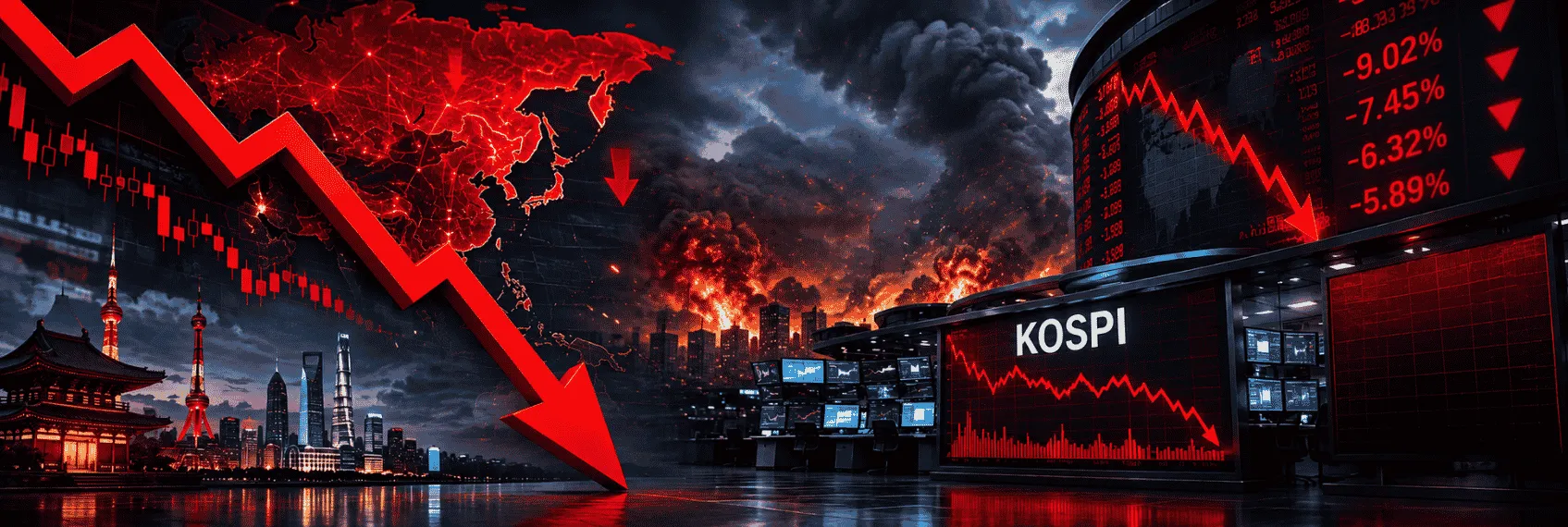
Asian stock markets witnessed a sharp sell-off on Monday, June 8, as escalating tensions in the Middle East and a steep decline in global technology stocks triggered widespread risk aversion among investors. South Korea emerged as the biggest casualty, with the benchmark KOSPI index plunging nearly 9% at the open, forcing authorities to halt trading for 20 minutes after a circuit breaker was triggered.
The sell-off came after reports that Iran fired multiple missiles at Israel over the weekend, raising concerns that the fragile ceasefire in the region could collapse. The renewed geopolitical uncertainty added to market nervousness already fuelled by last week’s sharp correction in global technology and artificial intelligence stocks.
KOSPI Suffers Biggest Blow
South Korea’s KOSPI index fell more than 8% shortly after trading began, prompting the Korea Exchange to activate a market-wide circuit breaker and temporarily suspend trading for 20 minutes. The halt was aimed at calming investor panic and preventing further disorderly selling.
Although the market recovered some losses after trading resumed, the benchmark remained under significant pressure. By midday, the KOSPI was still down around 5%, recovering from its earlier decline of nearly 9%.
The sharp decline was led by heavy selling in major technology and semiconductor stocks. South Korea’s chip giants, including Samsung Electronics and SK Hynix, reportedly lost around 8-10% of their market value during morning trade.
Three Key Factors Behind the Market Rout
Firstly, there was a sell-off of technology globally. Friday saw US technology equities experience significant losses with the biggest losses being in the space of semiconductors and artificial intelligence firms. Since South Korea relies significantly on the semiconductor industry, this had a big effect on KOSPI. Secondly, rising fears over US interest rates. Positive employment figures for May in the US strengthened the expectation that US Fed could keep interest rates high or even hike interest rates further. Rising interest rates normally affect company profits and stock valuations negatively.
Finally, there were heightened fears over the Middle East situation. There were reports indicating that Iran had fired missiles at Israel in response to attacks by Israeli forces against positions in Lebanon. This increase in tension raised fears of war, causing investors to shift away from risky investments.
Weakness Spreads Across Asia
The sell-off quickly spread across regional markets. Japan’s benchmark Nikkei 225 fell more than 4%, while India’s Nifty 50 declined around 1% in early trade. Hong Kong’s Hang Seng futures dropped to 24,544, significantly below Friday’s closing level of 24,961.95. Australian markets remained closed for a public holiday.
Wall Street Sell-Off Deepens Concerns
Investor sentiment was already fragile after a sharp correction on Wall Street. The Nasdaq 100 slumped 5% on Friday, its steepest fall since April 2025, while a major semiconductor index plunged 10%. The S&P 500 declined 2.6%, ending its attempt to record a tenth consecutive week of gains.
US Treasury yields also surged, with the two-year yield climbing 12 basis points to 4.16%. Markets are now fully pricing in at least one US rate hike before the end of 2026 following stronger-than-expected labour market data.
Oil Prices Surge on Supply Concerns
Middle East tensions also contributed to an uptick in the price of crude oil. The benchmark Brent crude surged by 3.6% at one point to $96.47 a barrel, while West Texas Intermediate was near $94 a barrel. Worries about possible interruptions in energy supply from the region increased the volatility of the global market environment.
Amid increasing geopolitical concerns, weak tech stocks performance and rate fears, investors will likely proceed with caution for the time being.