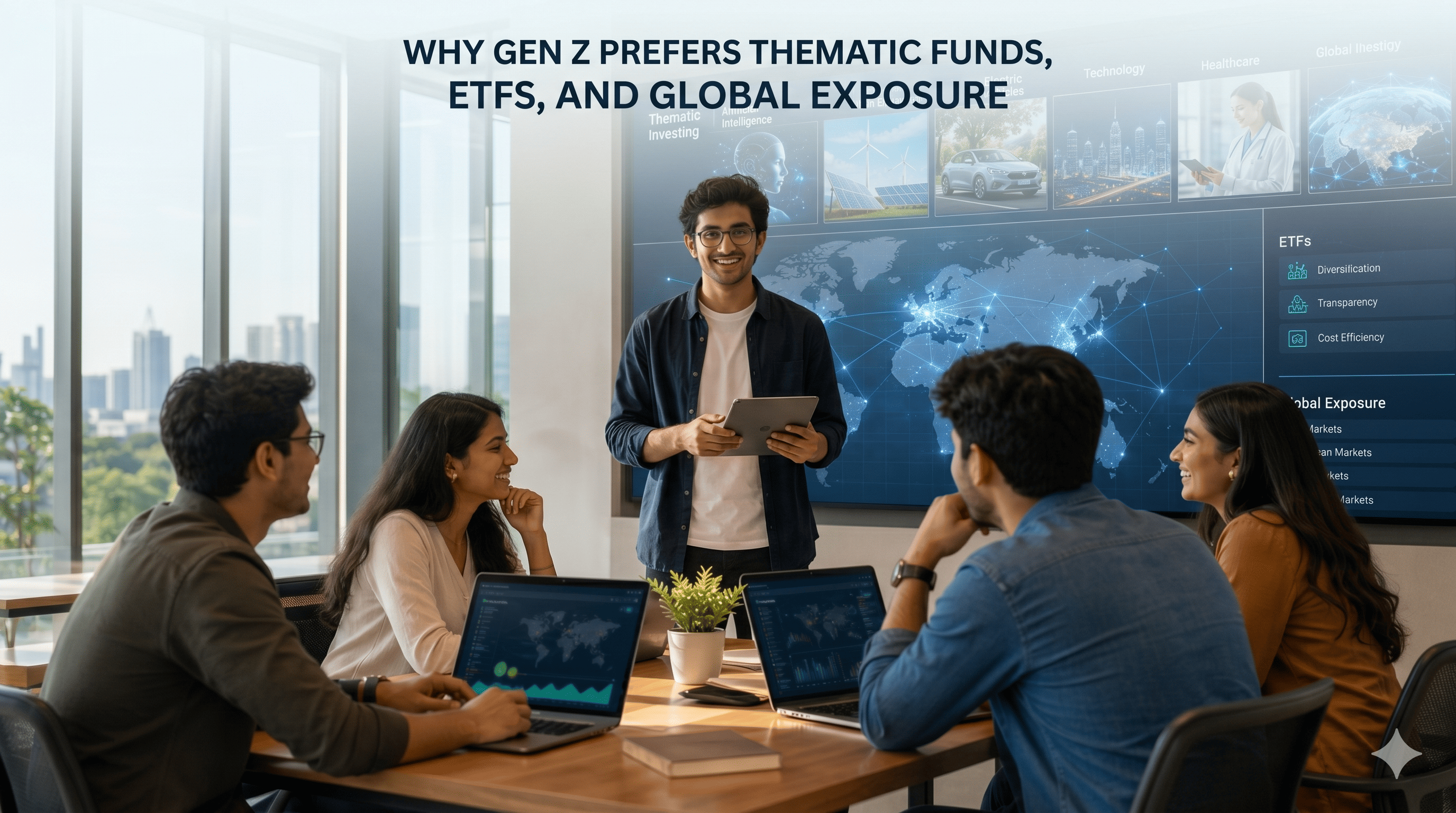
Ask a 22-year-old investor what is in their portfolio, and you are as likely to hear "AI fund" or "Nasdaq ETF" as "large-cap mutual fund". Something has shifted in how a generation thinks about where to put money. It is about investing in things they can see, use, and understand.
Understanding Gen Z's approach to investing
Gen Z did not learn about markets in a classroom. They learned through apps, YouTube channels, and watching American tech companies shape their daily lives. That context shapes not just what they invest in but how they think about it: globally, thematically, and with a keen eye for transparency.
Who is Gen Z?
Gen Z investors are those born between the late 1990s and early 2010s. Many opened demat accounts before they got their first full-time salary. They are digital-first, comfortable with financial apps, and more likely to follow a finfluencer than step into a bank branch for investment advice.
How their investment preferences differ
Previous generations defaulted to FDs, gold, and large-cap funds. Gen Z gravitates toward ideas like AI, clean energy, electric vehicles, and structures that feel transparent and controllable. They want to know exactly what they own and why, which is part of why ETFs and thematic funds resonate more than opaque actively managed products.
What are thematic funds and why do they appeal to Gen Z?
Thematic mutual funds have seen sharp growth in recent years, attracting a disproportionate share of young investors. The appeal is not hard to explain. These funds align investing with conviction in a way that a diversified large-cap fund simply cannot.
Understanding thematic funds
A thematic mutual fund invests in companies connected by a specific idea rather than a market cap bracket or sector classification. The fund's performance depends on whether the underlying theme plays out over time. That makes them higher conviction, higher concentration, and higher risk than a broadly diversified equity fund.
Popular investment themes
The themes attracting the most interest among younger investors include artificial intelligence, electric vehicles, digital infrastructure, manufacturing, and ESG. These are ideas Gen Z has grown up reading about and, in many cases, using daily. Investing in them feels less abstract than buying a fund tracking the top 100 companies by market cap.
Why Gen Z finds thematic funds attractive
The core appeal is in the narrative. Gen Z investors are comfortable making a bet on an idea they believe in over a 10-year horizon. A thematic fund gives that bet a structure. The risk is that conviction about a theme is not the same as understanding the investment. Valuations at entry and adoption timelines matter as much as the idea itself.
Why ETFs are becoming a preferred investment choice
The ETF structure suits how Gen Z engages with markets, because it is real-time, transparent, and low-cost. It removes the black box feel from active fund management and enables investors to see exactly what they own.
What are ETFs?
An exchange-traded fund is a collection of securities that trades like a security on a stock exchange. Typically, it follows an index, commodity or theme. An ETF’s price fluctuates during market hours, whereas a mutual fund is priced once at the end of the day. This allows investors to have real-time transparency into their exposure.
Key benefits of ETFs
ETFs tend to have lower expense ratios compared to actively managed mutual funds. They can be bought in single units, making them accessible at lower ticket sizes. They offer transparent, rules-based exposure, so you always know what the fund holds, and they can be traded intraday, which suits investors who want flexibility.
Why ETFs fit Gen Z's investment style
Gen Z checks portfolios on their phones between classes or during lunch breaks. Real-time pricing matters to them. The low cost, the transparency, and the ability to get specific exposure, like a Nifty 50 index, a gold ETF, or a Nasdaq-linked fund, without paying for active management aligns well with how this cohort thinks about value.
The growing demand for global exposure
One of the more striking shifts in young investor behaviour is the appetite for international markets. This is not just about diversification in the textbook sense. It reflects a generation whose frame of reference for great businesses is genuinely global.
What does global investing mean?
Global investing means allocating a portion of a portfolio to assets outside India, typically through international fund of funds or domestically listed ETFs tracking foreign indices like the Nasdaq 100 or S&P 500. It adds currency exposure alongside equity exposure, which can work for or against an investor depending on rupee movement.
Why Gen Z wants international exposure
Gen Z grew up using American platforms, watching global tech companies shape their daily experiences, and following international markets on social media. Putting money into a Nasdaq ETF or a global AI fund does not feel foreign to them. It feels logical. The companies they use every day are listed abroad, not in Mumbai.
Ways to gain global exposure
The main routes available to Indian investors include fund of funds investing in global indices, domestically listed ETFs tracking foreign benchmarks, and international thematic funds offered by Indian AMCs.
One practical note: some international funds have temporarily halted fresh investments when RBI overseas investment limits are reached. This is worth checking before committing.
Benefits and risks of thematic funds, ETFs, and global investing
These instruments offer genuine advantages for long-term investors. They also carry risks that are easy to underestimate when a theme is performing well and sentiment is positive.
Potential benefits
- Targeted exposure to high-conviction ideas or global markets
- Lower costs through ETFs compared to actively managed funds
- Currency and geographic diversification through international exposure
- Transparency in holdings and real-time pricing for ETFs
Potential risks
- Thematic funds can underperform for long periods if the theme takes longer to materialise than expected
- Concentration risk is higher than in diversified funds
- International funds carry currency risk alongside equity risk
- Liquidity in smaller thematic ETFs can be thin compared to broad index ETFs
How Gen Z can build a balanced investment portfolio
Thematic funds, ETFs, and global exposure work best as part of a broader portfolio rather than the whole of it. The compounding that builds long-term wealth tends to happen in the core allocation, not the satellite bets.
Importance of asset allocation
A portfolio without a clear allocation framework tends to drift toward whatever has performed recently. A deliberate separation of core diversifies equity, satellite thematic or global exposure and debt or stable assets, creating a structure that holds firm during volatile periods.
Combining growth and stability
A reasonable approach is running a core SIP in a diversified equity or index fund, with a smaller allocation to thematic funds or ETFs for specific convictions. Most advisors suggest limiting thematic and sectoral exposure to 10 to 15% of a portfolio. The core does the compounding work.
Staying focused on long-term goals
Thematic funds require a holding period most investors underestimate when they buy. An AI fund bought today may underperform for two or three years before the theme plays out. Attaching these investments to a specific goal and time horizon rather than checking performance quarterly makes it easier to hold through that period.
Avoiding trend-chasing and FOMO investing
The themes that attract the most inflows are usually the ones that have already run hard. Buying a thematic fund because it appeared in a trending financial reel is a different decision from buying because you have a considered view on the sector. The former is FOMO. The latter is investing.
Key takeaways
- Gen Z invests in ideas they understand. Thematic funds and ETFs align with that instinct
- ETFs offer low cost, transparency, and real-time pricing that suits a digitally native investor
- Global exposure through Nasdaq ETFs and international fund of funds reflects a genuinely global frame of reference
- Thematic funds work as satellite allocations, not core ones. The diversified base does the compounding
- Conviction about a theme is not the same as understanding the investment. Entry valuation and time horizon both matter