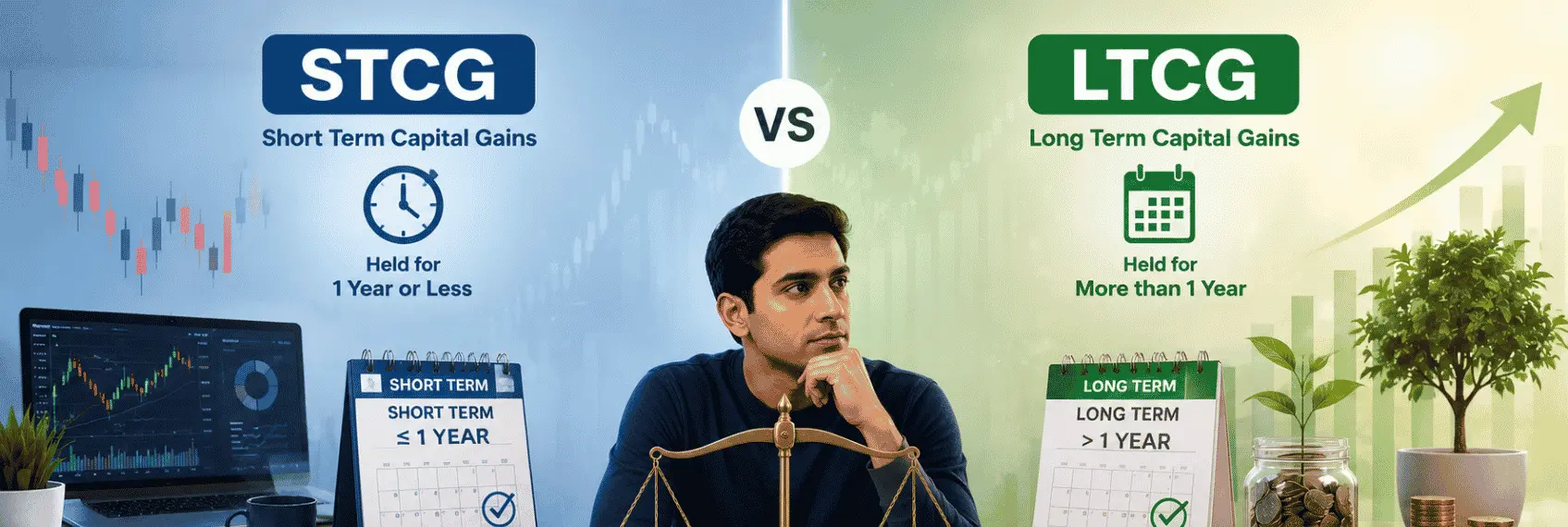
Two investors buy the same stock on the same day, sell at the same price - and walk away with different amounts after tax. The only difference: one held for 11 months, the other for 13. That two-month gap is the difference between Short-Term Capital Gains (STCG) taxed at 20% and Long-Term Capital Gains (LTCG) taxed at 12.5% with a ₹1.25 lakh exemption. Understanding STCG vs LTCG is not a compliance exercise — it is one of the most direct ways to improve your after-tax investment returns in India.
What Are Capital Gains?
A capital gain is the amount of increase in the value of an asset (such as equity shares or mutual funds or property) that has occurred between the time of purchase and the time of sale. You purchase a stock for ₹500 and sell it for ₹750, the difference ₹250 is your capital gain. Easy to understand but with far-reaching implications.
Understanding Capital Gains
As per provisions of Income Tax Act, 1961, capital gains are deemed to be earned when an asset is sold. The short answer is that the rate they're taxed at relies on one factor more than anything else: the length of time they've held the asset prior to its sale. This one decision — can alter the tax liability, and the actual net return materially.
Why Capital Gains Tax Matters
Two investors can purchase the same stock at a comparable price and sell at a comparable price and still have different after-tax returns due to holding it for 11 months versus 13 months. Not understanding the capital gains tax is not a compliance issue; it is a return optimisation decision and should be part of every investment plan.
What Is Short-Term Capital Gain (STCG)?
STCG Meaning
A short-term capital gain is the gain made from selling an asset before the minimum holding period stipulated by the tax law. In the case of listed equity shares and equity-orientated mutual funds, the time bar is 12 months. The selling of an investment prior to one year from the date of purchase is considered STCG; if each rupee of profit is sold before a year, then it is regarded as STCG.
STCG Tax Rate
Under Section 111A, STCG from equity and equity-oriented funds, where STT has been paid, will be taxed at 20% (from 15% earlier) after the Union Budget 2024 change. The effective rate is 20.8% (adding 4% health and education cess). On a profit of ₹1 lakh, it is equivalent to ₹20,800 due to the government at the end of the first year without the reinvestment of a single rupee.
Holding Period for STCG
The holding period for Debt Mutual Funds is 24 months. Since the April 2023 amendment, all debt funds' gains, irrespective of when they are held, have been considered as total income and taxed under the investor's applicable slab rate. The old LTCG benefit on debt funds (after indexation) has been eliminated.
In case of non-equity assets, STCG is also treated as income and taxed at rates as per the slab rates applicable to the investors in highest rates of income tax and effective rate for investors in the highest slab rate income tax may be 30% plus surcharge and cess.
What Is Long-Term Capital Gain (LTCG)?
LTCG Meaning
Long-term capital gain is the gain made on investment when the asset is held for a longer period than the prescribed limit of 12 months for listed equity shares and funds that invest in equity shares. It is taxed at a lower rate than STCG and includes an exemption, the structural tax policy incentive for patient investors.
LTCG Tax Rate
LTCG on listed equity and equity mutual funds taxed at 12.5% on gains exceeding ₹1.25 lakh in FY after Budget 2024. Gains upto that limit are completely exempt, which is also an increase from the previous limit of ₹1 lakh, offering a little but significant relief to retail investors who have a smaller equity portfolio.
With the 12.5% rate on top of the annual exemption, this is a strong mathematical argument to keep equity investments longer than a year.
STCG vs LTCG: Key Differences
Below captures the essential comparison across the parameters that matter most to equity and mutual fund investors:
Holding period: STCG applies to equity held for less than 12 months; LTCG applies at 12 months or more.
Tax rate on equity: STCG is taxed at 20%; LTCG at 12.5% on gains above ₹1.25 lakh.
Exemption: STCG carries no exemption; LTCG is exempt up to ₹1.25 lakh per financial year.
Applicable section: STCG falls under Section 111A; LTCG under Section 112A.
Debt mutual funds: Both STCG and LTCG on debt funds are now taxed at slab rates — the LTCG benefit no longer applies.
Intraday trading: Not classified as capital gains at all — treated as speculative business income and taxed at slab rates.
The difference between STCG and LTCG on an identical profit can be 7.5 % points of tax rate plus the loss of the exemption benefit. On meaningful investment amounts, that gap translates directly into the compounding base available for future returns.
STCG vs LTCG on Stocks
For equity shares listed on Indian exchanges, the arithmetic of the twelve-month threshold is stark.
Sell shares purchased in January 2025 in September 2025 and any profit attracts STCG at 20%. Wait until February 2026 — two additional months — and the same profit is LTCG, taxed at 12.5% with a ₹1.25 lakh exemption applied first. The business has not changed. The asset has not changed. The only variable is the calendar.
At a profit of ₹3 lakh: STCG liability is ₹60,000. LTCG liability is ₹21,875 (12.5% on ₹1.75 lakh after exemption). The difference is ₹38,125 — on the same investment, the same stock, the same gain but just difference in Time period.
Frequent traders bear the highest burden here. Each short-term exit resets the clock and crystallises tax at the higher rate. Portfolio churn is not merely an indirect cost through transaction fees and bid-ask spreads — it is a direct and recurring tax cost that compounds in the wrong direction.
Intraday trades carry a separate tax treatment entirely. Gains from positions opened and closed within the same trading day are classified as speculative business income, taxed at slab rates, and cannot be offset against capital gains from delivery-based trades.
STCG vs LTCG on Mutual Funds
Mutual fund taxation requires distinguishing between fund types before applying any holding period rule.
Equity-oriented mutual funds – those with more than 65% allocation to equities – follow the same twelve-month rule as direct equity: STCG at 20% for holdings under a year, LTCG at 12.5% above ₹1.25 lakh for holdings of a year or more.
Debt mutual funds, following the April 2023 amendment, no longer carry any LTCG benefit. All gains, regardless of holding period, are added to the investor's total income and taxed at their applicable slab rate. An investor in the 30% bracket pays 30% plus cess on every rupee of debt fund profit — irrespective of whether they held the fund for three months or three years.
Hybrid and balanced funds are assessed based on their actual equity allocation. Funds maintaining 65% or more in equities are treated as equity funds for tax purposes. Those below that threshold are taxed as debt funds.
SIP investors face a specific complexity that is frequently misunderstood. Each monthly instalment is treated as a separate purchase with its own acquisition date and holding period. When you redeem from an SIP, the oldest units are redeemed first – but units purchased within the preceding twelve months of any redemption will attract STCG at 20%. Tracking individual unit purchase dates, or using a fund house's statement of account that displays lot-wise holding periods, is essential for SIP investors planning redemptions.
How STCG and LTCG Affect Your Investment Returns
The post-tax impact of capital gains tax is most clearly understood through direct calculation rather than abstract rates.
Scenario: ₹500,000 invested in an equity mutual fund, sold after ten months with a profit of ₹80,000.
STCG at 20%: ₹16,000 in tax. Net gain: ₹64,000.
Same investment, same profit, held for two additional months past twelve: the ₹80,000 gain qualifies as LTCG and falls entirely within the ₹1.25 lakh annual exemption. Tax liability: zero. Net gain: ₹80,000.
The difference is ₹16,000 — generated by holding for sixty additional days. That ₹16,000, reinvested and compounded at 12% annually over ten years, becomes approximately ₹49,600. The real cost of early exit is not just the tax paid — it is the future value of the capital that tax removes from the compounding base.
At higher profit levels, the arithmetic intensifies. A ₹5 lakh profit sold short-term generates a tax liability of ₹1,00,000. The same profit held to LTCG status generates a tax liability of ₹46,875 — a saving of ₹53,125 from the same investment decision made at the point of sale.
Strategies to Minimise Capital Gains Tax
- Hold beyond twelve months. The single most impactful tax decision available to equity investors requires no sophistication — only patience. Converting STCG to LTCG reduces the applicable rate from 20% to 12.5% and activates the annual exemption.
- Harvest the ₹1.25 lakh LTCG exemption annually. Each financial year, long-term gains up to ₹1.25 lakh are fully exempt. Investors who systematically book gains up to that threshold and immediately reinvest reset their cost of acquisition — harvesting tax-free profits while maintaining their market position.
- Apply tax-loss harvesting deliberately. Capital losses can offset capital gains in the same financial year. Short-term losses offset both STCG and LTCG; long-term losses offset only LTCG. Identifying underperforming positions and booking those losses before year-end to offset gains elsewhere in the portfolio is a concrete and legal mechanism for reducing tax outgo.
- Sequence SIP redemptions correctly. For SIP investors, always redeem the oldest units first — they are most likely to qualify as LTCG and benefit from the exemption. Avoid redeeming recent instalments where the twelve-month threshold has not yet been cleared.
- Reduce portfolio churn. Every unnecessary exit from a position that would have qualified for LTCG in a further period triggers STCG at 20%. The indirect costs of high turnover — transaction costs, impact cost — are visible. The direct capital gains tax cost is equally real and often larger.
Common Mistakes Investors Make
Selling without checking the holding period: Investors frequently exit positions days or weeks before the twelve-month mark, paying STCG on a gain that would have qualified as LTCG with minimal additional wait.
Applying equity fund rules to debt funds: Post the 2023 amendment, debt funds no longer enjoy LTCG treatment. Investors who assumed long-term holding would provide a tax advantage in debt funds are now paying slab-rate tax regardless of tenure.
Ignoring cess and surcharge: The headline STCG rate is 20% and LTCG is 12.5%. The effective rates — after 4% health and education cess — are 20.8% and 13% respectively. High-income investors are subject to additional surcharges that increase effective rates further.
Miscalculating the cost of acquisition for corporate actions: For bonus shares, the acquisition cost is zero, and the holding period begins from the date of allotment, not the original purchase date. For rights issues, stock splits, and mergers, the adjusted acquisition cost and holding period require specific calculation. Getting these wrong changes both the gain amount and its classification.
Not carrying forward losses: Capital losses can be carried forward for up to eight assessment years and set off against future capital gains. Investors who do not file returns for loss years — or who are unaware of the provision — forfeit a genuine and compounding tax benefit.
Treating SIP gains as uniformly long-term: Investors with multi-year SIPs often assume all their gains are LTCG. Units purchased within the last twelve months of any redemption are not, and in a large SIP portfolio, that proportion can be material.
Key Takeaways
For equity shares and equity mutual funds, the twelve-month holding period is the defining line between STCG at 20% and LTCG at 12.5% with a ₹1.25 lakh annual exemption. Debt mutual funds no longer carry LTCG benefits — all gains are taxed at slab rates regardless of tenure. Intraday gains are not capital gains and are taxed as speculative business income. The annual LTCG exemption, tax-loss harvesting, reduced portfolio churn, and careful SIP redemption sequencing are the primary tools available to reduce capital gains tax legally and effectively. The difference between STCG and LTCG on the same profit is not marginal — on meaningful investment amounts, it is a figure worth planning around.
Disclaimer: This information is just for educational and general purposes. It isn't formal financial or tax advice. Tax laws and rates change all the time. The numbers and rates mentioned here are based on the Union Budget 2024 and were accurate when we wrote this. Because everyone's financial situation is different, you should definitely talk to a SEBI-registered investment advisor or a certified tax professional before you make any actual investment or tax decisions.