
What are post office savings schemes?
The government-backed Post Office Savings Schemes are a good option for you to invest your money safely. Since these schemes are not influenced by stock market changes, they are a safe way to save and grow your money. For all those who are looking for a good financial future whether it’s for retirement, tax breaks or simply keeping their money safe, these schemes are recommended.
Your Complete List of Post Office Savings Schemes (2026)
Here's a list of the different savings options that are available for you:
| Scheme | Tenure | Key Benefit | Ideal For |
| Post Office Savings Account | No fixed tenure | High liquidity | Beginners |
| Recurring Deposit (RD) | 5 years | Helps build a monthly savings habit | Salaried individuals |
| Time Deposit (FD) | 1–5 years | Fixed returns | Short-term investors |
| Monthly Income Scheme (MIS) | 5 years | Regular monthly income | Retirees |
| Senior Citizen Savings Scheme (SCSS) | 5 years | High interest | Senior citizens |
| Public Provident Fund (PPF) | 15 years | Tax-free returns | Long-term investors |
| National Savings Certificate (NSC) | 5 years | Tax saving + fixed returns | Conservative investors |
| Kisan Vikas Patra (KVP) | ~115 months | Doubles investment | Medium-term goals |
| Sukanya Samriddhi Yojana (SSY) | 21 years | High returns + tax benefits | Savings for a Girl child |
Which Post Office Plan Is Right for You?
The best plan for you depends on your financial needs..
Here is a helpful guide to help you pick the right one:
PPF and NSC are the best for saving taxes; you can grow your wealth while getting tax breaks under Section 80C.
SCSS and SSY are the best for earning returns; you get attractive fixed interest rates that are backed by the government.
MIS is the best for monthly returns; you get a steady, predictable cashflow every month.
Fixed Deposits protect your money by giving you fixed returns once they mature.
Current Interest Rates (For 2026)
The current interest rate for each savings plan is as follows:
| Scheme | Interest Rate (p.a.) |
| Savings Account | 4.00% |
| RD | 6.70% |
| Time Deposit | 6.9% – 7.5% |
| MIS | 7.40% |
| SCSS | 8.20% |
| PPF | 7.10% |
| NSC | 7.70% |
| KVP | 7.50% |
| SSY | 8.20% |
Note: Interest rates may change every quarter as set by the Government of India.
Getting to Know the Tax Benefits
Knowing how these plans can help you save money on taxes can really help you decide better which plan benefits you more: -
Deductions under Section 80C are available for:
PPF, NSC, SSY, SCSS
You can get back up to ₹1.5 lakh every year, for investment in these plans.
Returns Without Taxes:
PPF, SSY
The interest and the amount that is due on maturity, are both tax-free.
Taxable Interest Plans:
MIS, Time Deposit, and RD
The interest you earn on these plans will be added to your taxable income.
Comparing Post Office Schemes to Other Investment Options
| Feature | Post Office Schemes | Bank FD | Mutual Funds |
| Safety | Highest (Govt-backed) | High | Market-linked |
| Returns | Moderate | Moderate | Potentially High |
| Liquidity | Low | Medium | High |
| Risk | Very Low | Low | Medium to High |
If you want safety and stability of your money, Post Office plans are the best.
If you want to grow your wealth, mutual funds might be the best option.
How to Pick the Right Plan
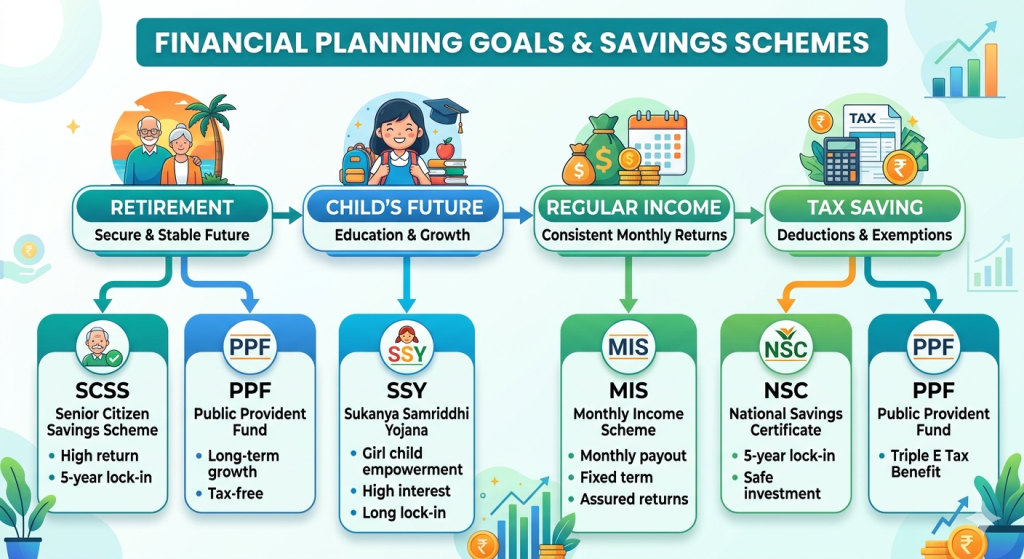
First, think about your end goal, and accordingly choose the right product.
A Simple Guide to Getting Started with Investing
1. Go to the nearest post office
2. Get your KYC papers ready, like your Aadhaar, PAN, and photos.
3. Pick the right plan based on your money goals.
4. Put down the least amount of money you need to.
5. Get your investment certificate or passbook.
Last Thoughts
If you are looking for safe and predictable investments in 2026, you should look into Post Office Savings Plans. They might not give you the same high returns as the stock market, but they are a safe way to protect your money, make steady income, and get tax deductions.