
MCX Natural Gas prices closely track the U.S. Henry Hub benchmark, making American supply, demand, weather, LNG exports and storage data the key drivers for Indian traders. With global LNG demand rising and U.S. exports expanding, understanding Henry Hub fundamentals has become essential for trading MCX Natural Gas.
Natural gas is a cornerstone of the global energy system, powering electricity grids, industrial processes, fertilizer production, city gas networks, and household heating.For Indian traders, MCX Natural Gas futures are essentially a rupee-denominated reflection of the U.S. Henry Hub benchmark, making U.S. fundamentals the primary driver of price action.
The Henry Hub is a natural gas pipeline interchange located in Erath, Louisiana. Owned by Sabine Pipe Line LLC, it connects multiple interstate and intrastate pipelines. Because of its massive volume and central location, it serves as the official pricing point for natural gas futures contracts traded on the Cme/Nymex Exchange.
How MCX Natural Gas Tracks the U.S. Market
MCX Natural Gas futures are directly linked to the NYMEX Henry Hub Natural Gas contract traded in the United States. The pricing chain works as follows:
Henry Hub price (USD/MMBtu) → USD/INR exchange rate → MCX price (₹/MMBtu)
At expiry, the MCX settlement price is calculated using the NYMEX front-month settlement price converted at the latest RBI USD/INR reference rate. This means MCX prices broadly move in tandem with U.S. natural gas futures, with minor deviations due to exchange rate fluctuations and contract specifications.
Contract Specifications: U.S. vs. India
| Particular | U.S. (CME/NYMEX Henry Hub) | India (MCX) |
| Benchmark | Henry Hub | Tracks Henry Hub |
| Contract Size | 10,000 MMBtu | 1,250 MMBtu |
| Price Quotation | US$/MMBtu | ₹ per MMBtu |
| Trading Hours | CME Globex (nearly 24/5) | 9:00 AM – 11:30/11:55 PM IST (Mon–Fri) |
| Settlement | Yes, physical delivery is possible | Cash-settled (USD/INR conversion) |
| Tick Size | $0.001/MMBtu | ₹0.10/MMBtu |
For Indian traders, the U.S. market serves as the primary price discovery venue, while MCX provides a localized, rupee-denominated exposure.
Current Market Snapshot (as of July 2026)
- MCX Natural Gas (near-month): ~₹307–309 per MMBtu
- NYMEX Henry Hub (front-month): ~$3.28 per MMBtu
- USD/INR (approx.): ₹94–95 (implied from MCX vs. Henry Hub pricing)
Recent U.S. natural gas futures have climbed to their highest level in over a week, supported by tighter supply-demand balances.
Key Drivers of the Recent Rally
1. Declining U.S. Gas Production
Production in the Lower 48 states has slipped from 110.0 bcfd in June to 109.4 bcfd in early July. This reduction in output tightens available supply and supports prices.
2. Surging LNG Export Demand
Flows to U.S. LNG export terminals have increased from 17.4 bcfd to 18.1 bcfd. Higher exports reduce domestic availability and strengthen Henry Hub prices.
3. Heatwave-Driven Power Demand
Extreme heat across the U.S. has boosted electricity consumption for air conditioning, prompting gas-fired power plants to burn more fuel. This has accelerated storage withdrawals and tightened market balances.
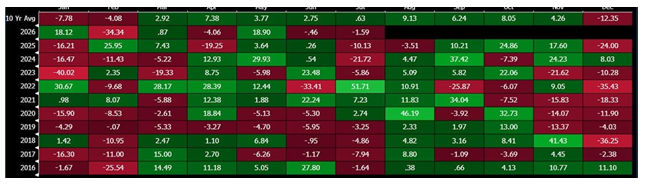
4. Natural Gas Seasonality: 10-Year Price Performance Analysis
Natural gas exhibits strong seasonal patterns driven by heating demand in winter and cooling demand in summer, with the most reliable bullish windows occurring in late spring (April-May) and early fall (September-October).
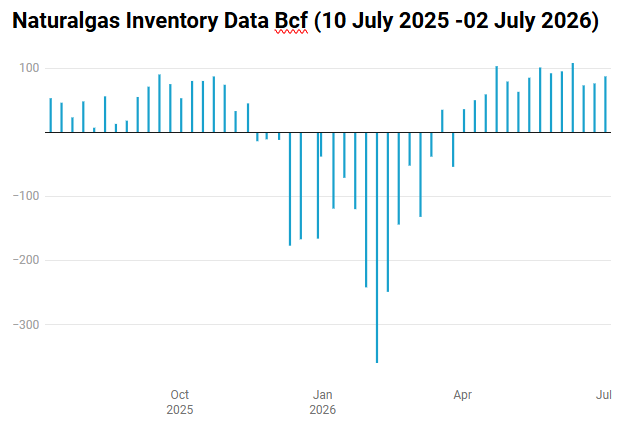
5. Natural Gas EIA Inventory.
Potential Headwinds to Further Gains
Despite the bullish momentum, several risks could cap further upside:
- Cooler Weather Forecast: Models indicate below-normal temperatures across the eastern U.S. through mid-July, which could reduce power demand and slow inventory draw downs.
- Larger Storage Injections: If weekly EIA reports show bigger-than-expected storage builds, sentiment could turn negative.
- Production Recovery: A rebound in Lower 48 output would ease supply concerns.
- USD/INR Strength: A stronger rupee would lower the rupee-equivalent MCX price even if Henry Hub holds steady.
Weather remains the dominant short-term price driver in natural gas markets.
The Structural Shift: U.S. LNG and Global Integration
The U.S. has emerged as the world's leading LNG exporter, fundamentally altering the global gas landscape. The International Energy Agency (IEA) projects Asian LNG imports to grow 10% in 2026, driven by rising energy demand and fuel-switching policies.
New U.S. export facilities—such as Golden Pass LNG and Plaquemines LNG—are significantly expanding America's export capacity. This deepens the link between U.S. domestic gas prices and international energy markets.
Why Global Events Now Matter More
As more countries rely on U.S. LNG, global supply disruptions increasingly feed through to Henry Hub prices. Key risk events include:
- Geopolitical tensions in the Middle East
- Disruptions in the Strait of Hormuz
- Outages at major LNG export terminals
- Extreme weather (hurricanes, freezes)
- Unexpected production declines
Any tightening in global LNG supply pushes international buyers toward U.S. cargoes, supporting Henry Hub—and by extension, MCX—prices.
What MCX Traders Should Monitor
Since MCX Natural Gas mirrors Henry Hub, Indian traders should prioritize U.S. fundamentals over domestic news. Key indicators include:
- U.S. Weather Forecasts (temperature outlooks)
- EIA Weekly Natural Gas Storage Report (Thursdays)
- Lower 48 Gas Production Data
- Henry Hub Futures Prices (NYMEX)
- LNG Export Terminal Flows
- USD/INR Exchange Rate
- Global Geopolitical Developments
These metrics often provide early signals for MCX price direction.
Short-Term Outlook
The near-term bias remains moderately bullish trading range RS 295 to RS 340, contingent on weather patterns and export flows.
Key Takeaway
MCX Natural Gas is fundamentally a rupee-denominated proxy for the U.S. Henry Hub market. While prices are quoted in INR, the real drivers—production, LNG exports, weather, and storage—originate in the United States.
For Indian traders, mastering U.S. fundamentals is far more valuable than focusing solely on domestic developments. As global LNG trade expands and Asia's dependence on U.S. exports grows, the Henry Hub–MCX link will only strengthen. Staying informed on these global dynamics can help traders anticipate volatility and make more confident decisions.