Summary:
India’s energy security concerns have intensified amid rising crude oil prices and limited battery storage capacity. The growing focus on Battery Energy Storage Systems (BESS) is expected to benefit companies such as Exide Industries, Amara Raja Energy & Mobility, Adani Green Energy, JSW Energy, and NTPC as India accelerates investments in renewable energy storage infrastructure.
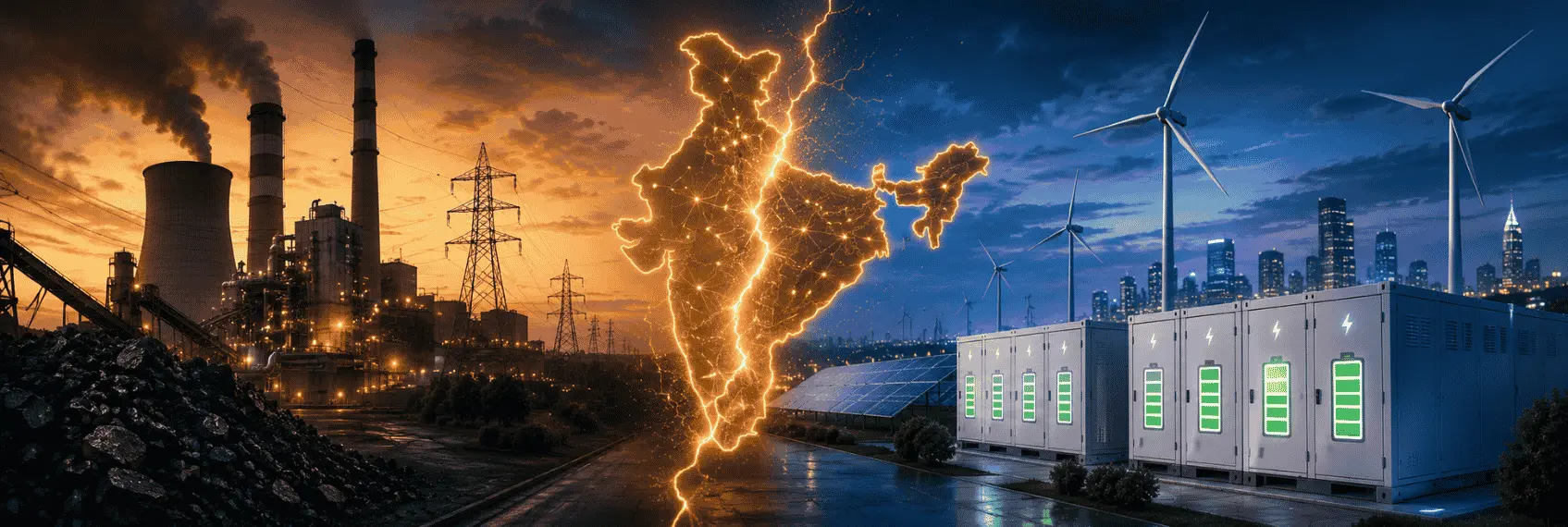
India is staring at an energy emergency from two directions at once, and the collision is forcing a reckoning that policymakers have long postponed.
On one side, there is a structural problem years in the making: a country that has built 200 GW of renewable capacity but can store only 4.86 GW of it, leaving the grid unable to function without fossil fuels propping it up after sunset (NLDC, 2025). On the other side, there is a geopolitical shock that has turned that structural weakness into an acute crisis. The ongoing Iran–US–Israel conflict, which erupted in early 2026, has effectively shut the Strait of Hormuz, the narrow waterway through which roughly 25% of the world's seaborne oil trade passes (IEA, 2026). For India, the consequences have been immediate and brutal.
The Hormuz Shock
India imports around 85% of its energy requirements. Some 50% of the crude oil that is imported by the country, 60% of the liquefied natural gas, and virtually all of the liquified petroleum gas goes through the Strait of Hormuz (CNBC, May 2026). With Iranian troops declaring the strait "closed" to shipping as of March 4, 2026, India saw over 40% of its crude oil shipments effectively shut off (OilPrice.com, May 2026). India's crude oil basket, which was trading at an initially manageable $69 per barrel in February 2026, quickly rose to $126 by March 2026 and reached $157 per barrel (ORF, May 2026). Brent crude prices may now average $86 a barrel in 2026 compared to $69 in 2025 and could climb to $115 (World Bank Commodity Markets Outlook, April 2026).
The government slashed excise duties on petrol and diesel by ₹10 per litre to shield consumers and issued a Natural Gas Control Order rationing supply. Oil marketing companies are bleeding up to ₹1,000 crore per day as pump prices are held artificially low (OilPrice.com). India's GDP growth forecast has been trimmed to 6.2–6.7% for FY2026-27, down from 7.7% the year before (UBS, Fitch/BMI).
Prime Minister Modi publicly urged citizens to reduce fuel consumption, carpool, and work from home, a signal of just how exposed India's fossil fuel dependency has made it.
The Storage Gap Underneath It All
This geopolitical shock didn't create India's energy problem, it exposed one that was already there. Even before a single missile flew over the Gulf, India's grid was quietly fraying under the weight of rising demand and inadequate storage.
During the period between May and December 2025, India had to reduce 2.3 TWh of solar energy production due to the lack of storage facilities, meaning that the sun was producing more energy than the national grid could handle (IEEFA, May 2026). Evening peak demand exceeds what the renewables can produce on average, meaning that although India has about 140 GW of renewable energy production capacity, not more than 8-10 GW is available during evenings in 2024.
The India Energy and Climate Center (IECC) estimates that the demand for electricity in India may lead to evening shortages of 20-40 GW by 2027. Even under the most optimistic assumptions, including the completion of all proposed power projects by schedule, the Central Electricity Authority believes that most of India's states would be experiencing power shortages by 2034 (IEA Electricity 2026 Report).
The last piece of the puzzle that is battery storage does not exist at any scale whatsoever. Between 2021 and September 2025, India tendered for 83 GWh worth of Battery Energy Storage Systems (BESS) installations. But by September 2025, less than 500 MWh had been installed (ORF, February 2026). This difference between promise and fulfillment is not just an approximation but rather a systemic problem. India spends $26.4 billion annually on imports of cooking gas, mostly via Hormuz. Its strategic reserve covers only 25 days of crude and LPG, and ten days' worth of LNG (IEEFA). Meanwhile, China, which has similar geographic limitations, maintains a strategic reserve of 1.2 billion barrels and has displaced more than 1 million barrels of oil daily through the EV initiative.
Who Benefits From the Crisis?
In cases of structural crisis situations, winners are bound to emerge eventually. The crisis caused by the Hormuz region seems to have been successful in forcing India's dependency on foreign fuels, which was otherwise not possible through policy measures alone. With the Union Budget 2026-27 showing an increase of about 900% in BESS budgets year-on-year and a directive to boost energy storage from 1% to 4% for power distributors till 2029-2030, India's BESS market, valued at $2.19 billion in 2025, is expected to touch $19.4 billion by 2035 with a CAGR of 24.3%.
Several Indian companies are already in position to capture this transition:
Exide Energy Solutions has made a $120 million investment for lithium-ion production in FY25, and its 12 GWh gigafactory in Bengaluru is undergoing Phase 2 expansion. The company’s first phase commercial production (6 GWh) is anticipated by FY26’s end. Cell manufacturing in India gives Exide an advantage over companies importing batteries when disruptions occur in their logistics chain.
The Giga Corridor being developed by Amara Raja Energy & Mobility in Telangana uses LFP (Lithium Iron Phosphate) chemistry, which is used in 90 percent of global battery storage installations in 2025 (IEA). It has already signed a supply agreement with Greenko Energies and licensed the technology from China’s Gotion High-Tech, thus speeding up production.
Adani Group revealed a record-breaking 1,126 MW/3,530 MWh BESS deployment at Khavda, Gujarat in November 2025, one of the most significant single storage deployments in Indian history. The project uses more than 700 lithium-ion containers in addition to its solar and wind resources.
JSW Energy will invest $150 million via a joint venture with Fluence for the deployment of 500 MWh capacity in Karnataka and Maharashtra, making energy storage a crucial part of JSW’s renewable energy plans.
India’s largest power generation company, NTPC, has tendered for 5 GWh of energy storage in 2025 under its “Thermal + BESS” strategy to manage the grid frequency without depending on fossil-based power generation.
Bottom Line
The Strait of Hormuz may reopen. Oil prices may normalise. But India's vulnerability to that chokepoint, its $174.9 billion annual oil import bill, its 96% petrol-and-diesel vehicle fleet, its 25-day crude reserve, will not fix itself. The crisis has made energy storage less of an infrastructure aspiration and more of a national security imperative. The companies building that infrastructure today are not just chasing market share. They are building the foundation India should have laid a decade ago.