
Summary:
The Indian rupee has strengthened against the US dollar as falling crude oil prices and renewed foreign portfolio investment inflows improve dollar supply. RBI measures, FCNR(B) deposits and forex reserves have supported stability, while global yields and oil remain key risks.
Indian Rupee Recovery: From Record Lows to Recent Gains
The rupee’s recovery is especially notable because it follows a record low. USD/INR had touched an all-time high of 96.90–96.96 earlier in 2026, meaning the recent move toward 93.7 represents a rebound of more than 3% from those lows.
The currency first found a footing after the RBI’s measures to manage dollar demand, including a special foreign-exchange window for state-owned oil refiners. That shifted a large part of refiner dollar demand away from the spot market and helped stabilise USD/INR near 95.
The recovery then accelerated as Brent crude corrected sharply and foreign portfolio investors returned to Indian equities. The rupee touched 93.69 on 9 November, its strongest level in about six months, before consolidating around 93.7–93.9.
What Is Supporting the Indian Rupee? FPI Inflows, Lower Crude Oil and RBI Measures
Foreign flows have made the biggest difference. foreign portfolio investors bought about US$5.68 billion of Indian shares during November, the strongest monthly inflow since September 2024. Dollar selling linked to these equity purchases has improved near-term supply in the local market.
Lower crude is equally important. Brent slipped below US$90 a barrel on Tuesday, after a sharp fall last week, as fears of a wider disruption in West Asia eased. For a large crude importer such as India, cheaper oil reduces the import bill and the demand for dollars from refiners.
Reserves remain a substantial buffer, but the latest trend needs context. RBI data showed foreign exchange reserves at US$717.06 billion for the week ended 30 October, down US$2.69 billion week-on-week and below the September record of US$785.71 billion. Dollar sales by the RBI, FCNR(B)-related flows and valuation changes have contributed to the decline. The reserve stock is still size able; the weekly fall should not be read as a standalone sign of stress.
There is, however, a ceiling to the rally. The RBI’s reported net short forward position of about US$239 billion may require future dollar accumulation as contracts mature, potentially limiting the pace of rupee appreciation. Meanwhile, firmer US inflation and higher Treasury yields could revive dollar demand.
How FCNR(B) Deposits and NRI Inflows Are Supporting the Rupee
A further, less visible source of support has come from the RBI’s special FCNR(B) deposit scheme for non-resident Indians (NRIs). Banks mobilised foreign-currency deposits under the scheme and subsequently swapped those dollars with the RBI, adding to the central bank’s usable foreign-currency resources.
These NRI-linked inflows helped bolster dollar supply at a time when the rupee was under pressure. They also gave the RBI additional ammunition to smooth volatility, complementing direct intervention and the special window for oil refiners.
The story is supportive in the near term but not costless over time. NRI deposits raised under FCNR(B) arrangements must eventually be repaid—market commentary points to maturities concentrated between 2029 and 2031—so the programme provides a buffer now while creating a future external-financing obligation.
In short, NRI bond/deposit flows have helped stabilise the rupee by supplementing reserves and reducing immediate spot-market dollar pressure. Their durability depends on continued depositor interest, global interest-rate differentials and the RBI’s ability to manage the eventual maturity profile without renewed pressure on the currency.
India's Forex Reserves: A Buffer Against External Pressure, Not a Stress Signal
Chart 2: India’s foreign-exchange reserves stood at US$717.06 billion for the week ended 30 October, down US$2.69 billion week-on-week and below the September record of US$785.71 billion.
Source: RBI weekly data cited in market commentary.
The reserve stock remains sizeable. The weekly decline reflects RBI dollar sales, FCNR(B)-related flows and valuation changes; it should not be read in isolation as a sign of external-sector stress.
USD/INR Technical Analysis: Support, Resistance and Momentum
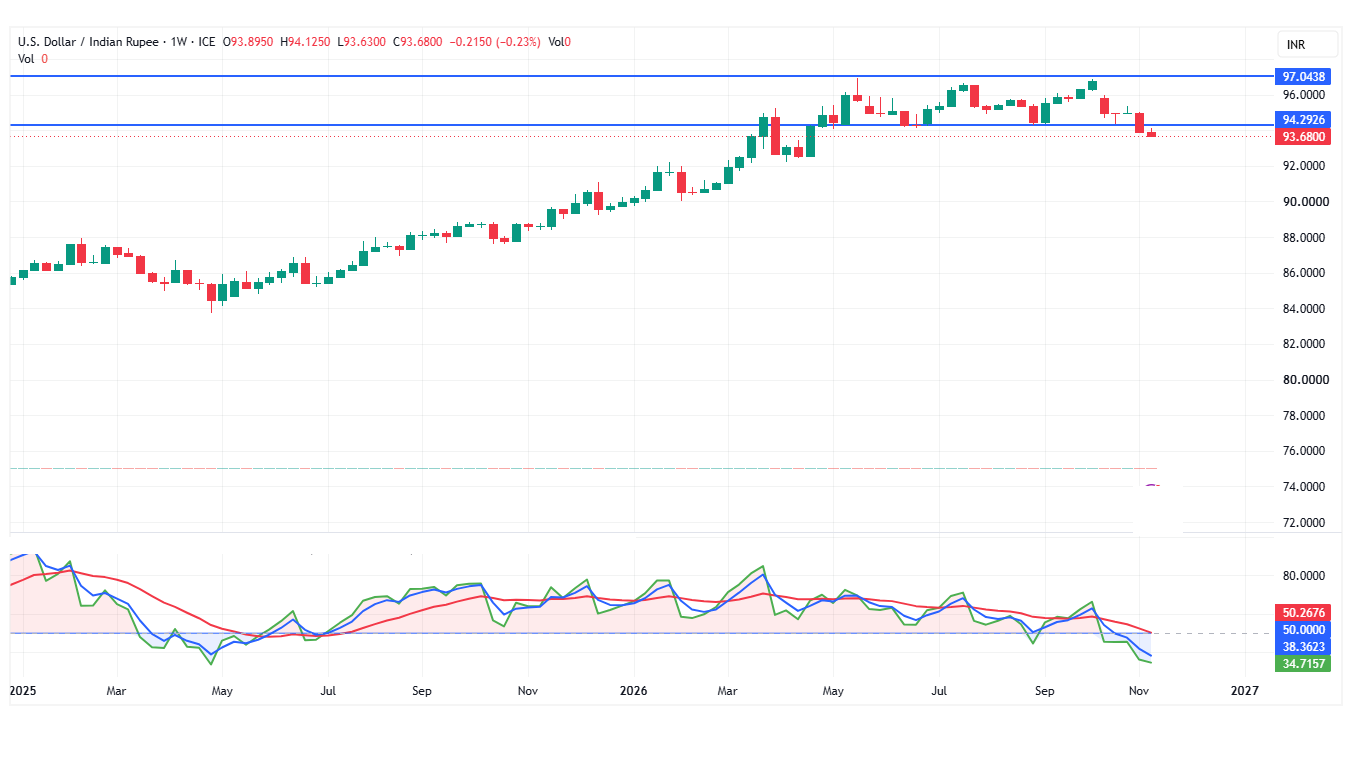
Source Image Trading view
The short-term bias remains mildly bearish for USD/INR (positive for the rupee). The pair is trading below its 20-, 50- and 200-day moving averages, while the daily RSI is near 43 and MACD remains negative. This points to weak momentum in the dollar-rupee pair, though a sharp one-way fall should not be assumed.
| Level | USD/INR zone |
| Immediate support | 93.60–93.50 |
| Next support | 93.30 then 93.00 |
| Immediate resistance | 93.80–94.00 |
| Major resistance | 94.30 |
A sustained break below 93.50 could open room towards 93.30 and 93.00. On the upside, a move back above 94.00 would signal that the recovery is losing steam; a close above 94.30 would weaken the near-term rupee-positive view.
Outlook and risks
The balance of risks favours a steady-to-firmer rupee, provided crude stays contained and foreign buying continues. The key tests are the durability of FPI inflows, the next moves in US yields and the RBI’s presence near key levels. Importer dollar demand and any renewed geopolitical shock remain risks to the recovery.