






For an insight into what active trading is, how active traders view the market, their tools and investment vehicles and finally, the risks associated with their style, here's an interesting article.
What Is Active Trading?
The best way to understand active trading is to differentiate it from buy-and-hold investing, which is based on the belief that a good investment will be profitable in the long term. This means ignoring day-to-day market fluctuations. Using a buy-and-hold strategy, this kind of investor is indifferent to the short-term for two reasons: first, because he or she believes any momentary effects of short-term movements really are minor compared to the long-term average, and second, because short-term movements are nearly impossible to exactly predict.
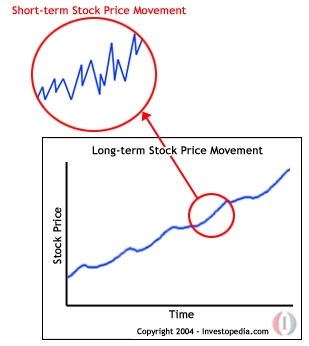
An active trader, on the other hand, isn't keen on exposing his or her investments to the effect of short-term losses or missing the opportunity of short-term gains. It's not surprising then, that active traders see an average long-term return not as an insurmountable standard but as a run-of-the-mill expectation. To exceed the standard, or outperform the market, the trader realizes that he or she must look for the profit potential in the market's temporary trends, which means trying to perceive a trend as it begins and predict where it will go in the near future. Below is a chart that demonstrates the difference between the long- and short-term movements of the market. Note that even though the security moves upward over time, it experiences many smaller trends in both directions along the way.
 |
Performance and the Short Term
Traders are "active" because for them the importance of the market's short-term activity is magnified - these market movements offer an opportunity for accelerated capital gains. A trader's style determines the time frame within which he or she looks for trends. Some look for trends within a span of a few months, some within a few weeks and some within a few hours. Because a shorter period will see more definitive market movements, a trader analyzing a shorter time frame will be more active, executing more trades.
A greater number of trades don't necessarily equal greater profits. Outperforming the market doesn't mean maximizing your activity, but maximizing your opportunities with a strategy. An active trader will strive to buy and sell (or vice versa in the case of shorting) at the two extremes of a trend within a given time frame. When buying a stock, a trader may try to buy it at the lowest point possible (or an upwards turning point, otherwise known as a bottom) and then sell it when there are signs that it has hit a high point. These signs are generally discerned by means of technical analysis tools, which we discuss below. The more the trader strives to buy and sell at the extremes, the more aggressive - and risky - is his or her strategy.
Technical Analysis
You need particular analytical techniques and tools to discern when a trend starts and when it will come to an end. Technical analysis specializes in interpreting price trends, identifying the best time to buy and sell a security with the use of charts. Unlike fundamental analysis, technical analysis sees price as an all-important factor that tells the direction security will take in the short term. Here are three principles of technical analysis:
- For the most part, the current price of stock already reflects the forces influencing it - such as political, economic and social changes - as well as people's perception of these events.
- Prices tend to move in trends.
- History repeats itself.
From these three principles emerges a complicated discipline that designs special indicators to help the trader determine what will happen in the future. Indicators are ways in which price data is processed (usually by means of a calculation) in order to clarify price patterns, which become apparent when the results of the indicator's calculation are plotted on a chart. Displayed together with plotted historical prices, these indicators can help the trader discern trend lines and analyze them, reading signals emitted by the indicator in order to choose entry into or exit from the trade. Some examples of the many different types of indicators are moving averages, relative strengths and oscillators.
Active trading offers the enticing potential of above-average returns, but like almost anything else that's enticing, it cannot be achieved successfully without costs and risks. The shorter time frame to which traders devote themselves offers a vast potential but, because the market can move fast, the trader must know how to read it and then react. Without skill in discerning signals and timing entries and exits, the trader may not only miss opportunities but also suffer the blow of rapid losses - especially if, as we explained above, the trader is riding on high leverage. Thus, learning to trade is both time-consuming and expensive. Any person thinking of becoming an active trader should take this into account. Also, the higher frequency of transactions of active trading doesn't come for free: brokerage commissions are placed on every trade and, since these commissions are an expense, they eat into the trader's return. Because every trade costs money, a trader must be confident in his or her decision: to achieve profits, the return of a trade must be well above the commission. If a trader is not sure of what he or she is doing and ends up trading more frequently because of blunders, the brokerage costs will add up on top of any losses.Finally, because securities are being entered and exited so often, the active trader will have to pay taxes on any capital gains realized every year. This could differ from a more passive investor who holds investments for numerous years and does not pay capital gains tax on a yearly basis. Capital gains tax expenses must also be factored in when an active trader is calculating the overall return.The Bottom Line
As you gain more education and experience as an investor, you may become curious about the different ways to reach returns. It is important to be willing to learn about different strategies and approaches, but it is equally important to know what suits your personality, skills and risk tolerance. You may have guessed that active trading is best suited to those who are committed to taking control of their portfolio and pursuing their goals quickly and aggressively. All of this requires a willingness to not only take risks but also keep up skills and efficiency. If this sounds like you, it may be time to start learning more!
Source: Investopedia
Disclaimer: Ventura Securities Ltd has taken due care and caution in compilation of data for its web blog. The information has been obtained from different sources which it considers reliable. However, Ventura Securities Ltd does not guarantee the accuracy, adequacy or completeness of any information and is not responsible for any errors or omissions or for the results obtained from the use of such information. Ventura Securities Ltd especially states that it has no financial liability whatsoever to any user on account of the use of information provided on its web blog. The information provided herein is just for the knowledge purpose and shouldn’t be construed as investment advice under any circumstances.











Post your comment
You must be logged in to post a comment.