Summary:
Furniture rentals are gaining traction as shorter urban tenancies make upfront furnishing costs harder to justify. Renting can offer flexibility and lower initial spending, but total costs depend on contract terms, maintenance, relocation frequency, ownership value and product utilisation.
Is renting furniture cheaper than buying it in India?
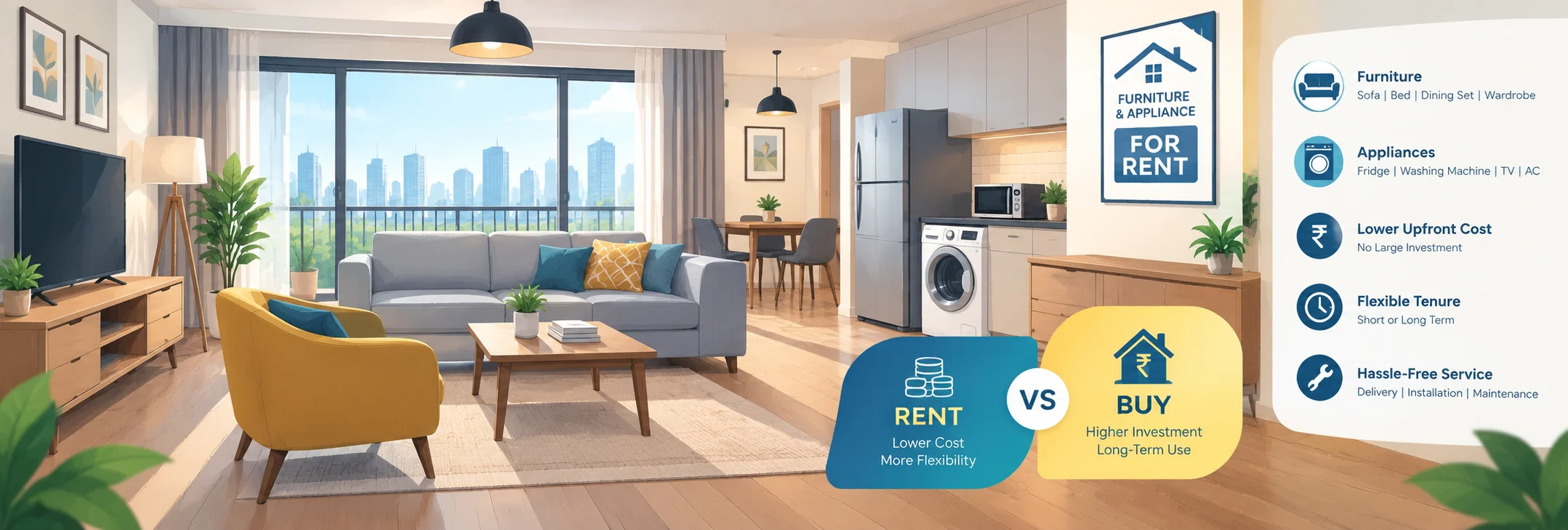
Renting beds, sofas, refrigerators and washing machines is becoming a practical alternative to buying them outright for some urban households. Shorter tenancies and higher upfront furnishing costs have made monthly subscription models more visible across Indian cities.
The economics differ by household. A two-year rental arrangement may reduce the immediate cash requirement, but the total cost depends on the contract, product selection, maintenance, and how often the customer moves.
| Key fact | Details |
| Average metro tenancy | About 1.3 years in 2025, compared with 1.8 years in 2021 |
| Cost of furnishing a one-bedroom home | Estimated at eight to nine months of average income |
| Two-year rental package | ₹3.33 lakh |
| Two-year upfront purchase | ₹4.02 lakh |
| Two-year EMI purchase | ₹4.41 lakh, based on an illustrative plan charging about 16% interest |
| Rentomojo revenue mix | Appliances accounted for 47% of revenue, according to the industry reporting cited |
| Key consumer consideration | Total contract cost, duration of use, extra charges and resale value |
| Key provider consideration | Inventory utilisation, maintenance, refurbishment, logistics and cash collection |
Shorter Urban Tenancies Are Changing Furnishing Decisions
Industry data cited in the October 2026 market coverage put average metro tenancies at about 1.3 years in 2025, down from 1.8 years in 2021. A family expecting to relocate after a year faces delivery, dismantling, storage, and resale costs when it owns bulky household goods.
Furnishing a one-bedroom home was estimated to cost around eight to nine months of average income in India. That comparison depends on the income base and products included. It should not be treated as the price of every furnished home.
Furniture Rental vs Buying: Comparing the Two-Year Cost
A two-year illustration circulated by a rental operator placed furniture and appliance rental costs at ₹3.33 L, compared with ₹4.02 L for outright purchases and ₹4.41 L under a 24-month instalment plan charging about 16% interest. The figures describe one package and financing assumption, not a universal price comparison.
Ownership has a resale value after the initial purchase, whereas renters typically return the items when the agreement ends. Deposits, damage charges, delivery fees and subscription extensions can change the final cost. Those details matter most when a tenancy lasts longer than expected.
Illustrative Two-Year Furnishing Costs
| Approach | Reported cost |
| Rental package | ₹3.33 L |
| Upfront purchase | ₹4.02 L |
| 24-month EMI purchase | ₹4.41 L |
| Illustrative EMI interest | 16% |
Rental Companies Expand Beyond Sofas
Home-rental businesses are widening their catalogues to include appliances, which can be rented alongside furniture in a single contract. Industry reporting indicates that appliances accounted for 47% of Rentomojo’s revenue, reflecting demand for products used every day.
The business model is capital-intensive. Companies buy inventory before collecting subscription fees, arrange delivery and installation, and repair or refurbish returned goods for subsequent customers. The number of rental cycles completed by each item determines how much revenue it earns over its usable life.
Longer utilisation periods can spread purchase costs across several tenants. Idle stock, damaged products and reverse logistics work in the opposite direction.
Why Contract Terms Remain Important
Rental plans can improve flexibility for students, newly employed workers and people on temporary assignments. The same arrangement may be more expensive than ownership for a family that stays in one location for several years and maintains the goods well.
Consumers need to compare the full contract value rather than only the monthly instalment. Cancellation conditions, deposit refunds, service coverage, product age and ownership options can all change the outcome.
Urban mobility is creating demand for home subscriptions, but profitability for providers will depend on inventory utilisation, repair costs and cash collection. Neither rising subscriptions nor lower initial customer spending automatically guarantees a cheaper lifetime cost.
This article is for informational purposes only and not investment advice.