Summary
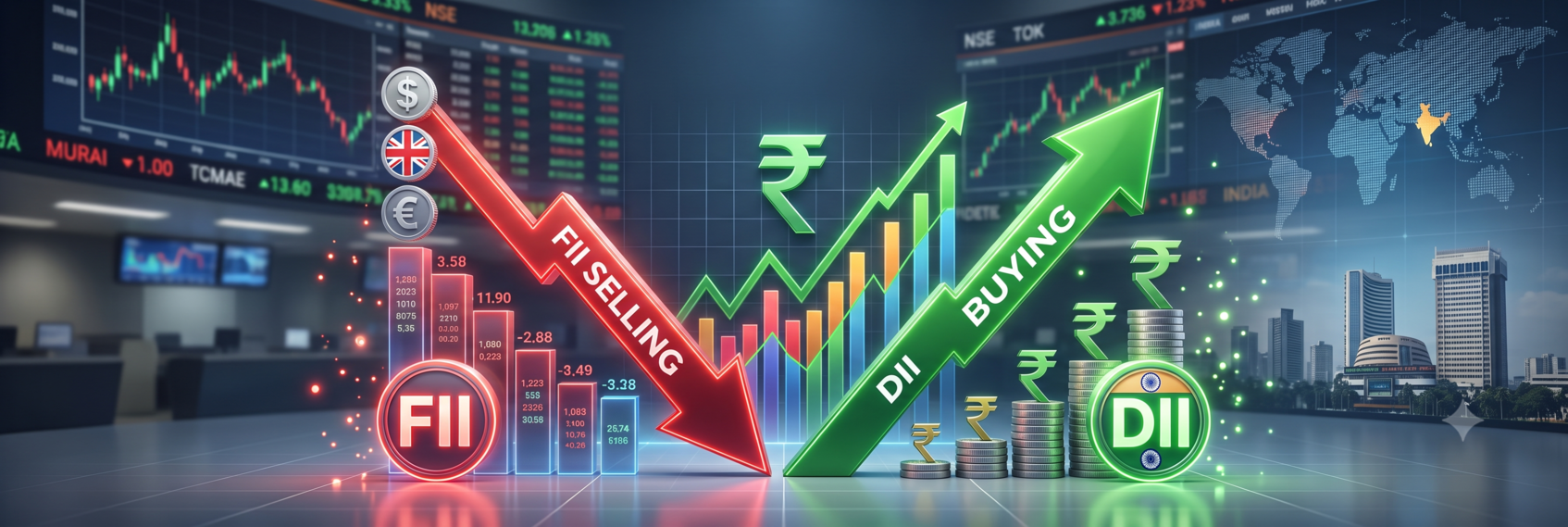
Domestic institutions have net bought a significant amount of Indian equities in 2026, even as foreign institutional investors have turned into persistent net sellers. This divergence has become one of the most watched dynamics in Indian markets this year, and it raises a genuine question about whether India's equity market is becoming structurally less reliant on foreign capital or whether this is simply a cyclical offset that could reverse.
Introduction
Foreign institutional investors have net sold Indian equities through much of 2026, driven by global risk factors, including crude oil price concerns and geopolitical tensions. Foreign selling has coincided with global risk-off sentiment tied to Middle East tensions, including reported strikes near the Strait of Hormuz and a subsequent surge in crude oil prices, both of which have added to broader market volatility through mid-2026.
Despite this, Indian benchmark indices have not seen the kind of sharp breakdown that comparable foreign outflows triggered in past cycles. The reason sits squarely with domestic institutional investors, who have been buying at a pace large enough to absorb much of the foreign selling pressure.
What the flow data actually shows
Between January and early June 2026, DIIs, which include mutual funds, insurance companies, pension funds, and corporate treasuries, net purchased Indian equities worth roughly ₹4.16 lakh crore, while FIIs net sold around ₹2.7 lakh crore over the same stretch.
| Metric | 2026 figure |
| DII net buying (Jan to early June) | Roughly ₹4.16 lakh crore |
| FII net selling (Jan to early June) | Roughly ₹2.7 lakh crore |
| DII ownership vs FII ownership | DII ownership overtook FII ownership for the first time in 2025 |
That last point is arguably the most structurally significant one. Domestic institutions are no longer just passive participants in Indian equities; they now have enough scale to absorb a part of foreign selling pressure.
Why DIIs are buying while FIIs sell
Steady SIP inflows
Domestic mutual funds receive significant, regular inflows from Indian retail investors through SIPs, money that fund managers are mandated to deploy into equities regardless of near-term sentiment
Valuation opportunity
DII fund managers often see FII-driven dips as buying opportunities at lower valuations, particularly in large-cap banking, FMCG, and IT stocks
Structural mandates
Institutions like LIC and EPFO have mandates to invest in Indian equities systematically, providing a consistent demand floor independent of foreign investor sentiment
This is not opportunistic buying alone. A meaningful share of it is mechanical, driven by inflows that need to go somewhere regardless of what foreign investors are doing.
Is this a structural shift or a cyclical offset?
| Argument for structural shift | Argument for cyclical offset |
| DII ownership has overtaken FII ownership, a first | FII selling has been driven by specific, time-bound global risk events |
| SIP inflows have shown consistent monthly growth over recent years | A reversal in crude oil prices or geopolitical tension could bring FII buying back quickly |
| Retail participation via mutual funds keeps broadening beyond metros | DII's buying capacity is large but not unlimited if outflows from retail ever accelerate |
Both readings have merit. The ownership shift is a genuine structural change built over several years of rising domestic savings flowing into equities. At the same time, the scale of FII selling this year is tied to identifiable global triggers that are not necessarily permanent features of the market.
What this means for market stability
The scale of domestic buying against sustained foreign selling is viewed by market participants as one reason Indian equities have not seen the kind of sharper breakdown that a comparable level of foreign outflows might have triggered in earlier years. That is a meaningful change from a decade ago, when FII flows had an outsized influence on index direction.
This does not mean foreign flows no longer matter. FIIs still represent a large pool of capital, and prolonged, aggressive selling can still pressure specific sectors or stocks even when aggregate index levels hold up. What is changed is the market's ability to cushion that pressure rather than transmit it directly into sharp corrections.
The risk in leaning too heavily on this narrative
DII buying capacity is ultimately tied to continued retail inflows through SIPs and institutional mandates. If retail sentiment were to sour meaningfully, whether due to a prolonged downturn or a shock to household savings, the domestic buffer that has been absorbing FII selling could weaken at the same time foreign selling potentially intensifies. That combination has not been tested at scale in the current cycle, since much of this domestic flow growth has occurred during a period when SIP discontinuation rates have stayed relatively low.
Conclusion
India's equity market is genuinely less dependent on foreign capital than it was a decade ago, and the ownership crossover between DIIs and FIIs marks a real structural milestone. But calling the market fully insulated from foreign flows would be premature. What 2026 has shown is a market with a stronger domestic shock absorber, not one that no longer feels the shock at all.