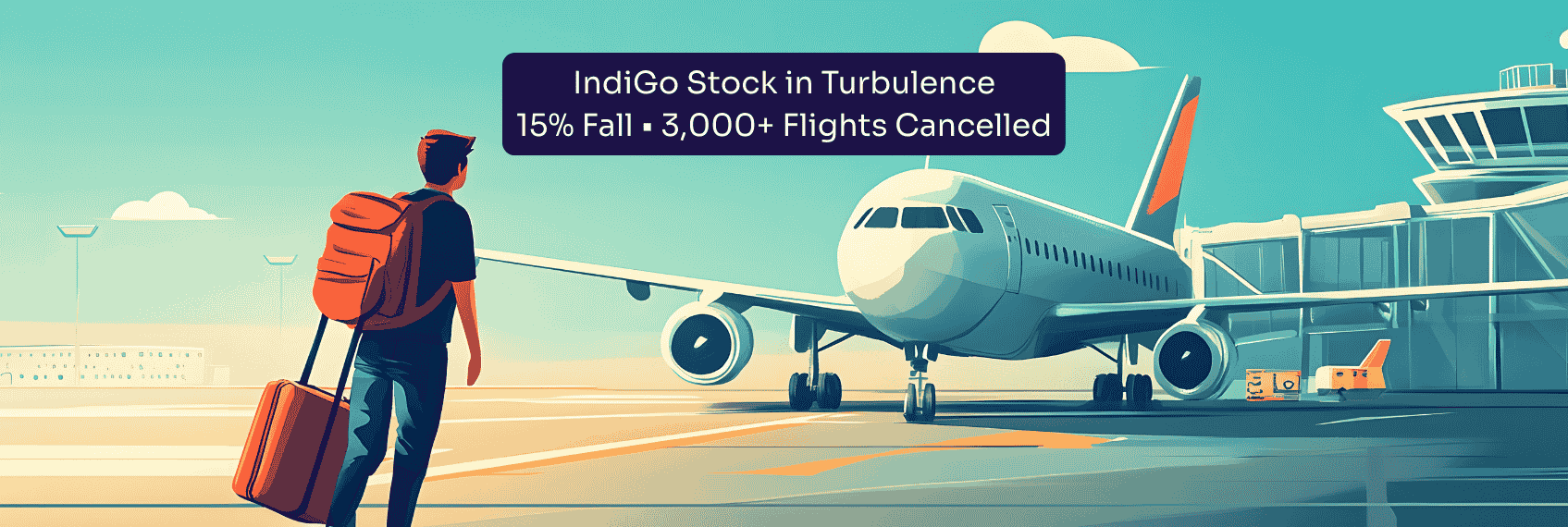
Flight cancellations have become the new norm, and at the center of all this disruption is India's largest airline operator, IndiGo.
InterGlobe Aviation's share price has plunged by a significant 15% over the past week. On December 8, the stock saw a sharp intraday decline of 9%, causing it to dip below the crucial ₹5,000 psychological threshold. So, what went wrong for India's largest airline by market share?
IndiGo's crisis started with 200 daily flight cancellations after new FDTL rules hit on November 1, 2025, as pilot rostering struggled with stricter rest norms, quickly escalating to 500 flights/day and over 1,600 (Friday) on peak days, the highest ever for an Indian carrier.
Stranded passengers faced poor communication, last-minute chaos, and sky-high fares on alternatives, fueling massive public rage on social media and news, which intensified scrutiny and triggered DGCA's probe and show-cause notices.
The immediate cause of the share-price crash was a large-scale operational breakdown triggered by the rollout of new Flight Duty Time Limitation (FDTL) rules for pilots. These rules mandate longer rest periods and tighter rostering norms to enhance pilot safety and well-being.
The phased FDTL changes rolling out from July to November 2025 significantly tighten pilot rest and duty norms: weekly rest increases from 36 to 48 hours, allowed night landings drop from six to two per week, night-duty flight time is reduced from 10 to eight hours between midnight and 6 AM, and pilots can operate a maximum of only two consecutive night duties with stricter rules on extensions and mandatory rest periods.
IndiGo failed to anticipate the short-term impact of these changes, resulting in a sudden drop in available crew and widespread disruption at airports across India. Within roughly five days, the airline reportedly cancelled over 3,000 flights, with countless delays and large numbers of stranded passengers.
The crisis triggered four layers of investor fear: major operational chaos with stranded passengers and severe delays, heightened regulatory scrutiny as authorities launched probes and sought accountability, financial worries from lost revenue, refunds, compensation, and potential penalties, and finally a sharp sentiment shock as IndiGo’s long-held reputation for flawless execution suddenly came into question.
All these forces combined to trigger a 9% single-day fall and a double-digit correction over just a few sessions.
Check the Indigo share price live to track how ongoing flight disruptions and regulatory actions are impacting the stock.
The government and regulator have responded aggressively, signalling that they view this as a serious systems failure.
The DGCA initiated a formal probe into IndiGo’s disruptions, citing failures in FDTL planning, crew rostering, and passenger support. It issued a strong show-cause notice to CEO Pieter Elbers and the accountable manager, seeking explanations under Aircraft Rules and warning of possible enforcement action. The regulator mandated fortnightly progress reports, deployed on-ground inspectors, and set a 30-day compliance roadmap, requiring full FDTL alignment by February 10, 2026.
To prevent a complete operational collapse, DGCA granted limited, time-bound exemptions from select FDTL rules, such as night-landing caps for A320 fleets, under strict conditions. These exemptions apply industry-wide where justified, though pilot unions flagged safety concerns, prompting DGCA to emphasise tight monitoring. IndiGo’s operations began stabilising, with full normalcy targeted by December 10.
The Ministry of Civil Aviation implemented passenger-relief measures, including full refunds within deadlines, fare caps, helplines, and additional railway coaches for stranded travellers. It urged pilot cooperation and launched a broader review of systemic issues. Reports also indicated potential board reconstitution at InterGlobe Aviation to strengthen governance.
For investors, this means increased regulatory scrutiny, potential fines, short-term earnings pressure, and temporary reputation risk, all valid reasons for the stock’s correction.
IndiGo's mass flight cancellations caused by crew shortages and new FDTL rules led to widespread chaos and regulatory scrutiny, severely disrupting its operations and shaking investor confidence. Over six days, IndiGo canceled more than 2,000 flights, exposing planning flaws and network fragility.
Meanwhile, SpiceJet capitalised on this disruption by planning a fleet expansion and increasing operational capacity. SpiceJet share price surged over 14% in two sessions as investors bet on SpiceJet capturing market share amid IndiGo’s troubles. SpiceJet aims to nearly double its operational fleet by the end of 2025, adding grounded aircraft back into service to meet peak travel demand.
This dynamic highlights how one player’s operational challenges can create growth opportunities for competitors in India’s fast-growing aviation market.

Natural Gas: A Guide to India’s Trading Market
3 min Read Mar 9, 2026
Capital Gains Tax on Property in India (FY 2025-26)
3 min Read Mar 9, 2026
Top Coal Stocks in India: Key Coal Mining and Lignite Companies to Know
3 min Read Mar 9, 2026
Long-Term Capital Gains (LTCG) Tax for FY 2025-26
3 min Read Mar 9, 2026
AI Summit 2026 Delhi: A New Blueprint for Global Intelligence
3 min Read Mar 9, 2026
For android only