Summary:
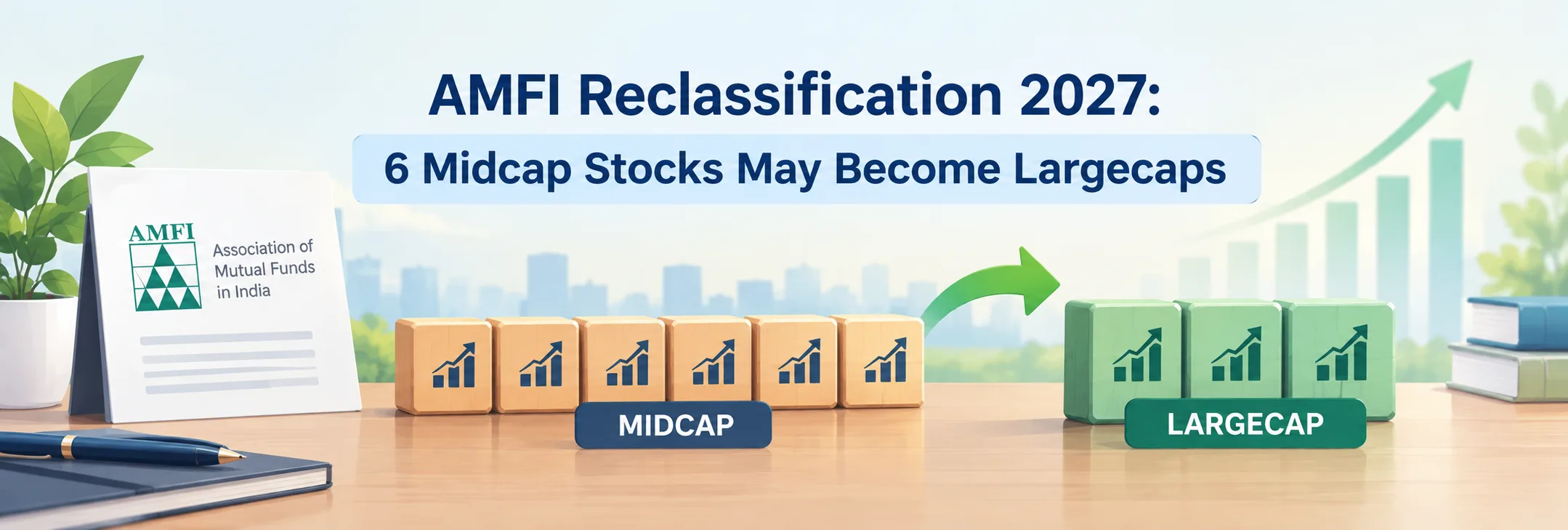
AMFI’s 2027 reclassification may move six midcap stocks, including Bosch, Siemens Energy India, Lenskart Solutions and LG Electronics India, into the largecap category. The proposed changes depend on July–December 2026 market capitalisation rankings and remain provisional until official confirmation.
Which midcap stocks may become largecaps in the 2027 AMFI reclassification?
Six midcap stocks, including Lenskart Solutions, LG Electronics India and Siemens Energy India, could move into the largecap category in the upcoming semi-annual reclassification by the Association of Mutual Funds in India (AMFI). The changes are expected to take effect from February 1, 2027, although the final list will depend on market capitalisation rankings between July and December 2026.
| Detail | Information |
| Classification authority | Association of Mutual Funds in India (AMFI) |
| Review frequency | Semi-annual |
| Expected effective date | February 1, 2027, as stated in the article; verify officially |
| Potential midcap-to-largecap entrants | Bosch, Siemens Energy India, Lodha Developers, Zydus Lifesciences, Lenskart Solutions and LG Electronics India |
| Classification basis | Average full market capitalisation over the review period |
| Review period cited | July–December 2026 |
| Status | Preliminary; subject to the official classification list |
Six Stocks Likely to Enter Largecap Category
The six companies identified as potential largecap entrants are Bosch Ltd , Siemens Energy India Ltd, Lodha Developers Ltd, Zydus Lifesciences Ltd, Lenskart Solutions Ltd and LG Electronics India Ltd.
Among them, Bosch has the highest reported market capitalisation at approximately ₹1,31,000 crore. Siemens Energy India, Lenskart Solutions and LG Electronics India each have a market capitalisation of around ₹1,19,000 crore.
Zydus Lifesciences stands at approximately ₹1,15,000 crore, while Lodha Developers has a market capitalisation of nearly ₹1,13,000 crore.
All six companies currently fall within the midcap category. Their possible inclusion in the largecap segment reflects their market capitalisation relative to other listed companies.
The National Stock Exchange of India, with an estimated market capitalisation of ₹4,30,000 crore, could also enter the largecap classification as a new entrant.
Largecap Market Capitalisation Threshold May Rise
Under SEBI's classification framework, the top 100 companies by full market capitalisation qualify as largecaps. Companies ranked 101–250 are classified as midcaps, while those ranked 251 onwards fall under the smallcap category.
AMFI reviews these classifications every six months using average market capitalisation during the relevant period.
The estimated threshold for entering the largecap category could increase to approximately ₹1,11,000 crore, compared with ₹1,06,000 crore in June 2026.
Similarly, the midcap threshold could rise from ₹33,600 crore to approximately ₹36,500 crore.
These figures remain preliminary. Market movements during the remaining review period could change the rankings and, consequently, the final classification.
Several Largecap Stocks May Shift to Midcap
While six midcap companies could receive upgrades, several existing largecaps may move into the midcap category.
The potential names include Godrej Consumer Products, Ambuja Cements, Tata Consumer Products, Indus Towers, Vedanta, HDFC Asset Management Company and Indian Railway Finance Corporation.
Meanwhile, RBL Bank, Welspun Corp, Ather Energy, Aegis Logistics, Gland Pharma and Sterlite Technologies are among the smallcap companies that could enter the midcap segment.
Several existing midcaps, including UCO Bank, Blue Star, Delhivery, Cochin Shipyard and Indian Renewable Energy Development Agency, could move into the smallcap category.
What Does the AMFI Reclassification Mean for Investors?
AMFI classifications help mutual funds identify the investment universe permitted under their respective scheme categories.
A company moving from midcap to largecap becomes eligible for investment by schemes specifically focused on largecap stocks. Similarly, a downgrade can change its eligibility within certain fund categories.
However, reclassification does not automatically result in buying or selling. Fund managers may adjust portfolios depending on scheme mandates, existing holdings and investment requirements.
The reshuffle also does not change a company's underlying business performance, earnings or financial position.
The final rankings will be determined using market capitalisation data for July–December 2026. Until the official list is released, the proposed upgrades and downgrades remain provisional.