Summary:
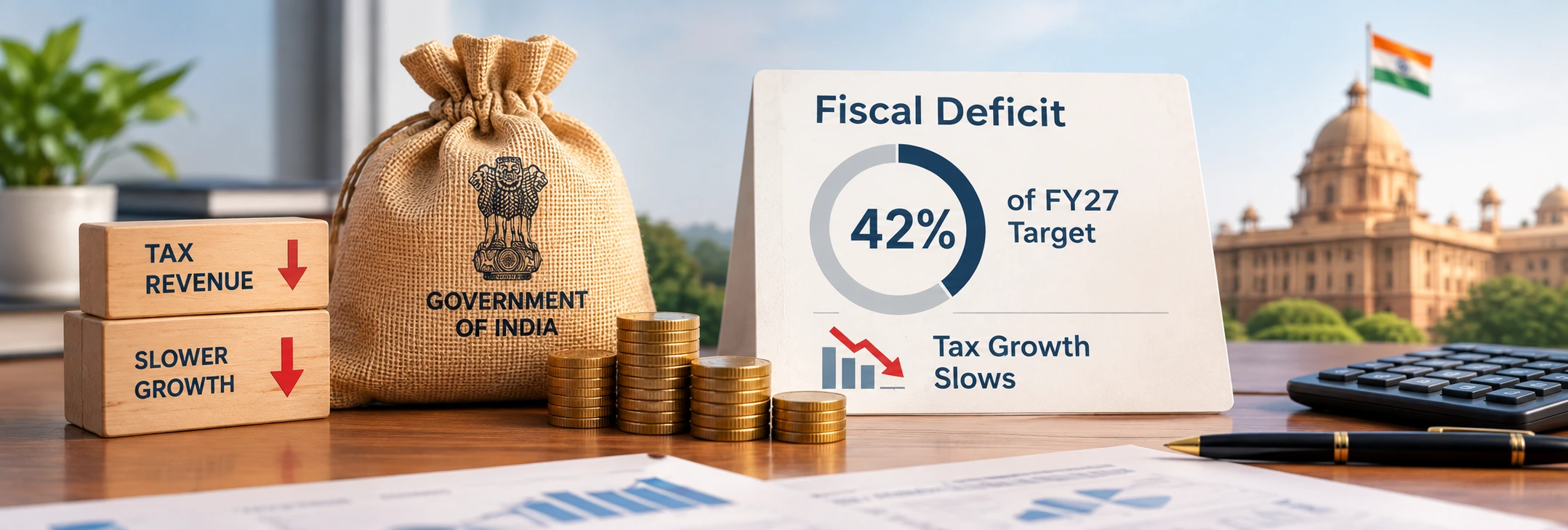
India’s fiscal deficit reached ₹7.10 lakh crore during April-August FY27, or 41.9% of the annual target. Higher capital expenditure and subsidy spending widened the gap, while moderate tax revenue growth keeps the government’s 4.3% of GDP fiscal deficit target in focus.
India’s fiscal deficit widened to ₹7.10 lakh crore during April-August FY27, reaching 41.9% of the full-year Budget Estimate, compared with 38.1% in the same period of FY26. Higher capital spending and subsidy outgo, combined with modest growth in net tax receipts, pushed the deficit higher during the first five months of the financial year.
The Centre has budgeted a fiscal deficit of about ₹16.96 lakh crore, equivalent to 4.3% of GDP, for FY27 as it continues its medium-term fiscal consolidation programme.
Tax Collections Grow at a Modest Pace
The latest government accounts show that revenue growth has lagged the pace required to comfortably meet the FY27 Budget targets.
The Centre’s net tax revenue increased just 3.5% YoY to ₹8.38 lakh crore during April-August. The Union Budget has projected net tax receipts of approximately ₹28.7 lakh crore for the full financial year.
Gross tax collections were somewhat stronger, rising 6.5% YoY to ₹14.32 lakh crore. However, the composition was uneven.
India Fiscal Deficit FY27: Key Numbers
| Indicator | April-August FY27 |
| Fiscal deficit | ₹7.10 lakh crore |
| Fiscal deficit vs FY27 BE | 41.9% |
| Net tax receipts | ₹8.38 lakh crore |
| Gross tax collections | ₹14.32 lakh crore |
| Capital expenditure | ₹5.09 lakh crore |
| Major subsidies | ₹1.87 lakh crore |
Excise duty collections fell nearly 23% YoY to ₹86,687 crore, largely reflecting reductions in additional excise duties on petrol and diesel earlier in the year. Customs duty collections, in contrast, increased around 28% YoY to ₹1.07 lakh crore.
Government Capex Remains Strong
While revenue growth remained subdued, government investment continued to support overall expenditure.
Government capital expenditure includes spending on areas such as:
- Roads
- Railways
- Infrastructure
- Transport
- Public assets
- Other long-term development projects
Higher capex can support investment activity and economic growth, but it also increases expenditure in the short term.
Capital expenditure increased around 18% YoY to ₹5.09 lakh crore during April-August FY27. This means the Centre has already completed roughly 42% of its annual capital expenditure target, versus around 38.5% during the corresponding period last year.
August itself, however, showed some moderation. Capital expenditure for the month was around ₹59,314 crore, substantially below the ₹84,653 crore spent in August last year, according to the government accounts reflected in the latest fiscal data.
Capital spending remains an important component of the Centre’s growth strategy as expenditure on infrastructure, roads, railways and other public assets can support investment activity across the broader economy.
Subsidy Spending Adds to Expenditure Pressure
Revenue expenditure also increased during the five-month period, with major subsidy payments rising sharply.
Spending on major subsidies climbed nearly 25% YoY to ₹1.87 lakh crore, with fertiliser subsidies increasing by about 21%. By August-end, around 46% of the full-year major subsidy allocation had already been utilised, compared with roughly 39% during the same period of FY26.
Another factor affecting the Centre’s finances was higher transfers to states. An additional monthly tax devolution in August took total transfers for the month to around ₹2.18 lakh crore, providing states with greater resources for development and expenditure.
On the positive side, non-debt capital receipts more than doubled to ₹75,239 crore, from ₹31,970 crore a year earlier, providing some offset to weaker tax revenue growth.
Can India Stay Near the 4.3% Fiscal Deficit Target?
The fiscal deficit is running ahead of last year’s pace, but the April-August reading alone does not determine the full-year outcome. Revenue collections are typically uneven across months, while expenditure patterns can also change significantly during the second half.
For FY27, the government has budgeted total expenditure of ₹53.5 lakh crore and non-debt receipts of ₹36.5 lakh crore. The fiscal deficit target of 4.3% of GDP is slightly below the 4.4% revised estimate for FY26.
The key variables for the remaining seven months will be the pace of direct tax collections, excise receipts, subsidy requirements and expenditure management. Strong capital spending remains supportive for economic activity, but slower tax growth means the balance between growth-oriented expenditure and fiscal consolidation will remain closely watched through the rest of FY27.
The government will therefore need to balance three objectives:
- Maintain capital expenditure to support economic growth.
- Manage subsidy and revenue expenditure.
- Keep the fiscal deficit within the FY27 consolidation path.
The remaining seven months will be particularly important for determining whether the current pace of deficit utilisation moderates.
What Will Determine India's Fiscal Deficit for the Rest of FY27?
Several factors will influence the fiscal deficit during the remainder of the financial year.
Direct Tax Collections
Income-tax and corporate-tax collections will be important for revenue growth. Stronger direct-tax receipts could provide greater fiscal room.
GST and Indirect Tax Collections
The trajectory of GST and other indirect taxes will also influence the government's revenue position.
Capital Expenditure
The pace of infrastructure and public investment spending will determine how quickly the expenditure side of the Budget is utilised.
Subsidy Requirements
Food, fertiliser and other subsidies could remain an important variable, particularly if global commodity prices remain elevated.
Government Borrowing
Borrowing requirements and the government's borrowing calendar will influence interest costs and the broader fiscal environment.
Economic Growth
Higher nominal GDP growth can improve the government's revenue position relative to GDP, while weaker growth could reduce the pace of revenue expansion.
What Does the Fiscal Deficit Data Mean for India's Economy?
The latest fiscal data presents two different aspects of the government's economic strategy.
On one side, strong capital expenditure can support infrastructure development, investment and economic activity.
On the other, higher subsidies and moderate tax-revenue growth can increase pressure on the government's fiscal position.
The key issue is therefore not simply whether the fiscal deficit has reached 41.9% of its annual target by August, but whether revenue growth and expenditure management remain consistent with the government's full-year fiscal consolidation plan.
Fiscal Deficit FY27: Key Takeaways
- India's fiscal deficit reached ₹7.10 lakh crore during April-August FY27.
- The deficit represented 41.9% of the full-year FY27 target.
- The Centre has set a fiscal deficit target of ₹16.96 lakh crore, or 4.3% of GDP, for FY27.
- Net tax revenue stood at approximately ₹8.38 lakh crore through August.
- Capital expenditure rose approximately 18% year-on-year to ₹5.09 lakh crore.
- Major subsidy spending increased approximately 24% to ₹1.87 lakh crore.
- Total government expenditure reached ₹20.78 lakh crore, or 38.9% of the annual Budget Estimate.
- Non-debt capital receipts increased to ₹75,239 crore.
- The fiscal deficit running at 41.9% of the annual target does not by itself mean the FY27 target will be missed.
- Direct-tax collections, capex, subsidies, borrowing and economic growth will be key variables through the rest of FY27.
FAQs
India's central government fiscal deficit stood at approximately ₹7.10 lakh crore during April-August FY27, equivalent to 41.9% of the full-year Budget target.
The Centre has set a fiscal deficit target of approximately ₹16.96 lakh crore for FY27, equivalent to 4.3% of GDP.
Higher capital expenditure and major subsidy spending, combined with moderate growth in tax revenue, contributed to the higher fiscal deficit during April-August FY27.
The Centre spent approximately ₹5.09 lakh crore on capital expenditure during April-August FY27, representing an increase of around 18% from the corresponding period a year earlier.
Major subsidy expenditure stood at approximately ₹1.87 lakh crore through August FY27, according to the government's monthly accounts.
No. The April-August figure represents the portion of the annual deficit target utilised during the first five months. Revenue collections and government expenditure can change significantly during the remaining seven months.
The fiscal deficit represents the gap between government expenditure and receipts during a financial year. Government debt represents the accumulated stock of borrowing and other liabilities built up over time.
Direct-tax collections, GST and other revenues, capital expenditure, subsidy requirements, government borrowing, interest payments and economic growth will be key factors.
Capital expenditure can support infrastructure creation, investment and economic activity. However, its fiscal impact needs to be assessed alongside revenue growth, subsidy spending and the government's overall fiscal-consolidation path.