Summary:
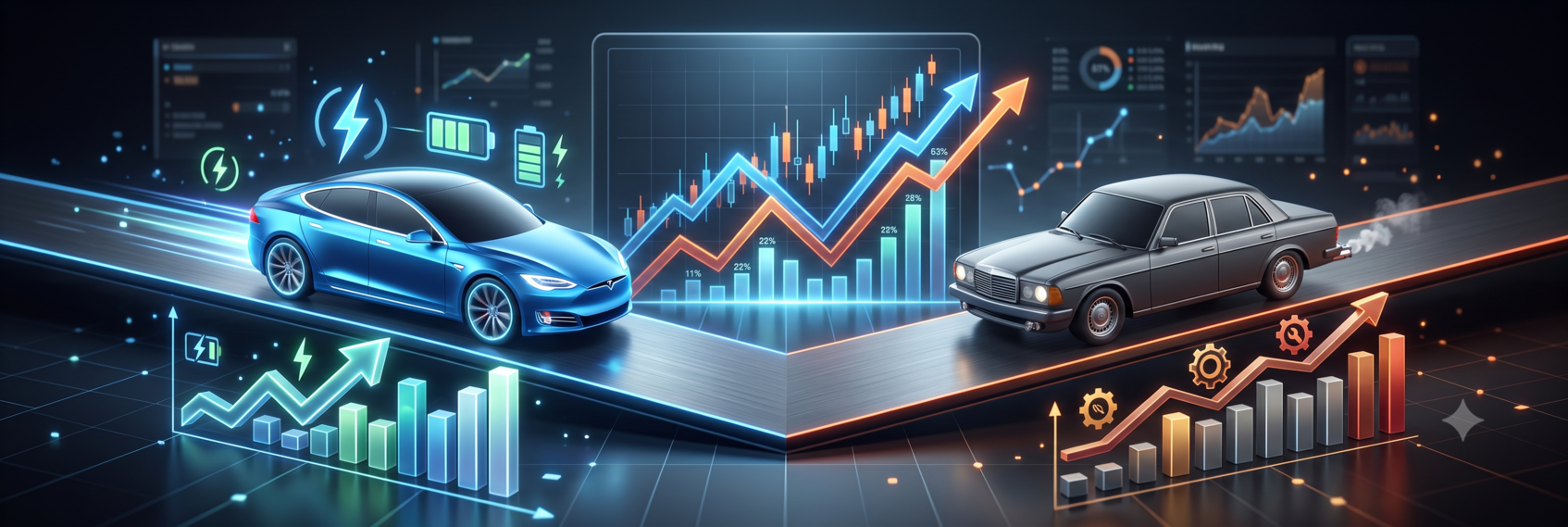
The auto sector in India has split into two fairly distinct investment conversations. One is about where the industry is going. The other is about where it already is.
Understanding EV stocks and traditional auto stocks
What are EV stocks?
EV stocks are shares of companies whose business is tied to electric vehicles, whether that's manufacturing EVs, making batteries, supplying components, or building charging infrastructure. In India, this includes pure-play EV manufacturers as well as traditional auto companies that have made EVs a core part of their strategy.
What are traditional auto stocks?
Traditional auto stocks are companies built on internal combustion engine vehicles. Two-wheelers, passenger cars, commercial vehicles, and the component suppliers that serve them. These businesses have decades of operating history, established distribution networks, and earnings that are more predictable than most EV plays currently on the market.
Evolution of India's automobile industry
India's auto industry spent decades building scale around ICE vehicles. Two-wheelers dominated rural and semi-urban demand. Commercial vehicles tracked the infrastructure and logistics cycle. Passenger cars grew as incomes rose.
The EV shift didn't arrive overnight. It started with two-wheelers and three-wheelers, where the economics made earlier sense, before moving toward passenger vehicles. The transition is still midway. Legacy manufacturers are investing in EV capacity while running profitable ICE businesses. New entrants are building from scratch. Both are listed, both are being tracked, and the sector looks very different from what it was ten years ago.
Historical returns: EV stocks vs Traditional Auto stocks
Comparing returns between EV and traditional auto stocks in India is messier than it sounds. Most listed Indian auto companies aren't pure-play EVs. Tata Motors, Bajaj Auto, Hero MotoCorp, Mahindra and Mahindra are traditional auto businesses with varying degrees of EV exposure. Pure-play listed EV companies in India are still relatively few.
What the return history does show is that traditional auto stocks have had strong performance cycles tied to domestic demand recovery, export momentum, and premiumisation. Companies like Mahindra and Mahindra and Bajaj Auto delivered strong returns over the past few years on SUV demand and export growth. Not primarily EV narratives.
EV-adjacent stocks, particularly in the component and battery supply chain, saw significant re-rating as investor interest in the theme grew. But much of that re-rating was valuation expansion rather than earnings growth. That distinction matters when sentiment shifts.
Traditional auto stocks have delivered more consistent, earnings-backed returns in the Indian market so far. EV stocks have delivered sharper moves in both directions. More upside in bull runs, more downside when sentiment turned.
Key growth drivers for EV stocks
Government incentives have created a policy environment that actively supports adoption. FAME subsidies, PLI schemes for battery manufacturing, and state-level EV policies affect both demand and the economics of domestic manufacturing.
Government incentives
FAME subsidies, PLI schemes for battery manufacturing, and state-level EV policies affect both demand and the economics of domestic manufacturing, making the policy backdrop one of the more consistent tailwinds for the sector.
Rising EV adoption
Two-wheeler and three-wheeler penetration is climbing. As consumers get more comfortable and total cost of ownership comparisons improve, adoption is moving beyond early adopters into the mainstream.
Battery technology improvements
Battery prices are falling and energy density is improving. EVs are becoming more competitive on price and range, which are the two things that have historically held adoption back.
ESG investing trends
Institutional investors with ESG mandates are increasingly looking for clean mobility exposure. That creates demand for EV stocks beyond just domestic retail interest.
Expansion of charging infrastructure
As public and private charging networks expand in cities, one of the more practical objections to EV ownership weakens. Range anxiety is a real barrier. Infrastructure is slowly addressing it.
Key growth drivers for traditional auto stocks
Strong domestic demand
India's vehicle penetration per capita remains low relative to comparable economies. Domestic demand has room to grow as incomes rise and financing access improves.
Export growth
Indian manufacturers have built meaningful export businesses, particularly in two-wheelers and components. A weak rupee adds to realisations and makes Indian manufacturing more price-competitive globally.
Premium vehicle sales
The premiumisation trend in passenger vehicles has surprised most analysts. SUV and higher-spec demand has stayed strong even as entry-level segments moved slower, improving the overall margin mix for manufacturers.
Commercial vehicle recovery
CV demand tracks infrastructure spending and economic activity. With government capex staying elevated, the commercial vehicle cycle has been supportive for manufacturers and component suppliers.
Diversification into EVs
Traditional auto companies aren't standing still. Tata Motors, M&M, Bajaj, and others are investing in EV capacity, so their stocks carry some EV optionality while still being backed by profitable ICE businesses.
Risks associated with EV stocks
- Valuation risk: EV-adjacent stocks have at times been priced for a future still several years away, leaving them vulnerable when sentiment shifts or timelines stretch
- Policy dependency: A cut in subsidies or change in government priorities can move the economics of EV ownership quickly
- Supply chain concentration: Most raw materials and cell manufacturing are still concentrated outside India, adding risk that domestic companies can't fully control
- Competition: New entrants and established players are all chasing the same market, which will compress margins for weaker players
Risks associated with traditional auto stocks
- Transition risk: ICE vehicle obsolescence is a real longer-term consideration, even if it isn't imminent in India
- Cyclicality: Auto demand is sensitive to interest rates, fuel prices, and consumer sentiment, all of which can turn fast
- Input cost volatility: Steel and aluminium price swings affect margins, and manufacturers have limited ability to pass all of it through
- EV investment drag: Capital being deployed into EV transition creates near-term pressure on returns even for businesses that are currently profitable
Factors investors should compare before choosing either segment
Earnings visibility
Traditional auto companies have it; most EV plays in India don't yet
Valuation vs growth
EV stocks tend to be priced on future potential, while traditional auto stocks trade closer to current earnings
Investment horizon
EV adoption is directionally clear but the timeline is uncertain; traditional auto businesses are generating profits now
Mixed exposure
Understanding how much of a company's value is tied to EV versus ICE business matters for anyone buying into large manufacturers doing both
Competitive position
In both segments, companies with stronger distribution, brand recognition, and balance sheets are better placed to weather the transition
Can both segments coexist?
Most of India's large listed auto companies are already running ICE and EV businesses in parallel. Traditional auto revenues are funding EV investment rather than being replaced by it. The choice between EV and traditional auto isn't always binary. Buying Tata Motors or M&M gives exposure to both, with a profitable core business underneath the EV ambition.
Which type of investor may prefer each segment?
Traditional auto stocks will generally suit investors looking for earnings-backed returns with lower volatility. More predictable businesses, more grounded valuations. EV-centric stocks or companies with greater EV exposure may be preferred by investors with a longer horizon and higher risk appetite, looking to position for where the industry is going rather than where it is. The upside potential is bigger, but so is the uncertainty around timing and execution.
Conclusion
Traditional auto stocks have delivered more consistent returns in India so far, backed by actual earnings. EV stocks have offered sharper upside in certain periods but carry more valuation and execution risk. The better question for most investors isn't which segment is superior. It's which one fits your time horizon and risk tolerance. For many, the answer is some exposure to both, through companies already navigating the transition.